Pick the Panasonic Lumix G Vario 35-100mm f/4-5.6 if you want the smallest, lightest telephoto zoom for portraits and travel, and pick the 45-150mm f/4-5.6 if you need extra reach for sports, events and wildlife. Both are Micro Four Thirds lenses with optical stabilisation, a similar aperture range and small filter size. The main trade-off is a roughly 70-200mm full-frame equivalent field of view against a roughly 90-300mm one.
Our top picks
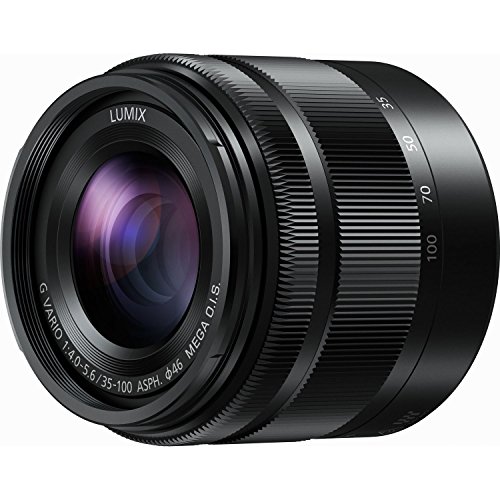 PANASONIC LUMIX G Vario Lens
- Premium Compact Design / Easy to Carry Around…
- High-Speed, High-Precision Focusing - 240 fps Drive Capability…
- Stable Flaming Even in Telephoto Setting - MEGA…


As an Amazon Associate we earn from qualifying purchases at no extra cost to you.
At a Glance
| Feature | Lumix G Vario 35-100mm f/4-5.6 | Lumix G Vario 45-150mm f/4-5.6 |
|---|---|---|
| Full-frame equivalent | About 70-200mm | About 90-300mm |
| Aperture | f/4 to f/5.6 | f/4 to f/5.6 |
| Stabilisation | Mega O.I.S. lens stabilisation, compatible with Dual I.S. on supported bodies | Mega O.I.S., compatible with Dual I.S. on supported bodies |
| Size and weight | Smaller and lighter, per the maker | Slightly larger and heavier, per the maker |
| Filter size | 46 mm | 46 mm |
| Best for | Portraits, street, travel, light kits | Sports, events, wildlife, distant subjects |
| Weather sealing | Not stated as sealed | Not stated as sealed |
Both lenses were released as compact kit-style zooms in the Lumix G line. Details such as exact weight and minimum focus distance are listed on Panasonic’s product pages, and are worth reading for the specific version sold in your region.
Focal Range and What It Means
Micro Four Thirds has a 2x crop factor, so the 35-100mm gives about 70-200mm equivalent coverage, which is the classic portrait and short-telephoto range. The 45-150mm gives about 90-300mm equivalent, getting noticeably closer to distant subjects at the long end.
The two ranges overlap from 45mm to 100mm. If you own a standard kit zoom such as a 12-32mm or 14-42mm, the 35-100mm fills in neatly above it with little redundancy. The 45-150mm leaves a small gap between a 42mm lens and 45mm, which is not an issue in practice, and it adds a notably longer finish.
Size, Weight and Carry
The 35-100mm is among the most compact telephoto zooms in the system, small enough to fit in a jacket pocket with a small body. Reviewers often describe it as a travel-friendly companion. The 45-150mm is a little larger but still compact compared with larger telephoto zooms. Both share a 46 mm filter thread, so a single set of filters works with either lens.
Image Quality and Aperture
Both lenses open at f/4 and narrow to f/5.6 at the long end. That is slower than premium f/2.8 telephotos, so subject isolation and low-light performance are modest. Reviewers generally describe image quality as good for the class, with sharper results when stopped down slightly. Neither lens is a substitute for faster professional glass if you shoot in dim light or need very shallow depth of field.
Stabilisation helps with handheld shooting at slower shutter speeds, and works with body stabilisation on compatible Panasonic cameras. It does not freeze subject motion, so use faster shutter speeds for action.
The Faster 35-100mm f/2.8 Option
The name 35-100mm also applies to Panasonic’s faster f/2.8 zoom, which belongs to a different class. It has a constant f/2.8 aperture and a larger build, according to the maker, and is aimed at enthusiasts and professionals who want better low-light performance and background blur. If you see a listing for a 35-100mm lens, check whether it is the f/4-5.6 compact version or the f/2.8 one, because size, weight, filter size and price differ considerably.
Compatibility
- Mount: Micro Four Thirds, so both fit Panasonic Lumix G bodies and OM System bodies.
- Stabilisation pairing: On Panasonic bodies, lens and body stabilisation can combine. On other bodies, check the maker’s manual to learn which stabilisation mode is active.
- Autofocus: Both are designed for contrast-detect autofocus, which works well on Lumix bodies.
- Video: The stabilisation and quiet focus motors make them workable for casual video, though dedicated video lenses offer smoother focus control.
Budget Tier Thinking
Both lenses sit in the budget tier, especially on the second-hand market. They are among the most affordable ways to add telephoto reach to a Micro Four Thirds kit. Mid-range alternatives include the Lumix 45-175mm power zoom and the Lumix 100-300mm. Premium choices are the f/2.8 zooms and Leica DG lenses.
Pick X If…
| Pick | If you |
|---|---|
| 35-100mm f/4-5.6 | Want a pocketable telephoto for portraits, street and travel |
| 45-150mm f/4-5.6 | Need more reach for kids’ sports, events or distant subjects |
| 35-100mm f/2.8 | Want faster aperture and shallower depth of field and accept more weight |
| Both lenses | Shoot a mix of subjects and want overlapping reach with different sizes |
| A longer zoom such as 100-300mm | Photograph wildlife or aircraft and need serious reach |
Care Notes
- Use a lens hood to reduce flare and protect the front element.
- Clean glass with a blower and a soft lens cloth following the maker’s instructions.
- Avoid rain and dust, as neither lens is described as weather sealed. Use a rain cover when needed.
- Collapse or retract the zoom for storage according to the manual.
- On used lenses, check for zoom ring smoothness, fungus, scratches on the front element and that stabilisation works.
Alternatives
- Lumix G Vario 100-300mm: More reach for wildlife and aircraft, at a larger size.
- Lumix G X Vario 35-100mm f/2.8: Faster aperture for low light and background blur.
- Olympus or OM System 40-150mm f/4-5.6 R: A compact alternative with a similar focal range to the 45-150mm.
- Lumix G Vario 45-175mm power zoom: Compact and suited to video with its power zoom, per the maker.
Frequently Asked Questions
Which lens is sharper?
Reviewers describe both as good for their class, with improved sharpness when stopped down. Differences are small enough that focal range and size should drive the decision.
Can I use both lenses on an Olympus or OM System camera?
Yes, since they share the Micro Four Thirds mount. Stabilisation behaviour may differ from Panasonic bodies, so read the manual for the body you use.
Are these lenses good for video?
They work for casual video with stabilisation and quiet autofocus. Photographers who shoot video seriously often prefer lenses designed for smooth focus and power zoom.
Is the 35-100mm good for portraits?
The roughly 70-200mm equivalent range suits portraits, though the f/4-5.6 aperture gives less background blur than faster lenses. The f/2.8 version is better for shallow depth of field.
Do I need both lenses?
Most photographers pick one. The 45-150mm covers more reach, while the 35-100mm is smaller. Owning both is mainly useful if you want the smaller option for travel and the longer option for action.
Are these lenses weather sealed?
Panasonic does not describe these compact zooms as weather sealed, so protect them from rain and dust with covers and keep them dry.
More from Amazon
Programs that pair well with the guide above. Offers and eligibility are set by Amazon and may change.
Free shipping on eligible items, Prime Video and more. Eligible new members can start with a free trial.
Start a Prime free trialAd-free music streaming. Eligible new subscribers can start with a free trial.
Try Music Unlimited freeA Prime membership for ages 18-24 with a trial period. Eligibility is set by Amazon.
See Prime for Young AdultsAudiobooks and podcasts to listen to on the go. Eligible new members can start with a free trial.
Try Audible freeAs an Amazon Associate we earn from qualifying purchases.