Key takeaways
- Driver size. A 4-inch woofer, as in the Edifier R1280T, moves much more air than a 2-inch driver, so it gives fuller midrange and bass at the same volume. Compact speakers with 2-inch drivers sound clearer but thinner.
- RMS, not peak. “80 W peak” is a marketing figure. RMS shows continuous power. A 40 W RMS speaker is plenty for a room of 150 square feet.
- Low-frequency limit. The Pebble V3 lists about 100 Hz, which means it cannot reproduce bass below that. A speaker reaching 55 to 60 Hz, such as a ported 4-inch design, sounds fuller.
- Inputs. Check that the speakers have the inputs your gear needs, such as optical for a TV, USB-C for a laptop, or RCA for a turntable’s preamp.
- Cabinet. Wood-style MDF cabinets resonate less than thin plastic, giving cleaner mids.
The best budget speakers under 100 are the Creative T100 for a desk or small room, the Logitech Z407 if you want a subwoofer and wireless volume control, and the Creative Pebble V3 if your limit is closer to 50. The Edifier R1280T sits at the edge of the budget and often beats the others for sound, but street prices move, so check it against your limit on the day you buy. Anything above that, such as the Edifier R1280DBs or Audioengine A1, belongs in a step-up tier rather than a true bargain bracket.
Budget speakers are easy to get wrong, because the labels advertise watts and bass while the real differences are driver size, cabinet material, inputs and how the speaker sounds at low volume. This guide compares five speakers that fit the limit and two step-ups, explains which specs matter, and gives a buying matrix by use. It is based on published specifications and professional reviews, not on personal listening. Prices vary by retailer and season, so “price tier” means position within the list, not a current figure.
Our top picks

As an Amazon Associate we earn from qualifying purchases at no extra cost to you.
Budget speaker comparison
| Model | Layout | Key specs (per maker and reviews) | Inputs | Price tier | Best for |
|---|---|---|---|---|---|
| Creative Pebble V3 | 2.0 compact | 8 W total class, low-frequency limit near 100 Hz, USB-C powered | USB-C, 3.5 mm, Bluetooth | Under 50 | Small desks, laptops |
| Creative Pebble Pro | 2.0 compact | Higher output than V3, RGB lighting, front-facing drivers | USB, Bluetooth, 3.5 mm | Under 100, lower end | Gaming desks |
| Creative T100 | 2.0 bookshelf-style | 80 W peak class, wood cabinets, remote | Bluetooth 5.0, optical, 3.5 mm, RCA, USB | Around the limit | Desk plus TV |
| Logitech Z407 | 2.1 with sub | 80 W peak, 40 W RMS class, wireless control dial | Bluetooth, USB, 3.5 mm | Around the limit | Bass on a budget |
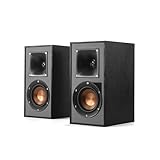
| Edifier R1280T | 2.0 bookshelf | 42 W RMS class, 4-inch woofers, remote, wood-style cabinets | Dual RCA, no Bluetooth | Entry to mid, near or above limit | Music and TV without Bluetooth |
| Edifier R1280DBs (step-up) | 2.0 bookshelf | Bluetooth 5.0, optical and coaxial inputs, subwoofer output, remote | Optical, coax, RCA, Bluetooth | Above 100, under 200 | Best sound in the next tier |
| Audioengine A1 (step-up) | 2.0 compact | Wireless Bluetooth, compact active speakers | Bluetooth, 3.5 mm | Above 100 | Small rooms, clarity |
Which specs matter on a budget
At this price, the number on the box is rarely the number that counts. Use these checks instead.
- Driver size. A 4-inch woofer, as in the Edifier R1280T, moves much more air than a 2-inch driver, so it gives fuller midrange and bass at the same volume. Compact speakers with 2-inch drivers sound clearer but thinner.
- RMS, not peak. “80 W peak” is a marketing figure. RMS shows continuous power. A 40 W RMS speaker is plenty for a room of 150 square feet.
- Low-frequency limit. The Pebble V3 lists about 100 Hz, which means it cannot reproduce bass below that. A speaker reaching 55 to 60 Hz, such as a ported 4-inch design, sounds fuller.
- Inputs. Check that the speakers have the inputs your gear needs, such as optical for a TV, USB-C for a laptop, or RCA for a turntable’s preamp.
- Cabinet. Wood-style MDF cabinets resonate less than thin plastic, giving cleaner mids.
Creative Pebble V3: best under 50
The Pebble V3 is the true bargain pick. It is a small 2.0 pair powered over USB-C, with 8 watts of output according to published specifications and a 100 Hz low-frequency limit. It connects by USB-C, a 3.5 mm cable or Bluetooth, which makes it work with laptops, tablets and phones. It is a good first desktop speaker and a clear step up from laptop speakers.
Spec line: 8 W class, USB-C power, Bluetooth, about 100 Hz limit. Best for: small desks and bedrooms. Skip if: you want bass or loud volume.
- Lowest cost and a tiny footprint.
- Bluetooth and wired inputs on a speaker this small.
- USB power means no wall adapter in many setups.
Cons: thin bass and limited volume, and the speakers are best listened to near-field.
Creative Pebble Pro: best for a desktop with lighting
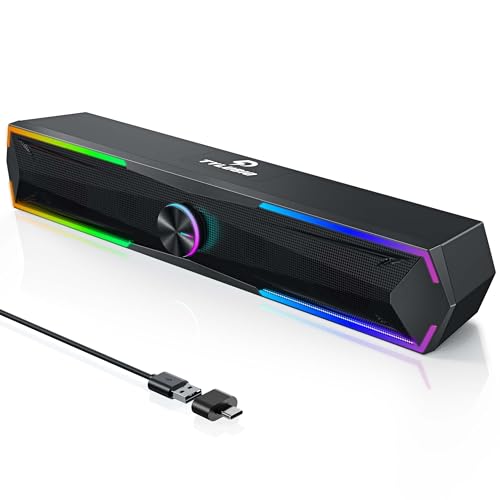
The Pebble Pro raises output over the V3 and adds lighting and a more robust set of controls, with USB and Bluetooth connections. Reviews list it among the better under-100 choices for a PC. It fills a small room better than the V3 and keeps the same compact design.
Spec line: compact 2.0, USB and Bluetooth, RGB lighting. Best for: gamers and creators on a desk. Skip if: you dislike RGB or want a larger sound.
- More output than the V3.
- Works on laptops and consoles with USB or Bluetooth.
- Small footprint.
Cons: limited bass, and the lighting adds nothing to sound.
Creative T100: best 2.0 pair around the limit
The T100 is a bookshelf-style pair with wood cabinets, a remote, and a wide set of inputs: Bluetooth 5.0, optical, RCA, 3.5 mm and USB. Tom’s Hardware lists it as its best PC speaker under 100. The larger cabinets and drivers give a fuller sound than compact desktop speakers, and the optical input makes a clean connection from a TV.
Spec line: 80 W peak class, Bluetooth 5.0, optical, remote. Best for: a desk with a TV or a small room. Skip if: you need a subwoofer.
- Broad inputs for TV, PC and phone.
- Fuller, warmer sound than small speakers.
- Remote and tone controls.
Cons: larger footprint than compact speakers, and bass is still limited without a sub.
Logitech Z407: best for bass under 100
The Z407 is a 2.1 system, which means two satellites and a small subwoofer. It reaches 80 W peak and about 40 W RMS, according to Logitech, and it has a wireless control dial, which adjusts volume and switches inputs from the desk. Inputs are Bluetooth, USB and 3.5 mm. For anyone who wants bass without spending more, this is the usual choice.
Spec line: 2.1 with sub, 40 W RMS class, wireless dial. Best for: gaming, movies and music with weight. Skip if: you want precise, tight sound or have no space for a sub.
- Subwoofer at this price.
- Wireless control dial.
- Bluetooth and USB for several devices.
Cons: the bass is boomy at high levels, and no optical input for TVs.
Edifier R1280T: best sound near the budget limit
The R1280T is a 2.0 bookshelf pair with 4-inch woofers, a remote and wood-style cabinets, rated around 42 W RMS. It has analog RCA inputs and no Bluetooth, which keeps cost down and sound quality high for the money. It remains a long-time default recommendation for small rooms. Retail prices have shifted over time, so confirm that it fits the limit when you shop, and consider it as the sound-first pick in the group.
Spec line: 42 W RMS class, 4-inch woofers, RCA inputs. Best for: music and TV in a small room. Skip if: you need Bluetooth or digital inputs.
- Bigger, fuller sound than compact speakers.
- Remote and bass and treble knobs.
- Good fit for turntable or TV analog output.
Cons: no Bluetooth, and larger than desktop speakers.
Step-up pick: Edifier R1280DBs
If you can stretch the limit to under 200, the R1280DBs adds Bluetooth 5.0, optical and coaxial digital inputs and a subwoofer output to the same basic design. SoundMavericks calls it the default budget recommendation for years, though its price has risen above the old 100 bracket. It is the speaker to buy if you see yourself adding a sub later.
Spec line: Bluetooth 5.0, optical, coax, sub output, remote. Best for: TV and desk in one pair. Skip if: your limit is a hard 100.
- Digital inputs and Bluetooth in one pair.
- Sub output for later upgrades.
- Strong tone for the tier.
Cons: above the budget bracket, and larger than compact speakers.
Step-up pick: Audioengine A1
The Audioengine A1 is a compact powered pair with Bluetooth that reviewers praise for clarity at its size. It costs more than the speakers above, but suits small desks where tone and finish matter. It is a step-up pick, rather than a budget one.
Spec line: compact active speakers with Bluetooth. Best for: small desks with a focus on clarity. Skip if: you want big bass at the lowest price.
- Compact and well made.
- Clear midrange.
- Wireless Bluetooth streaming.
Cons: above the 100 limit, and limited bass without a sub.
How to choose: a decision matrix
| Your situation | Best pick | Why |
|---|---|---|
| Limit is 50, laptop or phone | Creative Pebble V3 | Lowest cost, USB-C and Bluetooth |
| Limit is 100, gaming desk | Creative Pebble Pro or Logitech Z407 | USB, Bluetooth, and a sub with the Z407 |
| Limit is 100, TV and desk | Creative T100 | Optical, Bluetooth and remote |
| Limit is 100, music first | Edifier R1280T | Largest drivers and best tone |
| Limit is 200 | Edifier R1280DBs or Audioengine A1 | Better tone and more inputs |
Worked example: sizing the speaker to the room
A desk listener sits about 2 to 3 feet from the speakers, and a 2 to 8 W compact pair is loud enough at that distance. A speaker for a bedroom 10 by 12 feet, with the listener 6 to 8 feet away, needs roughly four times the power for the same level, because sound drops about 6 dB when distance doubles, so a 40 W RMS pair such as the R1280T is a better fit. If the speakers will fill a 200 to 250 square foot living room, consider a 2.1 system or step up to an under 200 pair.
Placement basics that cost nothing
- Place speakers at ear height, with tweeters aimed at your head, about equal in distance from you as from each other.
- Keep ported speakers at least 4 inches from the back wall to avoid boomy bass.
- Place a small foam pad or stand under desktop speakers to stop desk vibration from smearing the bass.
- Use an optical or USB connection instead of 3.5 mm when you hear hiss or hum.
What you give up at this price, and how to offset it
Every speaker under 100 trades something. Understanding the trade-off lets you pick the one whose weakness you can live with, or fix.
| Weakness | Seen in | Practical fix |
|---|---|---|
| Thin bass below 100 Hz | Pebble V3, Pebble Pro | Place close to a wall or desk edge for a few dB of boost, or add a sub later with a model that has a sub output |
| Boomy, loose bass at high volume | Z407 sub | Lower the sub level a notch and keep the satellites at ear height |
| No Bluetooth | Edifier R1280T | Add a small Bluetooth receiver to the RCA input |
| Bluetooth lag with video | Any Bluetooth connection | Use USB, optical or 3.5 mm for movies and games |
| Hiss at low volume | Budget analog inputs | Turn the source volume up and the speaker volume down, or use a digital input |
| Plastic cabinet resonance | Small compact speakers | Place on a stand or foam pad, away from a hollow desk top |
Two upgrades beat buying a pricier pair. First, a pair of simple desktop stands or a foam isolation pad lifts the tweeters to ear height and separates the speakers from the desk, which cleans up mid-bass for a tiny cost. Second, a quality USB or optical connection from your computer bypasses the noisy headphone jack, which removes hiss and hum in many setups. These two steps often give a bigger improvement than moving up one price tier.
Ownership realities for cheap speakers
Budget speakers fail slowly. Plastic knobs loosen, remotes get lost, and cheap power adapters can add hum. A ground loop hum, often heard on speakers connected to a PC and a TV at the same time, is fixed with a ground loop isolator rather than by replacing the speakers. Bluetooth connections may introduce a delay of 100 to 200 milliseconds, which shows as lip-sync lag on video, so use a wired connection for movies and games. Keep the volume knob below about 75 percent on small speakers; distortion rises quickly beyond that.
Frequently Asked Questions
What are the best speakers under 100?
The Creative T100, Logitech Z407 and Edifier R1280T are the three most recommended, depending on use. The T100 is best for desk and TV, the Z407 for bass, and the R1280T for sound quality, if its current price fits the limit.
Are there good speakers under 50?
Yes, though choices are limited. The Creative Pebble V3 is the usual pick, with Bluetooth and USB-C, but expect limited bass and modest volume.
Are speakers under 200 much better than speakers under 100?
They are noticeably better, with cleaner mids, more bass control and more inputs. The Edifier R1280DBs is the common example, and many buyers find the step worthwhile if the speakers will be used daily.
Do cheap speakers need a subwoofer?
Not always. A 4-inch woofer pair covers most music and TV needs. A sub helps for movies and electronic music, and models with a sub output, such as the R1280DBs, make it easy to add later.
Are Bluetooth speakers good enough for music at this price?
For casual listening, yes. For best quality and no lag, a wired connection through optical, USB or analog input beats Bluetooth, which compresses audio and adds delay.
How many watts do I need?
For a desk, 10 to 20 W RMS is enough. For a bedroom or small living room, aim for 30 to 50 W RMS. Ignore peak watt numbers, which are not comparable between brands.
More from Amazon
Programs that pair well with the guide above. Offers and eligibility are set by Amazon and may change.
Free shipping on eligible items, Prime Video and more. Eligible new members can start with a free trial.
Start a Prime free trialAd-free music streaming. Eligible new subscribers can start with a free trial.
Try Music Unlimited freeA Prime membership for ages 18-24 with a trial period. Eligibility is set by Amazon.
See Prime for Young AdultsAudiobooks and podcasts to listen to on the go. Eligible new members can start with a free trial.
Try Audible freeAs an Amazon Associate we earn from qualifying purchases.