The best powered speakers for home use are active pairs with the amplifier built in, and the right one depends on the job: Edifier R1280DB for a budget TV and music pair, Audioengine A5+ Wireless for a refined desk or small-room system, Kali Audio LP-6, Yamaha HS5 or JBL 305P MkII for neutral studio-style sound at a mid price, and KEF LSX II LT or Klipsch The Fives for premium living-room systems with HDMI ARC. If your budget is under $500, a pair from the first two groups covers nearly every home need. This guide explains how active speakers differ from passive ones, then compares seven real models using manufacturer specifications and professional reviews.
Our top picks


 Anker soundcore 2 Portable Bluetooth Speaker
- Outdoor-Proof Speaker: Portable design with IPX7 waterproof protection…
- 24H Non-Stop Music: With Anker's world-renowned power management…
- Powerful Sound: The speaker features 12W power with…

As an Amazon Associate we earn from qualifying purchases at no extra cost to you.
Powered speakers compared
| Model | Woofer and tweeter | Amplifier power | Inputs | Price tier | Best for |
|---|---|---|---|---|---|
| Edifier R1280DB | 4 in woofer, 13 mm tweeter | About 42 W RMS total | Bluetooth, optical, coaxial, 2 x RCA | Entry | TV, desk, small room |
| Audioengine A5+ Wireless | 5 in Kevlar woofer, 0.75 in silk tweeter | About 50 W RMS per channel class | Bluetooth, RCA, 3.5 mm, subwoofer out | Mid | Music and computer audio |
| Kali Audio LP-6 (V2) | 6.5 in woofer, 1 in tweeter | Bi-amped class-D | XLR, TRS, RCA | Entry to mid | Neutral sound for music and media |
| Yamaha HS5 | 5 in woofer, 1 in tweeter | 70 W (45 W LF, 25 W HF) | XLR, TRS | Mid | Accurate listening on a desk |
| JBL 305P MkII | 5 in woofer, 1 in tweeter | 82 W (41 W per driver) | XLR, TRS | Entry to mid | Wide sweet spot |
| KEF LSX II LT | 4.5 in Uni-Q | Built-in class-D, per KEF | Wi-Fi, Bluetooth, HDMI ARC, optical | Premium | Streaming and TV |
| Klipsch The Fives | Compact two-way, horn-loaded tweeter | Built-in amplifier | HDMI ARC, Bluetooth, USB, phono | Premium | TV plus turntable |
Amplifier figures are the manufacturers’ published numbers. They are useful for comparison but do not indicate loudness in isolation: efficient drivers and good tuning matter as much as watts.
What powered, active and self-powered speakers mean
The terms powered speakers, active speakers and self powered speakers all describe the same idea: the amplifier is inside the cabinet, so you plug the speaker into the wall and connect a source. Some are “bi-amped”, with one amplifier for the woofer and one for the tweeter, which lets the manufacturer tune each driver precisely. The benefit is a matched system without choosing an amplifier. The limit is that the amplifier is fixed, and you must power both speakers, usually with one cable to the wall and a link cable between the two cabinets.
Studio monitors such as the Yamaha HS5, JBL 305P MkII and Kali Audio LP-6 are powered speakers designed for audio production. At home they work well for music and screen use, but they need balanced XLR, TRS or RCA inputs, so you may need a small DAC or audio interface to connect a phone, TV or streamer. They lack Bluetooth and remotes, which is the main trade-off.
Best budget powered speakers: Edifier R1280DB
Spec line: 4-inch woofer, 13 mm silk dome tweeter, about 42 W RMS total, Bluetooth, optical, coaxial and two RCA inputs, bass and treble knobs, remote control, per Edifier.
Best for: TV and casual music in a small to medium room, and the cheapest sensible starting point for the best powered speakers under 500 category with money left for stands. Skip if: you want fine detail, deep bass or an audiophile balance.
- Pro: Digital inputs allow direct TV connection by optical cable.
- Pro: A remote and tone controls make it easy to adjust for a room.
- Pro: Wood-finish cabinets look decent in a living room.
- Con: Limited resolution compared with mid-priced active speakers.
- Con: The cable between the two speakers is a fixed length.
Best for music at a desk: Audioengine A5+ Wireless
Spec line: 5-inch Kevlar woofer, 0.75-inch silk tweeter, about 50 W RMS per channel and 150 W peak per the manufacturer, Bluetooth with aptX HD, RCA, 3.5 mm and a variable subwoofer output.
Best for: clear, balanced music playback from a computer, turntable preamp or streamer. It is a leading example when readers ask for the best powered bookshelf speakers. Skip if: you need digital inputs for a TV, because it relies on analog and Bluetooth.
- Pro: Clean, detailed sound with a tidy build.
- Pro: Subwoofer output makes a later bass upgrade simple.
- Pro: Bluetooth plus analog covers most casual sources.
- Con: No optical input and no remote on some versions.
- Con: Costs more than budget pairs with similar sound for casual listening.
Best neutral monitors for the home: Kali Audio LP-6, Yamaha HS5 and JBL 305P MkII
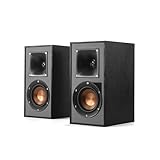
These three are the most common recommendations for people who want accurate sound at a fair price, and they differ in character. The Kali Audio LP-6 uses a 6.5-inch woofer with a 1-inch tweeter and is known for a clean, even response and good bass for its size. The Yamaha HS5 has a 5-inch woofer, 1-inch tweeter and 70 W of bi-amplification, and is known for a revealing, analytical sound that suits critical listening and mixing. The JBL 305P MkII has a 5-inch woofer, 1-inch tweeter and 82 W, with a wide sweet spot and slightly more forgiving presentation thanks to its waveguide.
- Pro: Flat, accurate sound that reveals recording quality honestly.
- Pro: Balanced inputs ignore interference over long cable runs.
- Pro: Good value compared with consumer speakers of similar quality.
- Con: No Bluetooth, remote or optical input; you will probably need a DAC or small interface.
- Con: Plain, utilitarian looks and rear-mounted controls.
Best premium streaming pair: KEF LSX II LT
Spec line: 4.5-inch Uni-Q coincident driver, Wi-Fi, Bluetooth, HDMI ARC and optical input, built-in digital amplifier, per KEF’s product information.
Best for: apartments and living rooms where hi-fi imaging, streaming and a TV connection are all wanted from one pair. Skip if: your budget is below the premium tier or you want to upgrade the amplifier later.
- Pro: Wide sweet spot thanks to the coincident driver.
- Pro: HDMI ARC means the TV remote controls volume.
- Pro: Supports AirPlay 2, Chromecast and major streaming services.
- Con: Premium tier for a small pair of speakers.
- Con: Bass is limited without a subwoofer.
Best active speakers for TV and vinyl: Klipsch The Fives
Spec line: compact powered bookshelf speakers with horn-loaded tweeters, HDMI ARC, Bluetooth, USB audio, a moving-magnet phono input and a subwoofer output, per Klipsch.
Best for: a single pair that serves the TV, a turntable and streaming. This answers the question best active speakers for tv for people with limited space. Skip if: you dislike a bright, energetic presentation.
- Pro: Built-in phono preamp and HDMI ARC cover most sources.
- Pro: Efficient horn tweeter gives lively dynamics.
- Pro: Attractive design that fits a living room.
- Con: Premium price tier.
- Con: Sound can feel forward on bright recordings.
How to choose active speakers: numbers that matter
Inputs decide convenience
List your sources first. A TV needs optical or HDMI ARC. A turntable needs a phono stage built in or added. A computer is happy with USB or 3.5 mm. A phone uses Bluetooth or Wi-Fi. A speaker without the right input may need an adapter, so choose inputs before sound.
Driver size and room
A 4-inch woofer is fine for a desk or room under 120 square feet. A 5-inch to 6.5-inch woofer fills 150 to 250 square feet. Beyond that, add a subwoofer, because small drivers lose output below roughly 50 to 60 Hz.
Distance from the speakers
Nearfield monitors are designed for 3 to 5 feet. At 8 to 10 feet in a living room, they need more output, so choose a larger woofer or a consumer speaker with higher output.
Amplifier power in practice
Watts alone do not decide volume. A doubling of amplifier power adds only 3 dB. A 40 W pair and an 80 W pair of the same sensitivity differ by 3 dB at their limit. Driver efficiency, cabinet tuning and distance matter as much, so use power as a loose guide.
Wiring and placement: steps and reasons
- Place the speakers on stands or isolation pads. This reduces desk vibration, which blurs bass.
- Form a triangle. Set the speakers and your head about the same distance apart, with tweeters at ear height.
- Connect the source with the best available input. Prefer optical, HDMI ARC or USB over Bluetooth for music quality.
- Use balanced cables on long runs. XLR or TRS cables reject interference. For short runs, RCA is fine.
- Set bass and treble controls to flat first. Then adjust gently for your room.
- Turn down input gain on the speaker if you hear hiss. Raise the source volume to compensate.
Decision matrix
| Situation | Choose | Reason |
|---|---|---|
| TV in a small room, tight budget | Edifier R1280DB | Optical input, remote, low price tier |
| Desk music from a computer | Audioengine A5+ Wireless | Clean sound and a subwoofer output |
| Accurate sound for music and editing | Yamaha HS5, Kali LP-6 or JBL 305P MkII | Flat response and balanced inputs |
| Streaming and TV in an apartment | KEF LSX II LT | HDMI ARC and Wi-Fi in one pair |
| TV plus records | Klipsch The Fives | Phono input and HDMI ARC |
Ownership realities
Because the amplifier is inside, powered speakers age differently from passive ones. Electrolytic capacitors and power supplies are the usual failure points after many years, and repairs are less likely to be economical on budget models. Choose models with a clear warranty, leave ventilation space behind the cabinets, and use a surge protector. Many active speakers have a standby mode that powers down after inactivity, which is convenient but can cause a short delay when waking; check whether you can disable auto-standby if you dislike it. Keep the cable between the two speakers away from power cords to reduce hum, and avoid placing a speaker on a heat source such as an amplifier or set-top box.
Worked example: connecting a TV, a turntable and a phone
Imagine a living room with a TV, a turntable and a phone. With the Edifier R1280DB you connect the TV by optical cable, the phone by Bluetooth, and the turntable to one of the RCA inputs through a separate phono preamplifier, because the speaker has no phono stage. With the Audioengine A5+ Wireless you use the RCA input for the turntable preamp, Bluetooth for the phone, and the 3.5 mm input for a laptop, but the TV needs an adapter from optical or HDMI to analog. With Klipsch The Fives the TV uses HDMI ARC, the turntable plugs directly into the phono input, and the phone uses Bluetooth, so no extra boxes are needed. The cost of those extra boxes, such as a phono preamplifier or a digital-to-analog converter, is why the cheapest speaker is not always the cheapest system.
Bluetooth, latency and lip sync
Bluetooth is convenient for music but can introduce a delay of around 100 to 200 milliseconds with standard codecs, which is noticeable when watching video unless the TV or speaker compensates. Low-latency codecs such as aptX Low Latency reduce the delay but need support on both ends. For TV use, a wired connection by optical or HDMI ARC avoids the problem completely. For music, Bluetooth with AAC or aptX is fine for casual listening, and Wi-Fi or wired connections preserve more detail for critical listening. If you do notice lip-sync drift, try a wired input or look for an audio delay setting in the TV menu.
Adding a subwoofer to a powered pair
Small active speakers with 4 to 5-inch woofers roll off below roughly 55 to 60 Hz. Adding a subwoofer extends the response to around 30 Hz and takes strain off the small drivers, which lets them play louder with less distortion. Choose a speaker with a subwoofer output, such as the Audioengine A5+ Wireless or Klipsch The Fives, or use a subwoofer with high-level inputs. Set the crossover near 80 Hz as a starting point, then adjust the subwoofer volume so bass blends instead of standing out. Place the subwoofer near a wall or corner for a stronger effect, and move it around the room by ear if bass sounds uneven. A small 8-inch or 10-inch subwoofer is enough for most rooms under 250 square feet.
Common mistakes with active speakers
- Ignoring the sources. Buying studio monitors and then discovering they have no Bluetooth or optical input is the most common surprise.
- Setting gain too high. Turning the speaker’s input gain up and the source volume down adds noise. Set the source near maximum and use the speaker’s volume knob.
- Placing speakers on the desk surface without isolation. A desk transmits vibration. Foam pads or small stands improve clarity.
- Leaving speakers too close to a wall. Rear-ported designs boom when they are within a few inches of a wall.
- Ignoring the power cable length. Powered speakers need a power outlet and a link cable between cabinets, so check lengths before placing them.
Frequently Asked Questions
Are powered speakers better than passive speakers?
Neither is better in general. Powered speakers are simpler and well matched internally, while passive speakers let you choose and upgrade the amplifier. For most small setups, powered pairs offer better value.
Can I use powered speakers with a TV?
Yes, if they have optical, HDMI ARC or analog inputs that your TV supports. Studio monitors without digital inputs need a small DAC or an adapter to connect to a TV.
Do active speakers need a separate amplifier?
No. The amplifier is built in. You only need a source and cables.
Are studio monitors good for home listening?
They can be, especially for music. They sound accurate but may feel less warm, and they lack Bluetooth and remotes, so they suit people who value precision and do not mind extra cables.
How big should powered speakers be for my room?
Use 4-inch woofers for desks and small rooms, 5-inch to 6.5-inch for rooms up to about 250 square feet, and add a subwoofer for larger spaces or for movies.
What are the best powered speakers under 500?
A pair such as the Edifier R1280DB or the Audioengine A5+ Wireless usually fits that budget, depending on sale cycles, and the studio monitors listed above sit near the same limit. Check current availability, because prices change through the year.
More from Amazon
Programs that pair well with the guide above. Offers and eligibility are set by Amazon and may change.
Free shipping on eligible items, Prime Video and more. Eligible new members can start with a free trial.
Start a Prime free trialAd-free music streaming. Eligible new subscribers can start with a free trial.
Try Music Unlimited freeA Prime membership for ages 18-24 with a trial period. Eligibility is set by Amazon.
See Prime for Young AdultsAudiobooks and podcasts to listen to on the go. Eligible new members can start with a free trial.
Try Audible freeAs an Amazon Associate we earn from qualifying purchases.