Key takeaways
- Pro: smooth, inviting sound that is easy to enjoy for hours.
- Pro: real wood-veneer styling suits a living room.
- Pro: does not need a very powerful amplifier.
- Con: the stand adds to the footprint.
- Con: bass depth is modest without a subwoofer.
The best high end speakers in 2026 depend on the ceiling you set: under 2000 a pair such as the Wharfedale Linton or SVS Prime Pinnacle delivers audiophile-grade sound, around the 5000 mark the Klipsch Heritage Cornwall IV, SVS Ultra Evolution towers and KEF R-series Meta models are the common shortlist, and above that the Monitor Audio Gold 500 6G, Revel Performa Be towers and KEF Reference 5 Meta define the top tier. The right pair is the one that suits your room, your amplifier and the type of music you play, not the highest price. This guide is based on manufacturer specs, published measurements and the consensus of professional reviews, not on our own listening.
Audiophile speakers cost more because of what you cannot see: rigid, braced cabinets, drivers made from beryllium, aluminium, ceramic or carbon, and crossovers with hand-tuned components. What you get in return is lower distortion, better tonal balance across the room and a more precise stereo image. What you do not get is a guarantee: a premium speaker in the wrong room, driven by the wrong amplifier, can sound worse than a modest pair that is set up well.
Our top picks


As an Amazon Associate we earn from qualifying purchases at no extra cost to you.
Quick comparison of eight high end speakers
| Pick | Type | Best for | Notable spec | Price tier |
|---|---|---|---|---|
| Wharfedale Linton (Heritage) | Stand-mount bookshelf | Warm, vintage-styled music listening | Heritage-styled two-way cabinet with stand | Upper-mid (entry high end) |
| SVS Prime Pinnacle | Tower | Balanced all-rounder | Multi-driver tower, strong bass | Upper-mid |
| Klipsch Heritage Cornwall IV | Tower | Dynamic, tube-friendly sound | 102 dB sensitivity | Premium |
| SVS Ultra Evolution Tower | Tower | Accurate music and home theater | Large multi-driver cabinet with advanced bass design | Premium |
| KEF R11 Meta | Tower | Wide, even imaging | Uni-Q coaxial driver, Metamaterial Absorption Technology | Premium |
| Monitor Audio Gold 500 6G | Tower | Refined, detailed sound | Gold-series 6th generation flagship-class tower | Upper premium |
| Revel Performa F228Be | Tower | Neutral accuracy in medium rooms | Beryllium tweeter | High premium |
| Revel Performa F328Be | Tower | No-compromise reference listening | Beryllium tweeter, 4-ohm load | Statement |
KEF’s Reference 5 Meta, an 88 dB, 4-ohm floorstander according to published specs, sits alongside the Revel F328Be at the statement end of this list. Price tiers are relative positions; actual retail prices vary by region, finish and promotions.
How to choose high end speakers: numbers and trade-offs
1. Start with the budget split
A common planning rule is to spend about 50 to 60 percent of a system budget on speakers, 25 to 35 percent on amplification and the rest on a source and cables. If your limit is 5000 in total, spending about 55 percent on speakers and 30 percent on a matching amplifier will almost always beat putting 90 percent into speakers and driving them with a weak amplifier. Room treatment, such as rugs and wall panels, often beats a higher tier of speaker in value.
2. Match impedance and sensitivity to the amplifier
Sensitivity tells you how loud the speaker plays for a given power; impedance (in ohms) tells you how much current the amplifier must supply. A 4-ohm speaker draws about twice the current of an 8-ohm one at the same voltage, so a small amplifier can overheat or clip. Worked example: an 88 dB speaker needs roughly 143 watts for 100 dB at a 3 metre distance (88 + 10 x log10(143) minus 9.5 is about 100). An efficient 102 dB speaker like the Cornwall IV needs about 6 watts for the same level. That is why efficient Heritage-style speakers pair with small tube amplifiers, while low-efficiency, low-impedance tower designs need robust solid-state power.
| Sensitivity | Approx. watts for 100 dB at 3 m | Typical amplifier match |
|---|---|---|
| 86 dB | about 225 W | Large solid-state amplifier |
| 88 dB | about 143 W | Quality 100 to 200 W per channel amplifier |
| 90 dB | about 90 W | Typical hi-fi integrated amplifier |
| 94 dB | about 36 W | Mid-power amplifier or large receiver |
| 102 dB | about 6 W | Small tube or class A amplifier |
3. Room size and placement
Large towers need room: the minimum for a pair with 8-inch or larger woofers is roughly 200 square feet with at least 2 feet to the front wall and 3 feet to the sides. In smaller rooms, a stand-mount pair with a good subwoofer (or a smaller premium tower like the KEF R-series) is easier to place. The lowest room mode is about 343 divided by twice the room length in metres, so a 4.5 metre room has a bass resonance near 38 Hz, which a speaker’s bass tuning should avoid reinforcing.
4. Choose a tuning that suits your music
Revel and KEF aim for a flat measured response and wide dispersion. Klipsch Heritage leans toward dynamics and efficiency. Monitor Audio and Wharfedale tend toward a slightly warmer tone. SVS focuses on bass control. Pick a tuning you enjoy with the genres you play, rather than the one with the best reputation.
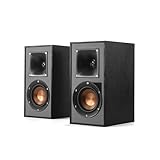
1. Wharfedale Linton: best high end bookshelf speakers on a smaller budget
Spec line: stand-mount design in Wharfedale’s Heritage range, with vintage styling and a matching stand. Price tier: upper-mid, an entry to high end.
Best for: music lovers with a modest budget who want warm, natural sound. Skip if: you want extreme bass from a bookshelf-size pair.
- Pro: smooth, inviting sound that is easy to enjoy for hours.
- Pro: real wood-veneer styling suits a living room.
- Pro: does not need a very powerful amplifier.
- Con: the stand adds to the footprint.
- Con: bass depth is modest without a subwoofer.
2. SVS Prime Pinnacle: best audiophile floorstanding speakers under 2000
Spec line: multi-driver passive tower with an aluminium dome tweeter, one of the most frequently recommended towers in its price class. Price tier: upper-mid.
Best for: mixed music and film in medium rooms, where tonal accuracy matters. Skip if: you want exotic materials or a luxury finish.
- Pro: balanced tone with controlled bass.
- Pro: very strong value for the price tier.
- Pro: works with a wide range of amplifiers.
- Con: styling is plain.
- Con: some listeners prefer a warmer midrange.
3. Klipsch Heritage Cornwall IV: best high end speakers for dynamics
Spec line: floorstanding horn speaker with 102 dB sensitivity, real-wood veneer cabinet. Price tier: premium.
Best for: vinyl, rock, jazz and tube amplifier setups in large rooms. Skip if: you want a flat, analytical sound or have a small room.
- Pro: explosive dynamics and a live-music feel.
- Pro: works well with low-power amplifiers.
- Pro: furniture-grade design.
- Con: large and needs space from the walls.
- Con: horn tone is not neutral.
4. SVS Ultra Evolution Tower: best for accurate music and cinema
Spec line: premium tower that is often named the audiophile all-rounder in 2026 roundups. Price tier: premium.
Best for: a dual-use room where music and films share a system. Skip if: you want the glow of a vintage-style speaker.
- Pro: clean, extended bass for a tower.
- Pro: detailed, accurate treble and midrange.
- Pro: matched centre and surrounds available.
- Con: big cabinet and a premium price.
- Con: needs quality amplification.
5. KEF R11 Meta: best for imaging and wide sweet spot
Spec line: floorstanding tower using the Uni-Q coaxial driver and Metamaterial Absorption Technology, which KEF says absorbs about 99 percent of unwanted rear sound from the tweeter. Price tier: premium.
Best for: listeners who sit slightly off-axis or share a sofa. Skip if: you prefer a warm, relaxed style.
- Pro: wide, even dispersion keeps the sound stable across seats.
- Pro: transparent, airy treble.
- Pro: high-quality cabinet and finish.
- Con: wants good amplification.
- Con: high price for the size.
6. Monitor Audio Gold 500 6G: best for refined detail
Spec line: flagship-class tower in the sixth generation of Monitor Audio’s Gold range. Price tier: upper premium.
Best for: large rooms, classical, acoustic and vocal music. Skip if: you are working below the premium tier.
- Pro: smooth, finely detailed sound.
- Pro: elegant finishes and build quality.
- Pro: good integration for home theater when paired with matching models.
- Con: requires space and strong amplification.
- Con: premium pricing.
7. Revel Performa F228Be: best neutral tower for medium rooms
Spec line: Performa Be tower with a beryllium tweeter, designed to be accurate and room-friendly. Price tier: high premium.
Best for: serious listeners who want a neutral, resolved sound without the largest cabinet. Skip if: your amplifier is modest.
- Pro: very neutral, with wide dispersion.
- Pro: reviewers describe it as close to the F328Be in character.
- Pro: suited to average-size rooms.
- Con: very high price compared with mainstream towers.
- Con: wants a quality amplifier.
8. Revel Performa F328Be: best statement speaker for audiophile reference
Spec line: flagship Performa Be tower with a beryllium tweeter and a 4-ohm load, so amplifier choice matters. Price tier: statement.
Best for: large dedicated rooms and reference listening with high-current amplifiers. Skip if: you need compact speakers or a smaller budget.
- Pro: extremely clean, detailed and powerful.
- Pro: flat measured response with minimal distortion.
- Pro: handsome, high-grade cabinet.
- Con: very expensive and large.
- Con: demands powerful amplification.
KEF’s Reference 5 Meta, an 88 dB and 4-ohm design, occupies the same statement territory with a coaxial approach. Audition both if you can.
Best speakers by budget: under 2000, under 5000 and beyond
| Budget goal | Shortlist | What you give up |
|---|---|---|
| Best speakers under 2000 | Wharfedale Linton, SVS Prime Pinnacle | Exotic drivers and luxury finishes |
| Best floorstanding speakers under 5000 | Cornwall IV, SVS Ultra Evolution, KEF R-series Meta | Statement-level bass and refinement |
| Beyond that | Monitor Audio Gold 500 6G, Revel F228Be and F328Be, KEF Reference 5 Meta | Cost, size and amplifier demands |
Retail prices differ between regions and finishes, so confirm the current listing before locking in a budget limit.
Best speakers of all time: the classics that shaped hi-fi
Many modern high end designs descend from a few classics. The BBC LS3/5a (produced by several makers, including Rogers) proved that a small monitor could sound lifelike. The Quad ESL-57 electrostatic showed how transparent a panel could be. The Klipschorn, in production since the 1940s, is the origin of the Klipsch horn sound. The JBL L100 defined the 1970s home studio style, and the Bowers and Wilkins 801 became a studio reference for decades. They are not necessarily the best sounding by modern standards, but they explain why current brands design speakers as they do.
Ownership realities of high end speakers
- Setup time is part of the cost. Expect to spend an evening moving speakers in small steps (about 2 to 5 centimetres) to find the best placement.
- Break-in is modest. Drivers loosen over the first 20 to 50 hours of use, but the effect is subtle, so judge them after a few days.
- Veneer and lacquer need care. Use a soft cloth, avoid direct sunlight and keep wet cleaners away.
- Grilles matter. Some speakers sound slightly better with the grilles removed; pick based on your ears and household risks.
- Warranty and support differ by brand. Premium brands often provide longer warranties through authorised dealers, so buy from one.
How to audition high end speakers before you commit
- Bring your own music. Choose five to eight tracks you know well, including one with deep bass, one with a solo voice and one with a busy mix.
- Listen at your normal level. Most people listen between 65 and 80 dB, so judge the speaker there rather than at demo volume.
- Match the electronics. If possible, hear the speakers with an amplifier of the same class as yours, not a showroom amplifier many times more powerful.
- Move and sit. Listen from your usual seat and from one seat to the side, to judge how stable the image is for shared listening.
- Ask about home trial and returns. Authorised dealers often allow short in-home trials, which reveal room interactions that no showroom can.
- Return to the first pair. After hearing two or three candidates, play the first one again; your opinion may change once the novelty has gone.
Treat measurements as a guide, not a verdict: a smooth on-axis response and low distortion are good signs, but your room, seating position and taste decide whether a pair is right for you.
Frequently Asked Questions
What are the best high end speakers?
There is no single best pair. The Klipsch Cornwall IV, SVS Ultra Evolution, KEF R11 Meta, Monitor Audio Gold 500 6G and Revel Performa towers are all strong choices in their classes. The right one depends on your room, amplifier and music.
What are the best speakers under 5000?
Common shortlists include the Klipsch Cornwall IV for dynamics, the SVS Ultra Evolution tower for accuracy and KEF’s R-series Meta towers for imaging. Verify current retail prices, as finishes and regions change the total.
What are the best speakers under 2000?
The Wharfedale Linton for warm bookshelf sound and the SVS Prime Pinnacle for a balanced tower are strong picks. Add a good amplifier and spend a few minutes on placement to get the most from them.
Do expensive speakers always sound better?
Not always. Above a certain tier, improvements are smaller and depend on the room and amplifier. A well-placed pair in a treated room often sounds better than a more expensive pair placed poorly.
Do I need a special amplifier for high end speakers?
Check sensitivity and impedance. Efficient speakers can work with small amplifiers, while 4-ohm designs such as the Revel F328Be benefit from a high-current amplifier. Matching the amplifier’s power to your listening level and room is more important than brand names.
Are audiophile speakers good for home theater?
Yes, especially towers from SVS, KEF and Monitor Audio that have matching centre and surround models. Their lower distortion improves dialogue and music in film soundtracks, though you still need a good centre channel and a subwoofer for the best results.
More from Amazon
Programs that pair well with the guide above. Offers and eligibility are set by Amazon and may change.
Free shipping on eligible items, Prime Video and more. Eligible new members can start with a free trial.
Start a Prime free trialAd-free music streaming. Eligible new subscribers can start with a free trial.
Try Music Unlimited freeA Prime membership for ages 18-24 with a trial period. Eligibility is set by Amazon.
See Prime for Young AdultsAudiobooks and podcasts to listen to on the go. Eligible new members can start with a free trial.
Try Audible freeAs an Amazon Associate we earn from qualifying purchases.