Key takeaways
- The Sony A6000 is an APS-C body with an E-mount, and that single fact shapes every lens decision.
The Sony A6000 is an APS-C body with an E-mount, and that single fact shapes every lens decision. Any E-mount lens will physically fit, but full-frame glass behaves differently on a crop sensor, and the camera has no in-body stabilization, so lens-based stabilization and aperture matter more than they would on a newer body. The question is not which lens is “best” in the abstract, but which one fills the gap your kit lens leaves.
This guide is for A6000 owners who want to move beyond the starter zoom: someone chasing portraits with a blurry background, someone who needs reach for a child’s soccer game, and someone who wants one lens to carry on a trip in 2026. It mixes native zooms, a full-frame prime, third-party primes, a wide-angle attachment, and an all-in-one travel zoom. Duplicate listings, including renewed copies of the same lens, are collapsed so each lens appears once, and one novelty lens with unclear mount details was left out. Judgments rely on the product titles only.
Quick Picks
Our top picks


As an Amazon Associate we earn from qualifying purchases at no extra cost to you.
| Product | Best for | Key spec from the title |
|---|---|---|
| Sony SELP1650 16-50mm | Compact everyday zoom | E PZ 16-50mm f/3.5-5.6 OSS |
| Sony FE 50mm F1.8 | Low-light portraits on a budget | 50mm f/1.8 standard lens |
| Sony E 55-210mm | Affordable telephoto reach | f/4.5-6.3, OSS, 49mm filter |
| TTArtisan 25mm F2 | Manual-focus wide prime | 25mm f/2, APS-C, E mount |
| NEEWER 40.5mm Wide Angle Lens | Cheap wide and macro experiments | 2-in-1, 18mm wide angle, 10x macro |
| VILTROX AF 56mm F1.7 | Autofocus portraits | 56mm f/1.7, 85mm equivalent, 170g, STM AF |
| Tamron 18-300mm F/3.5-6.3 | One-lens travel setup | Di III-A VC VXD, 18-300mm range |
How to Choose
Mind the crop factor
The A6000 applies roughly a 1.5x crop, so a 56mm lens frames like an 85mm, which the Viltrox title states directly. Choose focal length by the equivalent view: around 35mm equivalent for everyday scenes, 75 to 90mm equivalent for portraits, and 300mm or more equivalent for sports and wildlife. Lenses made for full-frame cameras still mount and work, but they project a larger image circle than the small sensor needs, so you pay in size and cost for coverage you cannot use.
Aperture for low light
Because the A6000 has no sensor stabilization, a wide aperture is your friend. A lens at f/1.7 or f/1.8 gathers far more light than a kit zoom at f/3.5 to f/5.6, which means lower ISO and faster shutter speeds indoors. For a tele zoom, expect a slow aperture and plan on daylight shooting. If you regularly shoot birthday parties or restaurants, a prime is the more sensible first purchase than another zoom.
Autofocus versus manual focus
Native and Viltrox lenses autofocus; the TTArtisan is a manual-focus fixed lens. Manual glass is rewarding for landscapes and street work but frustrating for moving subjects. If you photograph children or pets, insist on an autofocus lens with a quiet motor, such as one with STM or a power-zoom drive. Also check whether the lens title mentions stabilization, listed as OSS on Sony and VC on Tamron.
What to ignore and where budget lenses cut corners
Ignore claims of “professional” quality on cheap attachments. Budget lenses commonly cut corners on corner sharpness, coatings, and autofocus speed. Check the filter thread size if you plan to share filters across lenses, and weigh weight, since a heavy lens on a small body is awkward to hold and defeats the purpose of owning a compact camera. Renewed listings can work well, but confirm the return window.
One more consideration is budget order. Most A6000 owners get the biggest jump from a single bright prime, then add a telephoto or travel zoom later if their subjects demand it. Buying three mid-quality lenses at once usually leaves you with overlapping focal lengths and a heavier bag. Pick the lens that solves your most frequent frustration first, whether that is dark rooms, distant subjects, or constant lens swaps, and live with it for a few weeks before adding another.
The 7 Best Options
Sony SELP1650 16-50mm
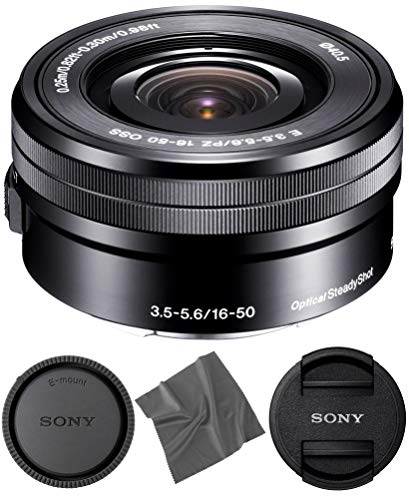
This is the compact power zoom that often ships with the A6000, listed here as a bundle with starter accessories, and a renewed copy shows up separately. It covers wide to short-tele with optical stabilization in a collapsible body. It suits owners who want a small walking-around setup, a replacement for a lost kit lens, or a spare for a second body that rides in a coat pocket.
- Strength: OSS stabilization helps compensate for the body’s lack of in-body stabilization.
- Strength: the power zoom is compact and light for travel.
- Trade-off: the f/3.5-5.6 aperture struggles in dim rooms.
Skip it if you already own the kit lens or want shallow depth of field.
Sony FE 50mm F1.8
This is a full-frame standard prime that works on the A6000 with a roughly 75mm equivalent view. It is an affordable path to a blurred background and good low-light performance for portraits, product photos, and quick street shots. Because it is built for a bigger sensor, the A6000 uses only the center of the image circle.
- Strength: the f/1.8 aperture is bright and enables shallow depth of field.
- Strength: small and light for a prime.
- Trade-off: the crop makes the framing tight indoors, so you need space to step back.
Skip it if you shoot in tight rooms or want a wider field of view.
Sony E 55-210mm
The E 55-210mm is an APS-C telephoto zoom with OSS, a 49mm filter size, a 1.0m minimum focus distance, and a listed weight near 345 grams. It is a low-cost way to get reach for sports, pets, and distant scenes. A renewed copy also appears in the listings and is the same optical design.
- Strength: optical stabilization helps at long focal lengths.
- Strength: modest weight and a small filter size keep it travel friendly.
- Trade-off: aperture of f/4.5-6.3 needs bright light.
Skip it if you need fast aperture for evening events.
TTArtisan 25mm F2
This manual-focus wide-angle prime is designed for APS-C E-mount cameras including the A6300, A6400, A6500, and A6600, plus NEX bodies. It suits street photographers and hobbyists who enjoy a tactile, deliberate workflow at a budget tier and who are happy to zone-focus on busy sidewalks. Check carefully that your A6000 is covered by the compatibility list in the full description.
- Strength: f/2 aperture offers low-light capability and background separation.
- Strength: compact fixed design is easy to carry.
- Trade-off: manual focus only, so it is a poor match for moving subjects.
Skip it if you depend on autofocus.
NEEWER 40.5mm Wide Angle Lens
This is an add-on attachment, not a native E-mount lens. It offers an 18mm wide-angle element and a 10x macro element in one, listed as compatible with several Sony bodies and the A6000 by name. It suits experimenters who want to try wide and close-up shots cheaply and who already own a lens with a matching thread.
- Strength: two effects in one inexpensive accessory.
- Strength: tiny and light.
- Trade-off: attachments typically soften edges compared with a purpose-built lens.
Skip it if image quality is your priority.
VILTROX AF 56mm F1.7
The Viltrox is an autofocus portrait lens for APS-C E-mount, with an 85mm equivalent view, a large f/1.7 aperture, STM autofocus, and a 170g body. It is the clearest portrait upgrade for an A6000, pairing a classic head-and-shoulders field of view with background blur that kit zooms cannot deliver.
- Strength: autofocus plus a bright aperture at a light weight.
- Strength: classic portrait framing with strong background blur.
- Trade-off: a single focal length limits flexibility.
Skip it if you need a zoom for unpredictable subjects.
Tamron 18-300mm F/3.5-6.3
This all-in-one travel zoom spans 18 to 300mm for E-mount APS-C, with VC stabilization and a VXD focus motor. It suits travelers who want to carry a single lens and never swap in a dusty location. It covers landscape, street, and distant wildlife with a single twist of the zoom ring.
- Strength: enormous range in one lens.
- Strength: stabilization and a modern focus motor are listed.
- Trade-off: variable aperture gets slow at the long end.
Skip it if you want the sharpest results or a compact setup.
Which One Fits Your Situation
You photograph portraits and family
Buy the Viltrox 56mm F1.7. Autofocus and the 85mm equivalent view make it the straightforward portrait lens, and it weighs little enough to carry all day.
You travel light with one lens
Choose the Tamron 18-300mm. It covers landscapes and distant subjects without a lens swap, which suits a week of sightseeing with one bag.
You shoot sports or wildlife on a budget
The Sony E 55-210mm gives affordable reach with stabilization, enough for a school field or a backyard feeder.
You love manual street photography
The TTArtisan 25mm F2 is a compact wide prime with a bright aperture and a slow, deliberate feel.
If you cannot decide between two of these, ask what you shoot most often in a month. A person who mostly photographs people should lean on the Viltrox, while someone who mostly photographs places should lean on the Tamron. Letting the subject choose the lens is more reliable than choosing by specification alone, and it keeps the bag lighter.
Common Mistakes
- Forgetting the 1.5x crop and buying a prime that is too tight for indoor use.
- Choosing manual-focus glass for moving children or pets.
- Expecting an attachment lens to match a dedicated lens in corner sharpness.
- Paying for full-frame lenses without wanting the extra size and cost.
- Ignoring the lack of body stabilization and skipping lenses with OSS.
Finally, remember that the A6000 is an older body with a modest autofocus system. Fast-moving subjects still work best with a native lens that has a quick motor, while slow subjects suit any of the primes here.
Keep an eye on filter sizes when you build a kit, since matching thread diameters lets one set of filters serve several lenses. Lens hoods and clean front elements also make a visible difference, especially with fast primes that flare under strong backlight.
Related guides
- Wireless Chargers For Iphone And Airpods
- Noise Cancelling Earbuds Under $100
- Mechanical Keyboard For Programming
Frequently Asked Questions
Do full-frame lenses work on the A6000?
Yes, FE lenses mount on E-mount cameras, and the crop factor applies. You gain a tighter view but carry more size and cost than a native APS-C lens.
Which lens is best for portraits?
The Viltrox 56mm F1.7 offers autofocus and an 85mm equivalent view, which is the classic portrait range. The Sony 50mm F1.8 is a close alternative.
Is one travel zoom enough?
For casual travel, yes. The Tamron 18-300mm covers a wide range, though a prime will beat it in low light and in background blur.
Do I need stabilization in the lens?
Yes, because the body does not stabilize. Lenses with OSS or VC help with handheld shots at slow shutter speeds and long focal lengths.