Key takeaways
- Picking the best wide angle lens for Sony cameras starts with one question that trips up many buyers: is your body full frame or APS-C?
Picking the best wide angle lens for Sony cameras starts with one question that trips up many buyers: is your body full frame or APS-C? A 14mm lens on an A7-series body delivers a dramatic ultra-wide view, while a 9mm lens built for APS-C bodies such as the a6400 or ZV-E10 produces a roughly similar field of view only because of the crop factor. Mix them up and you either get heavy vignetting or no coverage at all. After the sensor size, the choice narrows to how wide you really need to go, how much light you want to gather, and whether a zoom is worth its extra bulk.
This guide suits landscape and architecture shooters, vloggers who need a wide frame at arm’s length, real-estate photographers, and anyone building a travel kit for the E-mount system in 2026. The shortlist mixes third-party autofocus primes with two Sony G lenses so you can compare a compact budget route against a more premium one. All comments below come from the details in each product title, so check mount compatibility and your exact body before ordering.
Quick Picks
Our top picks




As an Amazon Associate we earn from qualifying purchases at no extra cost to you.
| Product | Best for | Key spec from the title |
|---|---|---|
| VILTROX 9mm F2.8 E | APS-C vloggers and interiors | 9mm f/2.8, APS-C, autofocus |
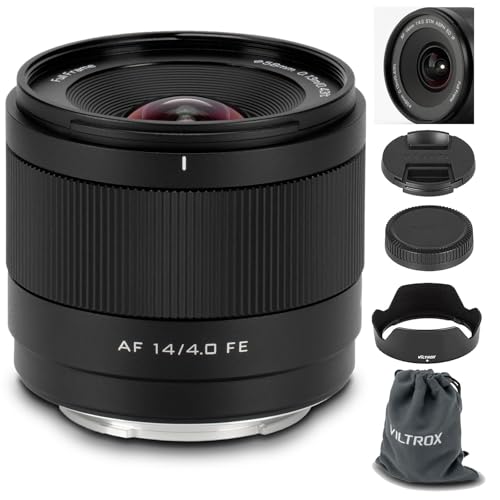
| VILTROX 14mm F4.0 FE | Full-frame landscapes and travel | 14mm f/4, 170g, STM |
| Sony FE 20mm F1.8 G | Astro and low-light wide shots | 20mm f/1.8, G lens, full frame |
| VILTROX 20mm f2.8 FE | Everyday wide on a budget | 20mm f/2.8, autofocus, FE mount |
| VILTROX 15mm F1.7 E | Bright APS-C street and video | 15mm f/1.7, 180g, STM |
| Sony FE PZ 16-35mm F4 G | Video-friendly zoom flexibility | 16-35mm f/4, power zoom, constant aperture |
How to Choose
Match the lens to your sensor
FE lenses cover full-frame sensors and also work on APS-C bodies, where the view tightens by about 1.5 times. Lenses labeled E with an APS-C designation, such as the 9mm and 15mm options here, are designed for crop sensors. Mounting them on a full-frame body can force a crop mode or produce dark corners. Before buying, write down your body name and check that it matches the compatibility list in the title.
Focal length: how wide is wide enough
Between 14mm and 16mm on full frame gives an ultra-wide look with strong foreground emphasis, ideal for landscapes and tight interiors. Around 20mm is a more natural wide angle that suits street scenes, group shots, and environmental portraits with less stretching at the edges. On APS-C, divide those numbers by 1.5 to find a matching full-frame value, so a 9mm lens lands near a 13.5mm view. Anything much wider than you need makes subjects look small.
Aperture, weight, and autofocus
An f/1.7 or f/1.8 lens gathers far more light than an f/4 option, helpful for night skies, dim interiors, and shallow depth of field. A constant f/4 aperture on a zoom keeps exposure steady while you reframe, which video shooters value. Weights listed in the titles, such as 170g and 180g, signal that the compact primes will not weigh down a gimbal. STM focusing motors are generally quiet and smooth, a plus for recording video.
Filters are another practical point. Very wide lenses often have bulging front elements or oversized threads, which can make screw-on filters awkward or impossible without special holders. If you shoot long exposures of waterfalls or coastlines, check whether the listing mentions filter threads at all, and expect to spend extra on a holder system for the widest primes.
Where budget lenses cut corners
Third-party primes often skip weather sealing, in-lens stabilization, and fast firmware updates. They may also rely on in-camera correction for distortion and vignetting, so check whether your camera applies profiles automatically. Ignore megapixel-style marketing claims and focus on aperture, focal length, and how much distortion you can tolerate. Sony G lenses add polished build quality and extended support, but at a clear premium.
The 6 Best Options
VILTROX 9mm F2.8 E
This APS-C prime offers an f/2.8 aperture and autofocus for crop-sensor Sony bodies, with the title naming the a6400, a6500, a6600, ZV-E10, and FX30. It is built for vloggers and interior shooters who want a very wide frame without a bulky zoom.
- Strength: Autofocus support makes handheld vlogging far easier than a manual wide lens.
- Strength: Ultra-wide field of view fits tight rooms and selfie framing.
- Trade-off: It is limited to APS-C bodies and is not designed for full-frame cameras.
Think of it as a purpose-built tool for small bodies: the title pairs it with compact cameras like the ZV-E10 and FX30, so the combined kit stays pocketable. Skip it if you shoot with an A7-series body or want a bright aperture for dim scenes, since f/2.8 is moderate and the crop-sensor design limits where it can be used.
VILTROX 14mm F4.0 FE
A full-frame autofocus prime listed at 170g with an STM motor, this lens targets travelers and landscape shooters on bodies such as the A7S III and A7 II. It delivers an ultra-wide view without adding much to a camera bag.
- Strength: Very light listed weight makes it easy to carry all day.
- Strength: 14mm on full frame provides a dramatic wide perspective for scenery.
- Trade-off: An f/4 maximum aperture is slow for night skies and dark interiors.
It also pairs well with older full-frame bodies, since the title lists the A7S III and A7 II among compatible cameras, which makes it a sensible way to refresh a travel kit. Skip it if astrophotography or low-light work is a priority, because the slower aperture will force higher sensitivity settings at night.
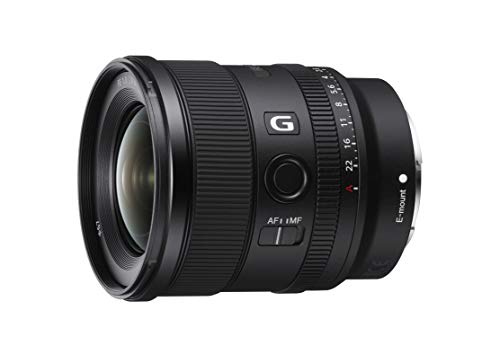
Sony FE 20mm F1.8 G
The model SEL20F18G is a full-frame ultra-wide prime with a bright f/1.8 aperture and a G designation. The title mentions XD Linear focus motors, which points to precise, quiet autofocus. It fits photographers who want a premium, fast wide option from the camera maker itself.
- Strength: f/1.8 gathers plenty of light for night scenes and indoor events.
- Strength: Native G-series design usually pairs well with Sony body features and firmware.
- Trade-off: As a Sony G lens it sits in the premium tier, well above third-party primes.
Because 20mm is less extreme than 14mm, it tends to be easier to compose with, and buildings or people near the frame edge look less stretched. Skip it if you want the widest possible view or are shopping on a tight budget, since the third-party 20mm option costs noticeably less.
VILTROX 20mm f2.8 FE
This autofocus 20mm f/2.8 lens fits FE-mount bodies and lists compatibility from the a6000 line through the a6600 and ZV models, so it can work on crop sensors as well. It is a flexible everyday wide choice at a gentler price tier than the Sony alternative.
- Strength: 20mm offers a natural wide look that suits street and travel photography.
- Strength: Works across many Sony bodies, giving it upgrade-path value.
- Trade-off: f/2.8 is a stop and a half slower than the Sony 20mm f/1.8.
Skip it if you want the brightest aperture or the widest possible frame.
VILTROX 15mm F1.7 E
An APS-C autofocus prime with an f/1.7 aperture, a listed weight of 180g, and an STM motor, this lens is aimed at crop-sensor shooters who want a bright wide option. The title names the FX30, ZV-E10, and ZV-E10 II among supported bodies.
- Strength: f/1.7 is bright enough for low-light video and shallow depth of field.
- Strength: Compact weight suits gimbal rigs and small vlogging setups.
- Trade-off: Designed for APS-C, so it is not a match for full-frame bodies.
Skip it if you use a full-frame camera or need an ultra-wide view beyond 15mm.
Sony FE PZ 16-35mm F4 G
This full-frame zoom offers a constant f/4 aperture and a power zoom mechanism, making it a natural choice for video creators who want smooth, motorized focal-length changes. As a G lens it sits in the premium range.
- Strength: Constant aperture keeps exposure steady across the zoom range.
- Strength: One lens covers ultra-wide to standard wide framing.
- Trade-off: Zooms cost more and weigh more than a compact prime for the same field of view.
For hybrid shooters, the power zoom is the headline, since smooth motorized zoom pulls are difficult to fake with a prime. Skip it if you want a featherweight kit or a bright aperture for night work, because f/4 and zoom-lens bulk both work against that goal.
Which One Fits Your Situation
You vlog on a ZV-E10
The VILTROX 15mm F1.7 E is a good match, with a bright aperture and light weight, and the title names the ZV-E10 family. If you need an even wider arm’s-length view, the 9mm F2.8 E covers that need.
You photograph landscapes while hiking
Pack the VILTROX 14mm F4.0 FE. Its listed 170g keeps the load down, and 14mm on full frame delivers a sweeping foreground-to-horizon view.
You shoot stars or dim events
Choose the Sony FE 20mm F1.8 G. The f/1.8 aperture is the brightest full-frame option on this list, and the focus motor is described as precise.
You make video and want one lens for everything
The Sony FE PZ 16-35mm F4 G gives you motorized zoom with constant aperture, so you can reframe a scene without changing lenses.
When two lenses seem equally good, let your existing gear break the tie. A photographer who already owns a standard zoom may gain more from a single fast prime, such as the Sony FE 20mm F1.8 G or the VILTROX 20mm f2.8 FE, than from a second zoom with overlapping range. Someone starting from a kit lens and a crop body will usually feel a bigger jump from the VILTROX 9mm F2.8 E, because it unlocks framing the kit lens simply cannot reach.
Common Mistakes
- Buying an APS-C lens for a full-frame body and discovering heavy vignetting or forced cropping.
- Assuming a lower number always means better, when f/4 lenses are fine in daylight but weak at night.
- Ignoring the weight of a zoom when planning a long hike or gimbal session.
- Skipping camera lens-profile settings, then blaming the lens for distortion software can fix.
- Choosing the widest option when a 20mm view would handle most of your scenes with less stretching.
Related guides
- Wireless Chargers For Iphone And Airpods
- Noise Cancelling Earbuds Under $100
- Mechanical Keyboard For Programming
Frequently Asked Questions
Can I use an FE lens on an APS-C Sony body?
Yes. FE lenses cover full-frame sensors and work on crop bodies, where the view tightens by about 1.5 times. Expect a narrower field than the number suggests.
Is a 9mm lens wider than a 14mm lens?
Not necessarily. A 9mm APS-C lens produces a view near 13.5mm in full-frame terms, so the two are close. The difference is the sensor each lens is designed to cover.
Do third-party lenses autofocus properly on Sony cameras?
The listings advertise autofocus for E-mount and FE-mount bodies. Compatibility and tracking quality can vary by camera, so check the listed body names and keep firmware current.
Is a constant f/4 zoom better than a prime?
It depends on your priorities. A zoom offers flexibility and steady exposure, while a prime usually offers a brighter aperture and lighter weight for the same focal length.