For most buyers, GreenPan is the safest first choice for a ceramic nonstick cookware set, Caraway suits those who want a coordinated, design-led set with storage, Our Place suits small kitchens that want a few multi-purpose pieces, and Xtrema suits buyers who specifically want solid ceramic cookware with no metal core. Cuisinart and Carote fill the budget end. The right pick depends on how long you expect the nonstick surface to last, what stove you have, and how you plan to clean the pans.
Our top picks



As an Amazon Associate we earn from qualifying purchases at no extra cost to you.
What “Ceramic Cookware” Means in Practice
Almost every ceramic cookware set sold today is made of an aluminum or stainless steel body with a sol-gel ceramic-type nonstick coating. The coating is silica-based and is marketed as an alternative to PTFE. A much smaller group, led by Xtrema, makes cookware from solid fired ceramic with no metal core. The two categories behave differently on the stove, so the buying advice differs too.
Reviewers consistently report one trade-off: ceramic-coated nonstick usually releases food well when new, but the surface can lose slickness faster than PTFE if it is exposed to high heat, metal utensils or dishwasher detergents. Following the maker’s care guide matters more than the brand.
At a Glance
| Option | Construction | Best for | Key points from the maker | Limits |
|---|---|---|---|---|
| GreenPan (Valencia Pro, Padova, other lines) | Hard-anodized or aluminum body with Thermolon ceramic coating | First ceramic set, wide range of budgets | Maker states the coating is PFAS-free, with induction compatibility on selected lines | Lines differ; confirm induction and oven limits for the exact set |
| Caraway Cookware Set | Aluminum core with ceramic coating, stainless handles | Coordinated look, includes lid and pan storage | Maker lists induction compatibility and a stated oven limit; coating described as free of PTFE and PFOA | Premium tier; limited piece count |
| Our Place (Always Pan, Cookware Set) | Aluminum body with ceramic coating | Small kitchens, multi-use pans | Maker describes a few pieces replacing several; sets include lids and utensils | Not a large set; mid to premium tier |
| Cuisinart Ceramica XT / similar | Aluminum or hard-anodized with ceramic-type coating | Budget to mid-range full sets | Maker lists oven and dishwasher guidance per line | Coating durability varies; read each line’s care guide |
| Xtrema | Solid fired ceramic, no metal core | Buyers avoiding metal and coatings | Maker states it is non-reactive and can be used on stovetop, in the oven and in the microwave, with guidance on heat settings | Heavy, slower to heat, can chip or crack; premium tier |
GreenPan: The Broadest Range
GreenPan is generally credited with popularising ceramic nonstick cookware, and its Thermolon coating is the one most reviewers refer to when they discuss the category. The brand sells lines at several budget levels, from lightweight aluminum sets to heavier hard-anodized ones with stainless steel handles. The maker states that its coatings are free of PFAS, PFOA, lead and cadmium.
It suits buyers who want a mainstream, widely stocked brand with plenty of replacement pieces. The main caveat is that line names change often, so confirm the exact material, induction compatibility and oven temperature limit of the specific set. Reviewers recommend medium heat, wooden or silicone utensils, and hand washing, and warn that cooking spray can leave a residue that degrades release over time.
Caraway: The Design-Led Set
Caraway sells a small, curated set of pans, a sauté pan, a Dutch oven, and lids, in a range of colours, supplied with magnetic pan racks and a lid holder. The maker emphasises its ceramic coating and states that it is free of PTFE and PFOA. Reviewers praise the look and the organisation system, while noting that the set has fewer pieces than a traditional 10-piece set and sits in the premium tier.
It suits those moving into a first apartment or refreshing a small modern kitchen, and who place value on storage and appearance. It is less suited to large families who need several large pots at once.
Our Place: Fewer Pieces, More Uses
Our Place is known for the Always Pan, a deep, lidded pan with a built-in spatula rest and steamer basket that the maker positions as replacing several single-purpose pieces. The brand has since added a wider cookware set. The idea is to buy fewer, more versatile pieces. Reviewers generally like the concept for studio apartments and dorm-style kitchens and are less keen where you need a stockpot or a large roasting setup.
Cuisinart and Carote: Budget Sets
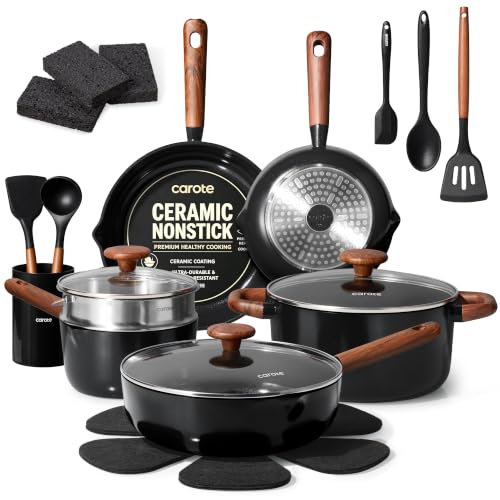
If the aim is to fill a kitchen at low cost, Cuisinart’s ceramic-coated lines and Carote’s value ranges offer large piece counts with stay-cool handles. They are the typical choices for students, rentals and anyone who expects to replace cookware every few years. Because specs differ per line, check whether the set is induction compatible, whether lids are glass or metal, and what the oven temperature limit is. Treat the dishwasher-safe label with caution: reviewers report that machine washing shortens nonstick life even on lines marked as dishwasher safe.
Xtrema: The Solid Ceramic Alternative
Xtrema takes a different approach, making pots and pans from a single fired ceramic body without a metal core or coating. The maker states the cookware is non-reactive and suitable for stovetop, oven and microwave. Reviewers note that it needs lower heat settings, takes longer to heat, and can crack from thermal shock or impact, so careful handling is essential. It is also heavier than coated aluminum. Buyers who prefer not to use any coating at all are the natural audience, as are those who value long-term durability from a rigid, scratch-free surface.
Check compatibility with your cooktop, especially induction, which requires a magnetic base. Follow the maker’s heating guidelines closely.
How to Choose a Set
Cooktop compatibility
Gas and electric coil stoves work with nearly everything. Glass-top ranges need flat, smooth bases. Induction needs a magnetic base or plate, which many ceramic-coated aluminum pans include but not all do. Always read the maker’s compatibility note.
Piece count
Most households use three pans daily: a small and a large skillet, and a saucepan. A pot with a lid for pasta or soup is the fourth. Anything beyond that is often unused. Sets with fewer pieces can be better value if they match your cooking.
Heat and utensils
Ceramic coatings generally perform best at low to medium heat. High heat, empty preheating and sudden cooling can shorten their life. Use silicone, wood or nylon tools.
Oven limits and handles
Oven safety temperatures vary by line and often depend on lids and handles. Glass lids commonly have lower limits than metal ones. If you braise or finish dishes in the oven, check the number before you buy.
Cleaning and care
- Let pans cool before washing to avoid warping or coating stress.
- Use a soft sponge and mild detergent, even on lines labelled dishwasher safe.
- Avoid aerosol cooking sprays and abrasive pads.
- Replace any pan with a flaking, chipped or deeply scratched surface, and follow the maker’s guidance on disposal.
Budget Tiers
- Budget: Carote and entry-level Cuisinart or GreenPan lines. Expect larger piece counts and shorter coating life.
- Mid-range: Hard-anodized GreenPan lines and Our Place pieces.
- Premium: Caraway and Xtrema, plus the upper GreenPan collections.
Pick X If…
| If you… | Pick | Reason |
|---|---|---|
| want a mainstream first ceramic set | GreenPan | Broad range, many sizes, easy replacements |
| value design and organisation | Caraway | Colour options and storage accessories included |
| have a small kitchen | Our Place | Few pieces with several functions |
| need many pieces at low cost | Cuisinart or Carote | Large sets in the budget tier |
| avoid coatings altogether | Xtrema | Solid fired ceramic body |
| cook on induction | Check each set’s note; Caraway and select GreenPan lines list it | Magnetic base required |
Alternatives
- Stainless steel clad sets: brands like Cuisinart, Tramontina and All-Clad make long-lasting sets that suit high-heat searing, though food can stick without technique.
- Seasoned cast iron or carbon steel: inexpensive, long-lived and nonstick once seasoned, but heavier and requiring maintenance.
- PTFE nonstick: often more slippery for longer. Many makers advise not overheating it, and reviewers consider it a reasonable choice for eggs and delicate fish if used within the manual’s limits.
Frequently Asked Questions
Is ceramic cookware healthier than traditional nonstick?
Makers of ceramic-coated cookware state their coatings are free of PTFE and PFOA, which is attractive to buyers who prefer to avoid those chemicals. That is a material choice rather than a proven health advantage. For specific health concerns, consult a qualified professional and the maker’s safety information.
How long does a ceramic nonstick coating last?
Reviewers commonly report that release performance declines within a few years under daily use, faster with high heat or dishwasher cleaning. Careful use, low-to-medium heat and hand washing help. Treat it as a replaceable item.
Can I use metal utensils on ceramic cookware?
Most makers advise against it, even when they describe the coating as durable. Silicone, wood and nylon are safer choices. Metal can scratch the coating and shorten its life.
Does ceramic cookware work on induction?
Only if the base includes a magnetic layer. Some GreenPan lines and the Caraway set list induction compatibility, while others do not. Always check the product specifications.
Why are my ceramic pans sticking?
Residue from cooking sprays and oils, overheating, and cleaning with abrasives are the usual causes. A gentle wash with baking soda and warm water may help restore release, but once the coating is worn, replacement is the practical fix.
Is solid ceramic cookware worth it?
It suits buyers who want a coating-free, non-reactive surface and accept the extra weight, slower heating and fragility. Follow the maker’s heating guidelines closely to avoid cracks. If you need fast, high-heat cooking, stainless steel or cast iron is usually the better match.