Key takeaways
- Best Overall: GMKtec M5 Ultra (Ryzen 7 7730U, 16GB DDR4, 512GB SSD)
- Best Integrated Graphics: Beelink SER9 Pro (Ryzen 7 H 255, Radeon 780M)
- Best Ryzen 7 6800H Value: Glorlin Mini PC (Ryzen 7 6800H, Radeon 680M)
- Best Slim Desktop Replacement: Minisforum UM870 Slim (Ryzen 7 8745H)
- Best Budget Office Mini PC: BOSGAME E7 (Intel Core 3 100U, 16GB, 512GB)
- Best Small Gaming PC: Empowered PC LAN Gamer 8.1L (RTX 5060)
- Best Small Gaming PC, Upper Tier: Empowered PC Continuum Micro (RTX 5060 Ti 8GB)
The best mini PC for most people is a Ryzen 7 model with at least 16GB of memory and a fast NVMe drive, and our top pick is the GMKtec M5 Ultra because it combines a Ryzen 7 7730U, upgradeable memory and dual 2.5G LAN in a small box. If you want the most graphics power in a truly compact case, the Empowered PC LAN Gamer 8.1L, with its RTX 5060 and Ryzen 7 8700F, is the runner-up and the right choice for small form factor gaming. This guide ranks seven main mini and small form factor PCs, adds four more to consider, and explains how to choose between an office mini PC and a gaming SFF build.
This guide is research-based. We did not personally use these computers. The picks come from product listings, the makers’ stated specifications and independent coverage of the processors involved, including published reviews of the Beelink SER9 Pro. Where a detail is not stated, we write “not listed.” Prices appear only as tier words (Budget, Mid-range, Premium) because they move often.
Our top picks


As an Amazon Associate we earn from qualifying purchases at no extra cost to you.
Top Picks at a Glance
- Best Overall: GMKtec M5 Ultra (Ryzen 7 7730U, 16GB DDR4, 512GB SSD)
- Best Integrated Graphics: Beelink SER9 Pro (Ryzen 7 H 255, Radeon 780M)
- Best Ryzen 7 6800H Value: Glorlin Mini PC (Ryzen 7 6800H, Radeon 680M)
- Best Slim Desktop Replacement: Minisforum UM870 Slim (Ryzen 7 8745H)
- Best Budget Office Mini PC: BOSGAME E7 (Intel Core 3 100U, 16GB, 512GB)
- Best Small Gaming PC: Empowered PC LAN Gamer 8.1L (RTX 5060)
- Best Small Gaming PC, Upper Tier: Empowered PC Continuum Micro (RTX 5060 Ti 8GB)
Mini PCs Compared
| Model | Best for | Key specs (from the listing) | Watch for | Price tier |
|---|---|---|---|---|
| GMKtec M5 Ultra | Home office, all-round | Ryzen 7 7730U, 16GB DDR4 upgradeable, 512GB SSD, dual 2.5G LAN, WiFi 6E | Integrated graphics only | Mid-range |
| Beelink SER9 Pro | Creative work, light gaming | Ryzen 7 H 255, 24GB LPDDR5X, 1TB SSD, Radeon 780M, 2.5G LAN | Memory is soldered | Premium |
| Glorlin Ryzen 7 6800H | Value performance | Ryzen 7 6800H up to 4.7GHz, 16GB LPDDR5, 512GB NVMe, Radeon 680M, triple 4K, dual LAN | Lesser-known brand | Mid-range |
| Minisforum UM870 Slim | Slim desktop replacement | Ryzen 7 8745H 8C/16T up to 4.9GHz, Radeon 780M, 16GB DDR5 | Check storage size on the exact listing | Mid-range |
| BOSGAME E7 | Basic office and browsing | Core 3 100U 6C/8T up to 4.7GHz, 16GB, 512GB, WiFi 6, dual RJ45 | Modest graphics | Budget |
| Empowered PC LAN Gamer 8.1L | Compact 1080p to 1440p gaming | RTX 5060, Ryzen 7 8700F, 32GB DDR5, 1TB Gen4 NVMe, Windows 11 Pro | Larger than a mini PC | Premium |
| Empowered PC Continuum Micro | Higher-end SFF gaming | RTX 5060 Ti 8GB, Ryzen 7 5700X, 32GB RAM, 1TB Gen4 NVMe, Windows 11 Pro | Older AM4-generation CPU | Premium |
1. GMKtec M5 Ultra: Best Overall Mini PC
- CPU: AMD Ryzen 7 7730U, turbo up to 4.5GHz, 15W TDP class
- Memory: 16GB DDR4, upgradeable
- Storage: 512GB SSD
- Networking: dual 2.5G LAN, WiFi 6E, Bluetooth 5.2
- Display: triple display output including USB-C
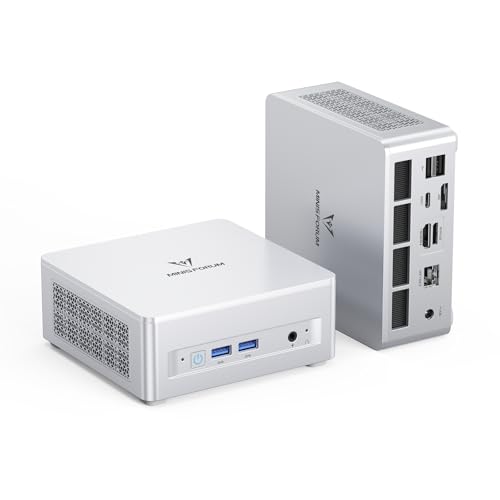
Best for: a home office desk, a family computer, or a quiet media and browsing machine. Skip if: you want to play modern 3D games at high settings.
The M5 Ultra is the model that shows what a mini PC does best: it gives a desktop-class eight-core Ryzen 7 in a case you can tuck behind a monitor. The 7730U is an efficiency-focused processor, which is why the listing mentions a 15W class power target. Lower power means the fan stays quiet and the box does not demand a large power brick, which suits an office. For spreadsheets, video calls, dozens of browser tabs and light photo editing, it has plenty of headroom.
The detail that earns it the top spot is memory. Because the RAM is described as upgradeable DDR4, you can start with 16GB and add more later rather than being locked into what the factory soldered on. The dual 2.5G LAN ports are also an unusual extra at this tier, useful for a home lab or a small network where you want a wired connection plus a second port. Integrated graphics are the limit: you can play older or lightweight games, but this is not a gaming machine. The listing notes triple display support, which is helpful for a multi-monitor office desk.
Pros: eight cores, upgradeable memory, dual 2.5G LAN, quiet power class, WiFi 6E. Cons: integrated graphics only, DDR4 is older memory, brand support varies by region.
2. Beelink SER9 Pro: Best for Integrated Graphics
- CPU: AMD Ryzen 7 H 255, 8 cores and 16 threads, up to 4.9GHz
- Graphics: Radeon 780M
- Memory: 24GB LPDDR5X (soldered)
- Storage: 1TB NVMe
- Networking: 2.5G LAN, WiFi 6, USB4
Best for: creators and professionals who want the strongest integrated graphics in a mini PC. Skip if: you want to upgrade the memory later.
Independent reviews describe the SER9 Pro as a strong small-form-factor machine with excellent sustained performance, and the Ryzen 7 H 255 is reported to be essentially a rebadged Ryzen 7 8745H. The Radeon 780M graphics with 12 compute units are among the best integrated options available, capable of running many popular games at modest settings and handling video editing and 3D tasks that older integrated chips struggle with. The package is notable for its USB4 port and compact size.
The trade-off is the soldered LPDDR5X memory. Fast memory is a big part of why the 780M performs well, but it cannot be upgraded, so choose the capacity you need on day one. 24GB is comfortable for most work. Dual M.2 storage slots are reported by independent reviewers, which lets you add drives later. If you want a mini PC that can double as a light gaming and creative machine, this is the strongest all-round choice in this guide.
Pros: strong integrated graphics, fast memory, USB4, generous storage. Cons: soldered memory, higher cost, WiFi 6 rather than WiFi 7.
3. Glorlin Mini PC with Ryzen 7 6800H: Best Ryzen 7 6800H Value
- CPU: AMD Ryzen 7 6800H, up to 4.7GHz
- Memory: 16GB LPDDR5
- Storage: 512GB NVMe SSD
- Graphics: Radeon 680M
- Ports: HDMI, DisplayPort, USB-C for triple 4K display, dual LAN, WiFi 6, Bluetooth 5.3
Best for: shoppers who want a high-performance mobile CPU in a compact case at a moderate cost. Skip if: you prefer a major-brand warranty and support network.
The Ryzen 7 6800H is a 45W-class laptop processor, so it is stronger than a 15W part like the 7730U in sustained multi-core tasks, and its Radeon 680M graphics are good enough for esports titles and casual games at lower settings. In a mini PC, that translates into a machine that handles heavier workloads such as video editing, virtual machines and many-tab research with ease. The three video outputs make it a good multi-monitor desk computer.
The unknowns are the brand and the memory design. Glorlin is not as established as Beelink or Minisforum, so check the return window and warranty terms on the listing. The memory is described as LPDDR5, which is usually soldered, though upgradeability is not listed, so treat 16GB as fixed. This is a performance-per-cost pick for buyers who read the specs and accept a newer brand.
Pros: strong CPU, triple 4K output, dual LAN, WiFi 6 and Bluetooth 5.3. Cons: lesser-known brand, memory upgrade not listed, older Zen 3+ architecture.
4. Minisforum UM870 Slim: Best Slim Desktop Replacement
- CPU: AMD Ryzen 7 8745H, 8 cores and 16 threads, up to 4.9GHz
- Graphics: Radeon 780M
- Memory: 16GB DDR5
- Storage: 512GB class SSD (exact size per configuration)
Best for: people who want a well-known mini PC brand and a slim shape that sits under or behind a monitor. Skip if: you plan to run several heavy tasks at once and need more memory out of the box.
Minisforum is an established name in compact computers, and the UM870 Slim brings the same 8745H processor family that sits in several popular mini PCs. The slim body is meant to be easy to place, whether under a monitor, behind it with a mount or on a shelf. With DDR5 memory and a Radeon 780M, it performs similarly to the SER9 Pro in many tasks, but at a different price and with a different design.
Memory configuration is the thing to confirm. The title lists 16GB of DDR5, which is fine for work, while the type of module and whether it is user-replaceable are not stated in the short title, so read the product page. Storage is another variable because the listing mentions a 512GB class drive for this version. For a home office it is a balanced, no-drama choice.
Pros: slim shape, 8-core CPU, 780M graphics, known brand. Cons: base storage is modest, memory details not fully listed.
5. BOSGAME E7: Best Budget Office Mini PC
- CPU: Intel Core 3 100U, 6 cores and 8 threads, up to 4.7GHz
- Memory: 16GB DDR4
- Storage: 512GB PCIe SSD
- Networking: WiFi 6, Bluetooth 5.2, dual RJ45 LAN
- Display: triple display support
Best for: students, reception desks, and anyone who only needs email, documents and web apps. Skip if: you edit video or play 3D games.
For everyday office work, the CPU matters less than the memory and the SSD. The E7 pairs a low-power Intel chip with 16GB of RAM and a PCIe SSD, which is the combination that makes a basic computer feel quick for browsing and document work. Dual wired LAN ports and triple display support are bonuses at this tier.
Intel’s integrated graphics are fine for video playback and general use, but they are not meant for demanding games. If your needs are modest and you want the lowest cost of entry, this is a practical pick. If you think you may take on heavier tasks later, spend more on a Ryzen 7 model.
Pros: low cost, 16GB and 512GB at this tier, two LAN ports, triple display. Cons: modest CPU performance, limited graphics, DDR4 memory.
6. Empowered PC LAN Gamer 8.1L: Best Small Gaming PC
- Case: 8.1 liter Mini ITX
- CPU: AMD Ryzen 7 8700F, 8 cores
- GPU: NVIDIA RTX 5060
- Memory: 32GB DDR5
- Storage: 1TB Gen4 NVMe SSD
- Extras: Windows 11 Pro, 3-year warranty, internal WiFi, RGB keyboard and mouse
Best for: a compact gaming PC that still has a real graphics card. Skip if: you only want an office mini PC.
A true mini PC relies on integrated graphics. A small form factor gaming PC like this one uses a discrete GPU, which is a different league of performance. The RTX 5060 is aimed at modern games at 1080p and 1440p, with ray tracing and DLSS support, and the 8-core Ryzen 7 8700F gives the processor power to keep it fed. At 8.1 liters it fits on a desk, a shelf or a TV stand more easily than a mid-tower.
The package is nearly complete: 32GB of DDR5, a fast Gen4 SSD, internal WiFi, Windows 11 Pro and a keyboard and mouse. The 3-year warranty is a meaningful extra for a prebuilt. Compact cases have limited airflow compared with large towers, so keep vents clear and expect some fan noise under load. The listing does not give the exact GPU variant or power supply details, so check the product page if you plan upgrades.
Pros: real discrete GPU, 32GB DDR5, 1TB Gen4 SSD, compact 8.1L case, 3-year warranty. Cons: costs far more than a mini PC, louder under load, limited upgrade room.
7. Empowered PC Continuum Micro: Best Small Gaming PC, Upper Tier
- GPU: NVIDIA RTX 5060 Ti 8GB
- CPU: AMD Ryzen 7 5700X, 8 cores
- Memory: 32GB RAM
- Storage: 1TB Gen4 NVMe SSD
- Extras: Windows 11 Pro, 3-year warranty, RGB keyboard and mouse, internal WiFi
Best for: compact gaming with a step up in graphics power. Skip if: you want the newest CPU platform.
The Continuum Micro uses the RTX 5060 Ti, one step above the 5060, with 8GB of video memory. Paired with the Ryzen 7 5700X, an older AM4 processor that is still capable in games, it offers a balanced mix for 1080p and 1440p gaming. Many modern games depend more on the graphics card than the CPU, so this configuration can compete with systems that cost more.
The trade-off is platform age. AM4 uses DDR4 memory and has no upgrade path to newer Ryzen generations, so future CPU upgrades are limited to the last AM4 chips. If you plan to keep the PC for years and upgrade the CPU later, consider the LAN Gamer’s newer platform. If you want the best graphics for the money in a small case now, this one is the stronger option. The listing does not state the memory speed or type, so check that before buying.
Pros: stronger GPU, 8-core CPU, 32GB RAM, Gen4 SSD, warranty. Cons: older platform, 8GB video memory limits some titles, price.
Also Consider
GMKtec M7 Ultra (Ryzen 7 PRO 6850U)
A step up from the M5 with 32GB of dual-channel DDR5, a 1TB SSD, dual 2.5G LAN and an Oculink port for connecting an external graphics dock. A good fit if you might add an external GPU later.
Beelink EQR7 (Ryzen 7 7735U)
A mid-range Ryzen 7 mini PC with 24GB LPDDR5 and a PCIe 4.0 SSD. A good alternative to the M5 Ultra if you prefer Beelink’s design and support.
Apple Mac mini (listed as 2026, M6, 16GB, 256GB)
For macOS users, the Mac mini is the natural compact desktop. The 256GB base storage is small, so consider the 512GB version, and confirm the exact chip and ports on Apple’s product page. It does not run Windows games natively.
ASUS NUC 14 Essential (N150, 8GB DDR5, 256GB)
An entry-level, low-power NUC for light use. Fine for signage, a home server or a basic desk, but not suited to heavy multitasking given 8GB of memory.
How We Chose
This guide is research-based. We did not personally use these computers. We began with a list of current mini and small form factor PCs and narrowed it by reading product listings, comparing processors and graphics, and checking independent reviews where they exist, such as published coverage of the Beelink SER9 Pro from several technology sites.
We prioritized four things: processor class (Ryzen 7 for the main picks), memory and storage size, port selection and networking, and whether the machine can be upgraded. We split the guide into mini PCs with integrated graphics and small form factor gaming PCs with a discrete GPU so the reader can see both categories. Where a detail such as memory type or upgradeability was missing, we marked it as not listed. We limited each brand to two products at most.
Buying Guide
Decide between a mini PC and a small form factor gaming PC
A mini PC uses a laptop-class processor with integrated graphics and is tiny, silent and efficient. A small form factor gaming PC uses desktop parts with a graphics card and is larger, louder and much faster in games. If you mainly work, browse and stream, a mini PC is the sensible choice. If you play recent 3D games, you need a discrete GPU.
Processor and memory
For a home office, an eight-core Ryzen 7 is a comfortable target. Intel Core 3 or Ryzen 5 class chips are fine for basic use. Aim for 16GB of RAM at minimum, and 32GB if you edit video or run virtual machines. Check whether memory is soldered or socketed: soldered LPDDR5X is faster but cannot be upgraded.
Storage and expansion
512GB is the practical minimum, and 1TB is better. NVMe drives are much faster than SATA drives. Look for a second M.2 slot or a 2.5 inch bay if you want to expand. External storage over USB4 or USB-C is an alternative.
Ports and networking
For a multi-monitor desk, count the video outputs: HDMI, DisplayPort and USB-C with display support. For wired networks, 2.5G LAN is useful on newer routers. WiFi 6 or 6E is a good baseline, and Bluetooth 5.2 or newer is standard.
Cooling, noise and warranty
Smaller cases run hotter, and fans spin up under load. Independent reviews often report sustained performance and noise levels, so read them for models you are considering. Check the warranty length and who handles service. The Empowered PC systems list a 3-year warranty, which is longer than typical for a mini PC.
Common Mistakes to Avoid
- Buying 8GB of memory for a work computer.
- Assuming every mini PC can upgrade its RAM.
- Expecting integrated graphics to match a dedicated graphics card.
- Ignoring the power adapter and mounting plate, which vary by model.
- Forgetting that some listings ship without Windows installed or activated.
More Picks Worth Considering
These additional options fit the same use case and are worth a look if the main picks above do not match your needs.
Glorlin Mini PC Ryzen 7 6800H(up to 4.7GHz), 16GB LPDDR5 512GB NVMe SSD, Radeon

Listed as Glorlin Mini PC Ryzen 7 6800H(up to 4.7GHz), 16GB LPDDR5 512GB NVMe SSD, Radeon . Compare size, material and compatibility with your own setup before choosing, and check the maker’s size or fit chart where relevant.
GMKtec M5 Ultra Mini PC AMD Ryzen 7 7730U (Turbo 4.5GHz) Upgradeable RAM

Listed as GMKtec M5 Ultra Mini PC AMD Ryzen 7 7730U (Turbo 4.5GHz) Upgradeable RAM. The maker’s listing highlights: Business Efficiency(15W TDP) Desktop Computers 16GB DDR4 512GB SS Dual NIC LAN 2.5G WiFi 6E BT 5.2 USB-C Triple 8K Display. Compare size, material and compatibility with your own setup before choosing, and check the maker’s size or fit chart where relevant.
LAN Gamer 8.1L Mini ITX Desktop RTX 5060, AMD 8-Core Ryzen 7 8700F CPU, 32GB DDR

Listed as LAN Gamer 8.1L Mini ITX Desktop RTX 5060, AMD 8-Core Ryzen 7 8700F CPU, 32GB DDR. Compare size, material and compatibility with your own setup before choosing, and check the maker’s size or fit chart where relevant.
Continuum Micro Gaming PC RTX 5060 Ti 8GB, AMD 8-Core Ryzen 7 5700X CPU, 32GB RA

Listed as Continuum Micro Gaming PC RTX 5060 Ti 8GB, AMD 8-Core Ryzen 7 5700X CPU, 32GB RA. Compare size, material and compatibility with your own setup before choosing, and check the maker’s size or fit chart where relevant.
Frequently Asked Questions
What is the best mini PC for a home office?
A Ryzen 7 mini PC with 16GB or more of RAM and an NVMe SSD, such as the GMKtec M5 Ultra, is the best fit for most home offices. It is quiet, capable and compact.
What is the best Ryzen 7 mini PC?
The Beelink SER9 Pro has the strongest integrated graphics, while the GMKtec M5 Ultra offers upgradeable memory. The Glorlin Ryzen 7 6800H is a value pick, and the Minisforum UM870 Slim is a slim alternative.
Can a mini PC replace a desktop computer?
For office, study and media use, yes. For high-end gaming or heavy 3D work, a small form factor PC with a discrete GPU is a better replacement.
What is a small form factor PC?
It is a compact desktop built to a small case standard, such as Mini ITX, that can still hold a graphics card. The Empowered PC LAN Gamer is an example.
Are mini PCs good for gaming?
Models with a Radeon 780M can handle lighter and older games at modest settings. For modern games at higher settings, you need a discrete graphics card.
Can I upgrade a mini PC later?
It depends on the model. Many allow SSD upgrades, some allow RAM upgrades, and few allow graphics upgrades. Check the maker’s specifications before buying.
How much memory do I need in a mini PC?
16GB is a sensible minimum for work, and 32GB suits creative tasks. Avoid 8GB unless the PC is for very light use.
Which One Should You Buy?
Choose the GMKtec M5 Ultra if you want a balanced, upgradeable home office mini PC. Choose the Beelink SER9 Pro if graphics performance matters and you accept soldered memory. The Glorlin 6800H is the value Ryzen 7 option, the Minisforum UM870 Slim is the slim desktop replacement, and the BOSGAME E7 handles basic tasks at the lowest cost. If you want to play modern games in a compact case, step up to the Empowered PC LAN Gamer 8.1L, or the Continuum Micro for a stronger GPU. Always confirm the exact memory, storage and warranty on the product page before ordering.
Sources
- Product listings and maker pages for GMKtec, Beelink, Glorlin, Minisforum, BOSGAME and Empowered PC
- TechRadar review of the Beelink SER9 Pro
- Windows Central review of the Beelink SER9 Pro
- GSMArena review of the Beelink SER9 Pro
- AMD processor specification pages for Ryzen 7 mobile and desktop chips
Last updated: October 2026