Key takeaways
- Find the best smart thermostats for heat pumps: six models compared on stage support, C-wire needs, aux heat settings and smart home features.
For a typical single-stage heat pump with one stage of backup heat, the ecobee Smart Thermostat Essential is the easiest overall recommendation in this group: its maker lists heat pump support with one stage of auxiliary heat, it works with the major voice assistants, and its app is straightforward to set up. A heat pump thermostat differs from an ordinary furnace thermostat because it must control a reversing valve, a compressor and a separate backup heat stage, and it needs settings that stop the expensive backup heat from running when the compressor alone could do the job. The six thermostats below cover single-stage heat pump systems and a few that handle more complicated setups.
Quick List
- Honeywell Home X2S (White) – best for a simple Matter-ready Wi-Fi thermostat on a 2-heat, 1-cool heat pump
- Sensi Lite ST25 – best for a no-frills smart upgrade of a basic heat pump system
- Sensi Smart Thermostat ST55 – best for multi-stage heat pumps and humidity control
- Honeywell Lyric T6 Pro – best for homeowners who like a Wi-Fi programmable thermostat made for installers
- Honeywell Home X2S (Gray) – best for matching a gray wall or decor with the same X2S hardware
- ecobee Smart Thermostat Essential – best overall for voice assistant support and app control with single-stage backup heat
Which One Is Right for You?
| If you… | Choose |
|---|---|
| have a standard heat pump with one stage of electric backup and want easy app control | ecobee Smart Thermostat Essential |
| have a two-stage compressor or more than two heat stages | Sensi Smart Thermostat ST55 |
| want the lowest-complexity upgrade on a basic system | Sensi Lite ST25 |
| want a thermostat with Matter and HomeKit support listed by the maker | Honeywell Home X2S (White) |
| need the same thermostat in a color that blends with a darker wall | Honeywell Home X2S (Gray) |
| want a programmable Wi-Fi unit often chosen by installers | Honeywell Lyric T6 Pro |
| worry about running emergency heat too often | Sensi Smart Thermostat ST55 |
First read the label on your outdoor unit and air handler, or look at the wires behind your current thermostat, to count how many compressor stages and backup heat stages you have. Then check for a common wire, because every model here either needs a C-wire or an accessory to supply power. After that, the choice comes down to the ecosystem you prefer and whether you need extras such as humidity control.
All 6 Picks in Detail
1. Honeywell Home X2S (White) – Best for a Simple Matter-Ready Heat Pump Upgrade
As an Amazon Associate we earn from qualifying purchases at no extra cost to you.

The X2S in white is listed as a Wi-Fi smart thermostat with conventional and heat pump compatibility. It suits a household with a standard heat pump and electric backup that wants app control, scheduling and a clean display without paying for a learning thermostat.
Honeywell’s published details describe support for up to two heat stages and one cool stage on a heat pump, or two heat and two cool on a conventional system. A C-wire is required and there is no battery-only mode, so if you do not have one you will need a C-wire adapter or an installer. The thermostat connects over 2.4 or 5 GHz Wi-Fi, supports Matter along with Alexa, Google Assistant and Apple HomeKit according to the maker, offers flexible schedules and geofencing, and includes decorative gray and white accent pieces in the box. It is not compatible with high-voltage electric baseboard heat.
- Heat pump support up to 2 heat and 1 cool stages
- C-wire required; adapter sold separately if you lack one
- Wi-Fi on 2.4 and 5 GHz, with Matter support listed by the maker
- Scheduling and geofencing
- Not for 120 to 240 volt baseboard heating
Pros
- Works on the common 2-heat, 1-cool heat pump layout
- Broad smart home compatibility
Cons
- Needs a C-wire
- Limited stage count for advanced systems
Compared with the ecobee Essential, the X2S offers more smart home standards, while the ecobee has the stronger app and an option for homes with no common wire.
2. Sensi Lite ST25 – Best for a No-Frills Smart Upgrade

The Sensi Lite is the entry model in the Sensi family, listed as a Wi-Fi smart thermostat with Alexa support, DIY installation and an ENERGY STAR certification. It suits a straightforward heat pump setup where you want remote control and a schedule and do not need advanced features.
Copeland, which makes Sensi, lists the ST25 as handling single-stage systems, multi-stage combinations such as 1 heat and 2 cool or 2 heat and 1 cool, and heat pumps with up to 2 heat and 1 cool stages. A common wire is required on heat pump systems. The company lists aux heat lockout and balance point settings for Sensi thermostats that support them, so confirm that the ST25 configuration options in the app match your system. It does not include humidity control.
- Heat pump support up to 2 heat and 1 cool stages per the maker
- C-wire required for heat pumps
- Wi-Fi with Alexa support in the listing
- DIY installation
- No humidity control
Pros
- Simple and approachable
- Well-established app
Cons
- Fewer stages than the ST55
- No humidity features
Next to the ST55, the Lite is simpler and more limited, and it fits single-stage systems best.
3. Sensi Smart Thermostat ST55 – Best for Multi-Stage Heat Pumps and Humidity Control

The ST55 is the fuller Sensi model, with Wi-Fi, DIY installation, Alexa support and ENERGY STAR certification in the listing. It suits homeowners with a two-stage heat pump or several backup heat stages who want a thermostat that can be configured to match.
Copeland’s comparison table describes the ST55 as supporting single-stage systems, multi-stage 2 heat and 2 cool, and heat pumps with up to 4 heat and 2 cool stages, which is considerably more than the Lite. It adds humidity and dehumidification control, and Sensi lists aux heat lockout and balance point settings for supported models. As with the Lite, a C-wire is required on heat pump systems.
- Heat pump support up to 4 heat and 2 cool stages per the maker
- Humidity and dehumidification control
- Aux lockout and balance point settings listed by the maker
- C-wire required on heat pump systems
- Wi-Fi with Alexa support
Pros
- Handles more complex equipment
- Humidity features included
Cons
- More settings to understand
- Still needs a common wire
Compared with the Lyric T6 Pro, the ST55 supports more heat pump stages, while the T6 Pro is a more installer-oriented unit.
4. Honeywell Lyric T6 Pro – Best for an Installer-Style Wi-Fi Programmable Unit
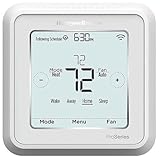
The Lyric T6 Pro TH6220WF2006 is described as a Wi-Fi programmable thermostat for up to 2 heat and 1 cool stages on a heat pump, or 2 heat and 2 cool on a conventional system. It suits a homeowner who prefers a conventional programmable interface with remote access, or who plans to have a contractor install it.
Resideo’s installation documentation states that a C-wire is required, and offers an adapter for four-wire systems. For heat pump wiring, the terminals include O/B for the reversing valve and W2/AUX for backup heat, and the guide says not to connect a wire to the W terminal on heat pumps. It does not work with high-voltage electric baseboard heat or millivolt systems. As an older, programmable design, it is less focused on learning features than the newer thermostats here.
- Heat pump support up to 2 heat and 1 cool stages
- C-wire required
- O/B reversing valve and W2/AUX terminals
- Wi-Fi programmable operation
- Not for baseboard or millivolt heat
Pros
- Familiar installer-grade platform
- Clear wiring documentation
Cons
- Older design
- Smart home details: confirm on listing
Against the X2S, the T6 Pro is the older and more installer-focused option, while the X2S has newer smart home standards.
5. Honeywell Home X2S (Gray) – Best for Matching a Darker Wall

This listing is the same X2S thermostat as the white pick, offered in gray, so the specifications and wiring requirements are identical. It is for buyers who prefer a gray face or have a darker wall where a white thermostat would stand out.
That means the same heat pump support of up to 2 heat and 1 cool stages, the same required C-wire, the same Wi-Fi and Matter details and the same exclusion of high-voltage baseboard heat. Honeywell includes both gray and white accent pieces in the package, so color is mostly a matter of which finish you prefer; confirm what ships with the exact listing you buy.
- Same hardware and software as the white X2S
- Heat pump up to 2 heat and 1 cool stages
- C-wire required
- Wi-Fi with Matter support listed by the maker
- Color finish is the only difference
Pros
- Same dependable feature set in another finish
- Wide smart home support
Cons
- Same C-wire requirement
- Same stage limit
Compared with the white version, there is no functional difference, so choose based on appearance.
6. ecobee Smart Thermostat Essential – Best Overall for Single-Stage Backup Heat

The ecobee Essential is a programmable Wi-Fi thermostat with ENERGY STAR certification and support for Siri, Alexa and Google. It is the best general-purpose pick for the common heat pump with a single stage of backup heat, particularly if you want a polished app and straightforward schedules.
Ecobee lists heat pump compatibility at two heat and one cool stage and says the Essential supports air, water and geothermal heat pumps with one stage of auxiliary heat, as well as dual-fuel systems. It does not support multi-stage heating and cooling, for which ecobee points to its Premium model. The wiring terminals include C, R, G, Y1, OB and W1, and the thermostat is for 24-volt systems only. It needs a common wire, but ecobee sells a Power Extender Kit for homes without one.
- Heat pump up to 2 heat and 1 cool, with one aux stage
- Works with Siri, Alexa and Google
- Power Extender Kit available if no C-wire
- 24-volt systems only
- No support for multi-stage heating or cooling
Pros
- Strong app and broad voice support
- Option for homes without a C-wire
Cons
- Not for multi-stage systems
- Accessory sold separately
Compared with the Sensi ST55, the Essential is simpler and more polished but cannot handle as many stages.
Specs Compared
| Thermostat | Heat pump stages | Power | Smart home | Humidity control |
|---|---|---|---|---|
| Honeywell Home X2S (White) | Up to 2 heat / 1 cool | C-wire required | Matter, Alexa, Google, HomeKit per maker | Humidity display option; confirm on listing |
| Sensi Lite ST25 | Up to 2 heat / 1 cool per maker | C-wire required for heat pumps | Alexa in listing | No |
| Sensi Smart Thermostat ST55 | Up to 4 heat / 2 cool per maker | C-wire required for heat pumps | Alexa in listing | Yes |
| Honeywell Lyric T6 Pro | Up to 2 heat / 1 cool | C-wire required | Confirm on listing | Confirm on listing |
| Honeywell Home X2S (Gray) | Up to 2 heat / 1 cool | C-wire required | Matter, Alexa, Google, HomeKit per maker | Humidity display option; confirm on listing |
| ecobee Smart Thermostat Essential | 2 heat / 1 cool with one aux stage | C-wire or Power Extender Kit | Siri, Alexa, Google | Confirm on listing |
How We Chose These
We started with the six thermostat listings and checked each against the manufacturer’s published compatibility information, focusing on the points that matter specifically to heat pumps: how many compressor and backup heat stages are supported, whether a common wire is required, and which smart home systems are listed. We gave extra weight to products where the maker explicitly states heat pump support rather than generic compatibility. We did not install or measure any of these thermostats, and the gray and white X2S are the same product in different finishes. Where a value is not stated, we say to confirm it on the listing.
What to Look For
Match the thermostat to your stage count
Stages describe how many steps of capacity your equipment can deliver. A single-stage heat pump has one compressor speed and often one stage of electric backup, written as 2 heat and 1 cool: the compressor counts as the first heat stage and the electric strip as the second. Two-stage or variable-speed compressors add more, and a thermostat that cannot control them will leave efficiency on the table or fail to run them correctly. Look at the wires behind the old thermostat: Y1 and Y2 usually indicate two compressor stages, and W2 or AUX indicates backup heat. If you see more terminals than the thermostat supports, choose a model with a higher stage rating.
Reversing valve: O versus B
Heat pumps heat and cool by reversing refrigerant flow, controlled by a reversing valve wired to an O/B terminal. Most brands energize the valve in cooling (an O setting), while some, notably Rheem and Ruud, energize it in heating (a B setting). The thermostat must be set to match, or heating and cooling will be swapped. A good thermostat lets you pick O or B during setup, and your equipment manual will state which one applies.
Auxiliary heat, lockout and balance point
Backup heat uses electric resistance, which is far more expensive to run than the compressor. Thermostats help by limiting when it can start. Aux lockout prevents backup heat above a chosen outdoor temperature, a balance point is the outdoor temperature below which the heat pump alone cannot keep up, and a runtime or temperature-difference rule decides when to bring the strips on. Also avoid large setbacks: if you lower the temperature by six degrees overnight, the system may need backup heat to recover in the morning, which can cost more than it saves. A two to three degree setback is a better rule of thumb.
Power, voltage and system exclusions
All of these are low-voltage 24-volt thermostats. A common wire provides continuous power, and without one you need an adapter or accessory kit. They do not work with line-voltage electric baseboard heaters, and many ductless mini-split systems use their own remote and do not accept a standard wall thermostat at all. If you are unsure, photograph your existing wiring and check the maker’s compatibility checker before you buy.
Wi-Fi, apps and the features that actually matter
For a heat pump, the app features worth caring about are not the flashy ones. Look for a clear display of whether the system is running on the compressor or on backup heat, because that tells you immediately when settings need adjusting. Look for runtime reports that show how many hours the backup strips ran, and for alerts when the system fails to reach the set temperature. Geofencing can lower the setpoint when everyone leaves, but on a heat pump it should be gentle for the same recovery reason described above. Make sure the thermostat connects to the 2.4 GHz band, since several models still do not use 5 GHz, and confirm that your router is within range of the wall location.
Voice assistants and Matter support are useful extras rather than essentials. If you run an Apple Home or Google Home setup, check the exact ecosystem listed by the maker. A thermostat that works with the assistant you already own saves setup time, but none of that affects whether the equipment is controlled correctly, which is the more important question.
Installation checks before you buy
Before ordering, turn off power to the heating and cooling system at the breaker and remove the old thermostat faceplate. Photograph the wire labels, noting the terminal letters rather than just wire colors, since colors are not standardized. Check that there is a wire on C, or a spare wire in the cable that could be used for it. If you only find four conductors, plan on an adapter kit rather than guessing. Look as well at the wall plate: a hole pattern larger than the new thermostat’s body may need a cover plate, and some thermostats include one. Finally, read the equipment manual to confirm whether the reversing valve is O or B and whether the backup heat is electric, gas or a dual-fuel furnace, since dual-fuel systems need extra configuration for the changeover temperature.
If any of this sounds unfamiliar, hiring a licensed HVAC technician for an hour is inexpensive insurance, especially when the existing wiring is old or when a wrong connection could damage the transformer in the air handler. Always follow the manufacturer’s wiring guide, never connect wires to terminals the guide tells you to leave empty, and keep the old wiring photo in case you need to revert.
Worked example: suppose your wall has wires labeled R, C, G, Y, O/B and W2. That points to a single-stage heat pump with a common wire and one backup stage, which suits any of the six thermostats here. If you also see Y2, look at the ST55 first.
Questions
Do all thermostats work with heat pumps?
No. A thermostat must explicitly support heat pump control, including the reversing valve and a separate backup heat stage. A furnace-only model can run the wrong equipment or none at all.
What is emergency heat?
Emergency heat is a manual setting that uses only the backup heat source and bypasses the compressor. It is meant for a failed outdoor unit and is expensive to run, so avoid leaving it on in normal weather.
Do I need a C-wire?
Every thermostat here needs one or an accessory that provides it. If you do not have a spare wire, consider an adapter kit or ask an installer to run a new cable.
Can I install a heat pump thermostat myself?
Many homeowners do, since the process is basically matching labeled wires. Turn off power at the breaker, photograph the old wiring, and choose a model that explicitly supports your configuration.
Will a smart thermostat lower my bills?
It can, by tightening schedules and reducing unnecessary backup heat, but the savings depend on your settings and climate. Avoid large setbacks on heat pumps.
Why does my heat pump blow cool air in winter?
Heat pump air is often lukewarm compared with a furnace, but it should feel warm. Persistent cold air may mean a defrost cycle, a setup error or a fault, so call a technician if it continues.
Update History
- October 20, 2026 – Initial publication; product set drawn from current catalog listings.
- Check the product page for current specifications and availability before buying.
Sources
- Manufacturer product and specification pages for Honeywell Home, Resideo, Sensi by Copeland and ecobee
- Manufacturer installation and wiring documentation for heat pump terminals
- Retailer listing titles and specification fields for each thermostat in this group