Key takeaways
- Compare the best smart telescopes: six app-controlled scopes with specs for aperture, sensor, storage and tracking, plus how to choose one.
If you want a real smart telescope that points itself, tracks the sky and hands you processed images on your phone, the ZWO Seestar S30 Pro is the strongest overall choice in this group, with a 30 mm apochromatic refractor, an 8.3-megapixel color sensor and a second wide-field camera for finding targets. A smart telescope is a small motorized scope with a built-in camera that aligns itself, finds objects automatically and stacks many short exposures into a single image, so you do not need to learn polar alignment or buy a separate camera. The picks below run from a pocket-size beginner scope to a 50 mm premium instrument, plus two generic digital scopes with far less published detail.
Quick List
- DWARFLAB Dwarf Mini – best for travelers who want the lightest app-controlled scope
- ZWO Seestar S30 Pro – best overall for sharp 4K imaging in a compact body
- DWARFLAB Dwarf 3 – best for a dual-lens kit with a wide camera and a larger telephoto aperture
- Smart Digital Telescope with 3-Inch Flip Screen – runner-up for casual family stargazing with an on-device screen
- Auto-Focus Digital Refractor Spotter – runner-up for daytime viewing and a dual-screen spotter
- Vaonis Vespera Pro 2 – best for advanced users who want the biggest aperture and the highest-resolution sensor
Which One Is Right for You?
| If you… | Choose |
|---|---|
| want the best balance of image quality, size and published detail | ZWO Seestar S30 Pro |
| are a serious hobbyist who wants a 50 mm aperture and mosaic mode | Vaonis Vespera Pro 2 |
| need something light enough to drop into a backpack | DWARFLAB Dwarf Mini |
| want a wide-angle camera alongside a telephoto lens | DWARFLAB Dwarf 3 |
| want a screen on the device so a child can look without a phone | Smart Digital Telescope with 3-Inch Flip Screen |
| mostly want daytime scenery and casual night viewing | Auto-Focus Digital Refractor Spotter |
| live under bright suburban skies and want built-in filters | ZWO Seestar S30 Pro |
Decide how much of the hobby you want. If the goal is a few quick pictures of the Moon, planets and bright nebulae from a balcony, a compact scope is plenty. If you plan to spend whole evenings building faint-object images, aperture and sensor size start to matter, and the larger instrument earns its place. Whatever you pick, plan for a steady tripod or table and a phone with a recent operating system.
All 6 Picks in Detail
1. DWARFLAB Dwarf Mini – Best for Travelers Who Want the Lightest Scope
As an Amazon Associate we earn from qualifying purchases at no extra cost to you.

The Dwarf Mini is described in its listing as a 1.85 lb portable astronomy telescope with app control, automatic GOTO, azimuth and equatorial modes and a long exposure option. It suits someone who wants a first smart telescope that can ride in a carry-on, and who values being able to set up in a couple of minutes at a campsite.
Published specifications from the maker and specialist retailers describe a 30 mm f/5 refractor with a 150 mm focal length, a Sony IMX662 sensor producing roughly 2-megapixel (1920 by 1080) frames, a 7000 mAh internal battery good for several hours, 64 GB of storage, and built-in filters including a dual-band option for light-polluted skies. Those numbers mean smaller, softer-looking final images than the 8-megapixel scopes in this group, but excellent portability and a gentler learning curve.
- 30 mm aperture, 150 mm focal length, f/5
- About 2-megapixel telephoto sensor
- Equatorial mode for longer tracked exposures
- Built-in battery and 64 GB storage
- Check whether a tripod is included on the listing
Pros
- Very light and quick to set up
- Approachable for beginners
Cons
- Lower-resolution sensor than the 4K models
- Small aperture limits faint targets
Compared with the Dwarf 3, the Mini trades image resolution and a second lens for a lighter, simpler body.
2. ZWO Seestar S30 Pro – Best Overall for Compact 4K Imaging
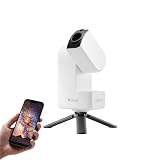
The Seestar S30 Pro is listed as an app-controlled astrophotography scope with a 4K dual camera, auto tracking and GoTo, and one-tap capture and processing. It is the right default for most buyers because it combines a decent aperture, a modern sensor, strong automation and a compact footprint.
ZWO’s specification table describes a 30 mm telephoto aperture with a 160 mm focal length at f/5.3 and a four-element apochromatic design using ED glass, a Sony IMX585 sensor at 8.3 megapixels (3840 by 2160), and a separate wide-angle camera on an IMX586 sensor. Reported extras include built-in UV/IR cut, light-pollution and dark-field filters, 128 GB of internal storage, a 6000 mAh battery rated around six hours, and a weight of roughly 3.6 lb. It uses an alt-azimuth mount and supports an equatorial mode.
- 30 mm aperture, 160 mm focal length, f/5.3
- 8.3-megapixel telephoto sensor plus a wide-angle camera
- Built-in filters including light-pollution and dark-field
- 128 GB internal storage and a battery rated at about six hours
- Tripod or table needed; confirm what ships with the listing
Pros
- High resolution in a small package
- Well-documented specifications
Cons
- Still a 30 mm aperture, so faint objects need patience
- Heavier than the Dwarf Mini
Next to the Dwarf 3, the Seestar has the longer published runtime and filter set, while the Dwarf 3 has a larger telephoto aperture.
3. DWARFLAB Dwarf 3 – Best for a Dual-Lens Kit with a Wider Aperture

The Dwarf 3 is listed as a portable 3 lb astrophotography camera scope with 4K auto-tracking, azimuth and equatorial modes and built-in processing. It suits people who want to photograph both small deep-sky objects and wider scenes without swapping hardware.
Published specifications describe a telephoto lens with a 35 mm aperture and 150 mm focal length at f/4.3, using a Sony IMX678 sensor at 3840 by 2160, together with a separate wide-angle lens of roughly 3.4 mm aperture on a smaller sensor. The telephoto field of view is about 2.9 by 1.7 degrees, the internal battery is about 10,000 mAh, storage is 128 GB, and the scope supports tracked exposures in equatorial mode. A wider aperture gathers more light than the 30 mm scopes, which helps on dim nebulae.
- 35 mm telephoto aperture, 150 mm focal length, f/4.3
- Separate wide-angle camera for framing and sky scenes
- About 10,000 mAh built-in battery
- 128 GB internal storage
- Filter wheel with visual, astro and dual-band options
Pros
- Larger aperture than the Mini and Seestar
- Large battery for long sessions
Cons
- Heavier body
- Maximum exposure lengths vary by mode, so confirm them
Against the Vespera Pro 2, the Dwarf 3 is far easier to carry, while the Vespera offers a bigger aperture and much higher resolution.
4. Smart Digital Telescope with 3-Inch Flip Screen – Runner-Up for Casual Family Stargazing

This unbranded listing is aimed at adults, kids and beginners, and describes a 4K digital electronic astrophotography telescope with a 3-inch flip screen, app and remote control, and a 64 GB card. Treat it as a runner-up: it is a digital-camera-style scope, and the listing does not publish the aperture, focal length, sensor model or tracking method that would let us compare it fairly with the named smart telescopes above.
It is appealing because a built-in screen means you can show the Moon to a child without handing over a phone. Before buying, confirm the optical aperture, whether the mount is motorized with automatic tracking and GoTo, how images are stored and exported, and what the 4K claim refers to. Without motorized tracking, long-exposure deep-sky imaging will not be practical.
- 4K digital imaging claimed in the listing
- 3-inch flip screen on the device
- App and remote control
- 64 GB storage card named in the listing
- Aperture, focal length, tracking and GoTo: confirm on listing
Pros
- On-device screen is friendly for kids
- Storage card is part of the package
Cons
- Optical specifications are not published in the listing
- Likely not a substitute for a tracked, stacking smart scope
Compared with the Auto-Focus Digital Refractor, this one leans toward night viewing and kids, while that one leans toward a spotter-style daytime tool.
5. Auto-Focus Digital Refractor Spotter – Runner-Up for Daytime and Casual Night Viewing

This listing calls itself a professional auto-focus digital refractor smart telescope with a 4K astrophotography camera and a dual-screen portable spotter design. The wording points to a hybrid spotting scope rather than a motorized astronomy instrument, so we place it as a runner-up and ask you to read the product page carefully.
A spotter-style digital scope can be useful for birds, distant scenery and casual views of the Moon, and an auto-focus camera removes fiddly focusing. However, nothing in the listing name states a motorized mount, automatic alignment, star tracking or image stacking, which are the features that define a smart telescope. If you want deep-sky astrophotography, one of the named scopes above is a safer match.
- Auto-focus digital refractor design
- 4K camera claimed in the listing
- Dual screens for a portable spotter format
- Aperture, magnification and mount type: confirm on listing
- GoTo, tracking and stacking: confirm on listing
Pros
- Auto-focus is easy to use
- Portable format suits daytime and casual use
Cons
- Not clearly a tracking astronomy scope
- Few verifiable optical details
Compared with the flip-screen scope, this is a better fit for daytime spotting, while the flip-screen model is aimed more at stargazing with kids.
6. Vaonis Vespera Pro 2 – Best for Advanced Users Who Want a 50 mm Aperture

The Vespera Pro 2 is the premium option, listed with a 12.5-megapixel square sensor, a 50-megapixel mosaic mode, signal enhancement and full manual control. It suits an experienced hobbyist who wants more control and resolution than the compact scopes offer, and who is willing to carry a bigger kit.
Vaonis and retailer specifications describe a 50 mm apochromatic quadruplet refractor with a 245 mm focal length at roughly f/4.9, a Sony IMX676 sensor at 3536 by 3536 pixels with 2 micron pixels, a 1.6 by 1.6 degree native field of view, about 225 GB of internal storage and a battery quoted at up to 11 hours of imaging. Mosaic mode stitches panels into very large images, which is where the square sensor shines.
- 50 mm aperture, 245 mm focal length, f/4.9
- 12.5-megapixel square sensor with a 50-megapixel mosaic mode
- About 1.6-degree native field of view
- Roughly 225 GB internal storage
- Battery quoted at up to 11 hours
Pros
- Largest aperture and sensor in the group
- Manual controls for experienced users
Cons
- Bigger and heavier to move
- More scope than a first-time buyer needs
Compared with the Seestar S30 Pro, it has twice the nominal aperture and a bigger sensor, while the Seestar is much more portable.
Specs Compared
| Telescope | Aperture | Focal length | Sensor | Storage | Control |
|---|---|---|---|---|---|
| DWARFLAB Dwarf Mini | 30 mm | 150 mm, f/5 | Sony IMX662, about 2 MP | 64 GB per maker | App, GOTO, AZ/EQ modes |
| ZWO Seestar S30 Pro | 30 mm | 160 mm, f/5.3 | Sony IMX585, 8.3 MP | 128 GB per maker | App, auto tracking and GoTo |
| DWARFLAB Dwarf 3 | 35 mm telephoto | 150 mm, f/4.3 | Sony IMX678, 8.3 MP | 128 GB per maker | App, auto tracking, AZ/EQ modes |
| Smart Digital Telescope with 3-Inch Flip Screen | Confirm on listing | Confirm on listing | 4K claimed; model confirm on listing | 64 GB card named | App and remote; tracking confirm on listing |
| Auto-Focus Digital Refractor Spotter | Confirm on listing | Confirm on listing | 4K claimed; model confirm on listing | Confirm on listing | Auto-focus; tracking confirm on listing |
| Vaonis Vespera Pro 2 | 50 mm | 245 mm, f/4.9 | Sony IMX676, 12.5 MP | About 225 GB per maker | App with full manual control |
How We Chose These
We began with the six listings in this group and compared them using what each listing says and what the manufacturers and specialist astronomy retailers publish about aperture, focal length, sensor, storage and control. We favored scopes that clearly describe automatic tracking and GoTo, because those features define the category, and we gave more weight to products with verifiable optical numbers. Two generic listings with very little published detail are placed as runners-up with an explicit note to confirm the basics. We did not carry out our own measurements or image comparisons, and we state “confirm on listing” wherever a value is not given.
What to Look For
Aperture, focal length and what they mean
Aperture is the diameter of the main lens and controls how much light the scope collects. A 30 mm scope is fine for the Moon, planets and bright objects such as the Orion Nebula, while a 50 mm scope collects nearly three times the light, since light gathering grows with the square of the diameter (50 squared is 2,500 versus 900 for 30 mm). Focal length sets the field of view: around 150 to 160 mm gives a wide, forgiving view of about 2 to 5 degrees, while 245 mm frames smaller objects more tightly. The ratio of the two, the f-number, tells you how quickly the scope gathers light; lower is faster.
Sensor size and resolution
A smart telescope is only as good as its camera. A 2-megapixel sensor is enough for a satisfying first image but crops out detail, while an 8.3-megapixel 4K sensor records far more of the object. Larger sensors, such as the 1/1.2-inch type in some scopes, collect more light per frame. Square sensors, as in the premium scope, suit mosaic work because panels tile neatly. Pay attention to whether images are saved as processed pictures or as raw stacked files, because that decides how much editing you can do later.
Tracking, GoTo and alignment
Look for plate solving, which identifies your location in the sky by comparing a photo with a star database, because it removes manual alignment. Alt-azimuth mounts are simple, but over long exposures the field slowly rotates, so equatorial mode, which tilts the mount to match the sky’s rotation, allows longer exposures with less rotation. If a listing does not mention tracking, assume it is not motorized.
Light pollution, filters and safety
City skies wash out faint nebulae. Built-in dual-band filters, which pass the hydrogen-alpha and oxygen-III wavelengths emitted by many nebulae, help considerably. Never point any telescope at the Sun unless it has a certified solar filter fitted over the front of the lens; unfiltered sunlight can cause permanent eye injury and damage the camera. Check that a solar filter is actually included and certified before using it for solar viewing.
Power, storage, app and Wi-Fi behavior
Every smart telescope depends on its app, so the connection method matters. Most create their own Wi-Fi network that your phone joins directly, which keeps the scope working in a field with no internet but means your phone briefly loses normal data access. Some also let you join the scope to a home network, which is convenient in a backyard. Storage is the other practical limit: a stacked 4K image can be tens of megabytes, but saving every raw frame for later processing can fill 64 GB in a handful of sessions. Plan to offload files after each night, and confirm that the app can export to your phone or a computer without a paid add-on.
Battery capacity is quoted in milliamp-hours, but what you actually care about is runtime at the temperature you will use it. Lithium cells lose capacity quickly below freezing, so a scope rated for six hours may give noticeably less on a cold autumn night. A scope that can run from a USB power bank while mounted is a practical advantage, and it is worth checking whether the listing mentions external charging during use.
Setting up your first night
Choose a spot with a clear view of the part of the sky you want and as little direct light as possible, such as a dark corner of a yard away from porch lights. Level the tripod, power on the scope, let it connect to your phone, and run the automatic alignment, which typically takes a minute or two. Start with the Moon or a bright planet to confirm focus and framing, then move to a bright nebula or cluster and let the stack build for 10 to 20 minutes. Check the sky forecast for transparency as well as clouds, because humid or hazy nights reduce contrast even when no clouds are visible.
Keep expectations realistic. The Moon and planets will look best at the scope’s native resolution, while nebulae need minutes of accumulated exposure and will look soft at first. Most satisfaction comes from repeating the same target on several nights and watching the detail improve as you learn the controls.
Worked example: if you live in a suburb and want to photograph a nebula, a 30 mm scope with a dual-band filter and a 60-second exposure per frame, stacked over an hour, will show more than a single long frame ever could. That is why a small aperture can still produce good results with a patient plan.
Questions
Do I need a tripod for a smart telescope?
Yes, a stable base is essential, whether a photo tripod, a heavier astronomy tripod or a sturdy table. Check whether the listing includes one, because some scopes ship without a tripod.
Can I use a smart telescope in a city?
Yes, especially with a light-pollution or dual-band filter. You will see the Moon and planets easily, and bright nebulae and clusters are possible, but faint galaxies will be harder.
How long does the battery last?
Makers quote roughly four to eleven hours for the scopes with published figures here. Cold weather shortens battery life, so keep a USB power bank handy.
Is a generic digital telescope the same as a smart telescope?
Not necessarily. A smart telescope combines motorized tracking, automatic alignment and image stacking, while many digital scopes simply add a camera and a screen. Read the listing for a motorized mount and GoTo.
What can I photograph with a 30 mm scope?
Bright targets such as the Moon, Jupiter, Saturn, the Orion Nebula and the Pleiades are realistic. Fainter galaxies are possible with longer stacking from a dark site.
Is it safe to look at the Sun?
Only with a certified solar filter that is firmly attached to the front of the lens. Never view the Sun through the scope or the screen without one.
Update History
- October 20, 2026 – Initial publication; product set drawn from current catalog listings.
- Check the product page for current specifications and availability before buying.
Sources
- Manufacturer product and specification pages for ZWO, DWARFLAB and Vaonis
- Specialist astronomy retailer specification tables and published product coverage
- Retailer listing titles and specification fields for each scope in this group