
Key takeaways
- Use the lower end of the manufacturer’s range for a fully insulated basement cellar with a solid, well-sealed door.
- Reduce the assumed coverage when the room has exterior walls, a garage location, a ceiling below a hot attic, or a large glass door.
- Allow extra capacity for frequent door opening and newly loaded wine.
- Do not compensate for inadequate insulation by buying the biggest available unit; the system may short-cycle and control humidity poorly.
Best Wine Cellar Cooling Units for Every Space
The best wine cellar cooling unit is the one sized for your room’s heat load—not simply its floor area—while also fitting your venting, noise, humidity, and installation constraints.
Quick picks by cellar situation
| Cellar situation | Best unit type | Typical capacity | Why it fits | Main compromise |
|---|---|---|---|---|
| Small, insulated closet up to about 500 cubic feet | Through-wall self-contained unit | 1,500–2,500 BTU/h | Lower purchase and installation cost; simple controls | Compressor and fan noise reach the cellar or adjacent room |
| Medium cellar around 500–1,000 cubic feet | Quiet through-wall unit or compact split system | 2,500–5,000 BTU/h | Good balance of capacity, serviceability, and cost | Requires careful hot-air exhaust planning |
| Living-area installation or noise-sensitive home | Split system | 3,000–8,000 BTU/h | Compressor can be located remotely; less vibration indoors | Higher installation complexity and refrigerant-line work |
| Warm room, glass door, poor insulation, or frequent access | Oversized commercial-style or high-capacity system | 5,000–10,000+ BTU/h | Handles higher heat gain and recovery demand | More cost, noise, and potential short-cycling if oversized |
Best wine cellar cooling units compared
Best compact through-wall choice: 2,000–2,500 BTU/h class
For a properly insulated cellar of roughly 200–500 cubic feet, a unit such as the WhisperKOOL SC-2000i, CellarCool CX2200, or Breezaire WKL-2200 is the appropriate starting point. These systems are commonly rated around 2,000–2,200 BTU/h, although the usable room size varies with ambient temperature, wall construction, door area, and desired set point.
Our top picks


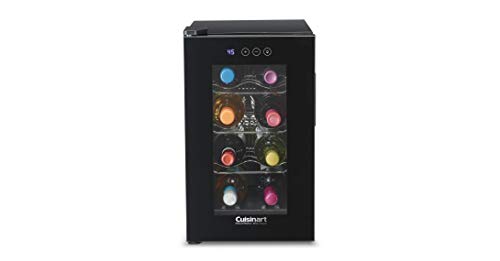
As an Amazon Associate we earn from qualifying purchases at no extra cost to you. Ratings are shown as listed on Amazon.
These units install through a wall and reject heat into an adjoining room. They are practical for a basement closet, under-stair wine room, or converted pantry where the exhaust side has plenty of air space. They are less suitable for a sealed cupboard or a small utility room that can become hot.
Expect roughly 50–65 pounds for many units in this class, with a sound level often in the mid-50-decibel range depending on the model and installation. That is audible in a quiet room. A solid mounting frame, rubber isolation pads, and a louvered exhaust grille can reduce vibration, but they cannot eliminate compressor noise.
Best for a medium cellar: 3,000–5,000 BTU/h
A medium cellar with 500–1,000 cubic feet of volume generally needs more than a compact closet cooler, particularly if it has a glass door or borders a warm garage. Wine Guardian D025 and D050 systems are established examples of ducted or split-oriented equipment in this broader capacity category; exact ratings and configurations depend on the selected model and installation arrangement.
A larger through-wall system can work when the hot side vents into a spacious basement or mechanical room. Choose a split configuration instead when that room is occupied, already warm, or separated from the cellar by a long wall. Split systems move the condensing section away from the bottle room, which usually improves acoustics and gives more freedom over the evaporator location.
Do not compare BTU numbers without checking rating conditions. A rating measured at a relatively mild ambient temperature may not represent performance when the exhaust room reaches 90°F. Look for the manufacturer’s maximum ambient temperature, airflow requirements, condensate instructions, and recommended cellar volume at your actual conditions.
Best premium option for quiet rooms: split cooling
Split systems are the strongest choice when the cellar is beside a dining room, bedroom, office, or entertainment area. The evaporator remains near the bottles while the condensing unit sits in a garage, mechanical room, attic, or outdoors where permitted by the manufacturer. Wine Guardian offers dedicated wine-cellar split systems, including the D025 and larger D050/D088 product families.
The advantage is not merely lower noise. A split arrangement also avoids dumping several thousand BTU/h into the room on the other side of a cellar wall. It can support ducting, making it easier to distribute cool air evenly and hide the equipment. The disadvantages are higher installed cost, refrigerant-line routing, condensate management, and the need for qualified installation.
How to size a wine cellar cooling unit
Start with volume:
Length × width × height = cubic feet.
For example, a 10 × 8 × 8-foot room equals 640 cubic feet. That number alone is not enough. Add heat-load factors:
- Use the lower end of the manufacturer’s range for a fully insulated basement cellar with a solid, well-sealed door.
- Reduce the assumed coverage when the room has exterior walls, a garage location, a ceiling below a hot attic, or a large glass door.
- Allow extra capacity for frequent door opening and newly loaded wine.
- Do not compensate for inadequate insulation by buying the biggest available unit; the system may short-cycle and control humidity poorly.
As a practical example, suppose a manufacturer lists a 2,200-BTU/h unit for up to 650 cubic feet under favorable conditions. A 640-cubic-foot room with two exterior walls, a glass door, and a 90°F adjoining space should not be treated as an ideal 650-cubic-foot installation. A 3,000–5,000-BTU/h system, improved insulation, or a professional heat-load calculation may be more appropriate.
Through-wall versus split installation
| Factor | Through-wall | Split |
|---|---|---|
| Typical installed complexity | Low to moderate | Moderate to high |
| Typical equipment cost range | About $1,200–$3,500 | About $2,500–$7,000 or more |
| Noise inside cellar | Usually audible | Usually lower, depending on evaporator fan and ducting |
| Heat rejected into adjacent room | Yes | Usually no, if the condenser is remote |
| Service access | Generally simple from the wall opening | More components and refrigerant connections |
For either design, verify that the unit has the required clearance on both sides. A through-wall cooler may need several inches around the intake and exhaust, while a split condenser may require substantial open space for airflow. Never place the hot exhaust in a sealed closet without a return-air path and ventilation.
Humidity control: what the cooler can and cannot do
Wine cellar systems typically aim for a stable temperature around 55°F, with humidity often maintained in the broad 50–70% range. Cooling alone does not guarantee that range. A very well-sealed cellar in a dry climate may need a separate humidifier; a damp basement may require drainage or dehumidification.
Condensation is normal when warm, moist air enters a cold room. Install the drain according to the manual, use a trapped line where specified, and make sure the outlet cannot back up into insulation or finished walls. A condensate pump may be necessary when gravity drainage is impossible.
Ownership costs and maintenance
The parts most likely to demand attention are filters, condenser coils, fan motors, drain lines, and door seals. Dust on the condenser coil raises operating temperature and can shorten compressor life. Inspect and clean the coil at least annually, or more often in a dusty garage. Clean reusable filters according to the manual rather than fitting a restrictive household filter that reduces airflow.
- Keep the exhaust room below the unit’s specified maximum ambient temperature.
- Check the cellar temperature with an independent thermometer rather than relying only on the controller display.
- Inspect the drain for algae, kinks, and standing water.
- Seal gaps around the door, framing, and cable penetrations.
- Leave clearance around bottle racks so supply and return air can circulate.
Replacing a filter or clearing a drain is inexpensive; compressor or refrigerant repairs are not. A unit that runs continuously, cycles every few minutes, or cannot reach its set point may be incorrectly sized, starved for airflow, or exposed to excessive heat—not necessarily defective.
Final buying recommendation
Choose a 2,000–2,500-BTU/h through-wall cooler for a small, well-insulated cellar where moderate fan noise is acceptable. Move to a 3,000–5,000-BTU/h system for medium rooms or warmer surroundings. Choose a split wine cellar system when the condenser’s heat and noise would affect a living space, or when ducting and installation flexibility justify the added cost. Before purchasing, calculate room volume, inspect the insulation and door, measure the exhaust location, and compare the unit’s rating at your actual ambient temperature.


