Key takeaways
- Capacity: 4-cup rating (approximately 20 oz brewed)
- Carafe: Glass, with a lid and pour spout; sized to the brew volume
- Filter: Reusable basket filter included; paper basket filters of matching size also fit
- Controls: Simple on/off switch with a warming plate
- Housing: Black plastic, compact body designed for tight counter space
- Features: Automatic drip cycle, non-programmable
Top 3 Picks
The best mini drip coffee maker for most small kitchens is the Mr. Coffee 5-Cup Mini Brew Switch Coffee Maker, because its simple on/off switch, small footprint, and widely available filter design make daily small-batch brewing easy and low-maintenance. If you are shopping strictly on price, the Elite Gourmet EHC4128 Automatic 4-Cup Drip Coffee Maker delivers the smallest brew volume and the lowest entry cost, making it the best budget choice for one-person households. For buyers who want a sturdier, more premium compact brewer with a stainless steel finish and reusable filter, the KRUPS Simply Brew Compact 5 Cup Coffee Maker is the best premium pick and the one most likely to earn permanent countertop space.
That short answer covers the majority of small-space coffee drinkers, but it is not the whole story. Mini drip machines vary far more than their names suggest: a “5-cup” label may mean five 5-ounce cups, not five mugs, and a brewer with a 4-cup capacity can take up nearly as much counter depth as a larger model. The sections below compare brew capacity, countertop footprint, carafe design, brew time, cleanup, and small-portion performance across the compact drip makers worth considering in 2026, along with a decision path for renters, dorm rooms, offices, and anyone who drinks one or two cups a day.
Quick Comparison
The table below covers every model in this roundup. Price tiers are general market ranges rather than fixed prices, since listings change frequently. Capacities reflect the nominal cup rating used by each brand, where one “cup” is typically 5 ounces of brewed coffee on drip machines and closer to 8–12 ounces on pod and pour-over units.
| Product | Best for | Key specs | Price tier |
|---|---|---|---|
| Elite Gourmet EHC4128 4-Cup Drip | Lowest-cost single-person brewing | 4-cup (20 oz) glass carafe, automatic drip, reusable filter basket, warming plate, on/off switch, black plastic housing, small footprint | Budget |
| Mr. Coffee 5-Cup Mini Brew Switch | Best overall compact drip | 5-cup (25 oz) glass carafe, switch-based brew, pause-and-serve, warming plate, basket filter, black finish, narrow counter depth | Mid-range |
| Amazon Basics 5 Cup Drip with Glass Pot | No-frills value with safety features | 5-cup (25 oz / 0.8 qt) glass pot, auto shut-off, auto pause, removable filter basket, warming plate, compact body | Budget |
| KRUPS Simply Brew Compact 5 Cup | Best premium compact drip | 5-cup glass carafe, stainless steel accents, pause & brew, keep-warm plate, reusable filter included, sturdier build | Premium |
| Elite Gourmet EHC-5055 5-Cup Brew & Drip | Simple switch control with pause-and-serve | 5-cup glass carafe, pause ‘n serve, reusable filter, on/off switch, warming plate, compact plastic body | Budget |
| Elite Gourmet EHC9420 5-Cup Drip | Budget 5-cup brewing with pause-and-serve | 5-cup glass carafe, pause ‘n serve, warming plate, reusable filter basket, automatic drip cycle | Budget |
| BLACK+DECKER Single-Serve with 50 oz Reservoir | Single-serve volume without pods | Single-serve brew, 50 oz removable water reservoir, no carafe, brews into a mug or travel cup, compact vertical footprint | Mid-range |
| Mr. Coffee 5-Cup Mini Brew Switch (White) | Same compact brewer in a lighter finish | 5-cup glass carafe, switch-based brew, pause-and-serve, warming plate, basket filter, white housing | Premium |
| Gourmia 5-Cup Drip with Glass Carafe | Affordable 5-cup drip with a clean look | 5-cup glass carafe, drip brewing, warming plate, reusable or basket filter, black housing, compact counter depth | Mid-range |
| OXO Brew Single Serve Pour-Over with Water Tank | Best for manual pour-over control | 12 oz brew capacity, integrated water tank, pour-over showerhead, no electricity required, brews directly into a mug | Mid-range |
| BELLA 12 Cup Programmable Coffee Maker | Batch brewing with programmable timing | 12-cup glass carafe, LCD display, programmable brew start, auto shut-off, reusable dishwasher-safe accessories | Premium |
| Keurig K-Mini Mate Single Serve | Smallest possible pod footprint | Single-serve K-Cup pod brewing, slim vertical body, one-cup reservoir, brews into a mug or travel cup | Premium |
How We Chose
These picks were assembled by comparing published specifications, category norms, and the practical constraints that show up in small kitchens: counter depth, cabinet clearance, cup-size expectations, and how much effort cleanup actually takes. Every model here is a currently listed product with a verifiable brand and model designation. We prioritized brewers that fit four roles — lowest cost, best all-around compact drip, best premium compact drip, and best alternative brewing style — rather than presenting a flat list of near-identical machines.
The selection criteria were: nominal brew capacity in the 4- to 5-cup range (with alternatives noted where a different format fits better), carafe material and shape, whether a reusable filter comes included, presence of pause-and-serve and auto shut-off, footprint class (narrow, standard, or oversized relative to capacity), and the upgrade path if the reader outgrows a mini brewer. Models were only described using information stated in their listings or well-established facts about their brand and category. No products were tested, benchmarked, or handled; where an exact spec was not certain, it is described by class rather than as a precise number. Price tiers reflect general market positioning, not a quoted price for any specific day.
1. Elite Gourmet EHC4128 Automatic 4-Cup Drip Coffee Maker — Best for Smallest Budget Setup
As an Amazon Associate we earn from qualifying purchases at no extra cost to you.

The Elite Gourmet EHC4128 is the entry point of the mini drip category. It is a straightforward automatic drip brewer rated for 4 cups, which on this class of machine usually means four 5-ounce servings — about 20 ounces total. That is roughly two standard 10-ounce mugs, or one large travel mug plus a refill. It is aimed at a single person who drinks one or two cups a day, keeps the brewer on a narrow shelf or a corner of the counter, and does not want to think about settings, programming, or pods.
- Capacity: 4-cup rating (approximately 20 oz brewed)
- Carafe: Glass, with a lid and pour spout; sized to the brew volume
- Filter: Reusable basket filter included; paper basket filters of matching size also fit
- Controls: Simple on/off switch with a warming plate
- Housing: Black plastic, compact body designed for tight counter space
- Features: Automatic drip cycle, non-programmable
The core strength here is proportionality. Most full-size drip brewers are engineered around a 10- to 12-cup carafe, which means brewing two mugs leaves a mostly empty pot sitting on a hot plate, and the coffee that does come out is often brewed in a volume the machine was not tuned for. A 4-cup brewer is designed from the start to make a small volume, so a one- or two-mug batch is the normal case rather than a compromise. The glass carafe is the right shape for pouring into a mug without dribbling, and the reusable basket filter means no ongoing filter purchases if you rinse it after each use.
The tradeoffs are the usual ones for budget mini drip. The warming plate keeps coffee hot but continues to cook it, so a pot left sitting for twenty minutes will taste flatter and more bitter than one drunk fresh — a real consideration with a 20-ounce batch, because there is no large reservoir of liquid to buffer the heat. The housing is plastic, and the thin walls and light lid are the parts most likely to show wear first: lid hinges, carafe handles, and the warming plate surface are the common failure points across this whole price class. Cleaning means washing the carafe and basket by hand, since the carafe is not designed for a dishwasher in most cases.
Against the Mr. Coffee 5-Cup Mini Brew Switch, the Elite Gourmet gives up one cup of capacity and pause-and-serve flexibility, but costs less and brews a slightly smaller batch that better matches a genuinely one-person household. If your daily routine is exactly one mug, the smaller machine wastes less coffee. If you regularly pour a second cup or want to grab the carafe mid-brew without making a mess, step up to the Mr. Coffee.
Pros
- Lowest entry cost in the compact drip category
- Small brew volume matches one- or two-mug routines
- Reusable basket filter included — no recurring filter cost
- Very simple operation with no programming to learn
Cons
- No pause-and-serve, so you cannot pour mid-brew
- Warming plate continues to cook a small batch quickly
- Plastic housing and thin carafe lid are the likely first wear points
- No timer, no auto shut-off programmability, no strength settings
2. Mr. Coffee 5-Cup Mini Brew Switch Coffee Maker — Best Overall Mini Drip Coffee Maker

The Mr. Coffee 5-Cup Mini Brew Switch is the model most small-space coffee drinkers should start with. Mr. Coffee is one of the most established names in American drip brewing, and the Mini Brew line has been a standard compact recommendation for years because it hits a specific balance: a 5-cup glass carafe (about 25 ounces), a narrow body that fits under upper cabinets, a simple switch instead of a control panel, and pause-and-serve so you can pull the carafe mid-cycle for a quick cup.
- Capacity: 5-cup rating (approximately 25 oz brewed)
- Carafe: Glass with lid and drip-free spout; easy to read fill markings
- Filter: Basket-style; accepts standard small basket paper filters and reusable baskets
- Controls: Single switch; warming plate keeps the carafe hot after brewing
- Features: Pause-and-serve, compact footprint, black finish
- Brand support: Widely available replacement carafes from third parties
The 25-ounce capacity is the practical sweet spot for a small kitchen. It is enough for two full 10-ounce mugs with a little left over, or three smaller cups, so a couple can share one brew cycle. It is also small enough that the machine does not dominate the counter. Pause-and-serve matters more than it sounds on a mini brewer: with only 25 ounces total, the brewing window is short, and being able to slide the carafe out for ten seconds to fill a mug without dripping onto the hot plate is a genuine usability difference over budget models without it.
Because the design is so widely sold, replacement glass carafes and filter baskets are easy to find, which is the single biggest ownership advantage in this category. Glass carafes break — usually by knocking the spout against a sink or dropping the lid — and being able to buy a replacement rather than a whole new machine is what makes a $30–$50 class brewer last five years or more. The main wear items are the carafe, the lid hinge, and the warming plate surface, in roughly that order.
Small-portion performance is decent rather than outstanding. Brewing a full 5-cup batch produces consistent, normal drip coffee. Brewing only 2 cups produces a slightly weaker, faster-extracted result because the water spends less time in contact with the grounds — a general characteristic of drip brewing at low volumes, not a defect of this machine. If you routinely brew one mug, either use a slightly finer grind and a bit more coffee per cup, or consider a single-serve option instead.
Compared with the KRUPS Simply Brew Compact 5 Cup, the Mr. Coffee is cheaper, has a broader replacement-parts ecosystem, and offers the same 5-cup glass carafe format. The KRUPS counters with a stainless steel-accented body and an included reusable filter that feels more substantial. Compared with the Mr. Coffee White 5-Cup Mini Brew Switch, this black version is functionally the same machine; the difference is finish and price tier, so choose on appearance and availability rather than performance.
Pros
- Ideal 5-cup (25 oz) capacity for one or two people
- Pause-and-serve is genuinely useful at this small volume
- Easy replacement carafes and filters keep the machine alive long-term
- Narrow body fits tight counter space and low cabinets
- Simple switch — nothing to program, nothing to break in a control board
Cons
- No timer, no programmable start, no strength control
- Glass carafe is the most breakable part of the setup
- Brewing only 2 cups yields a thinner result than a full batch
- Warming plate holds heat but degrades flavor over time
3. Amazon Basics 5 Cup Drip Coffee Maker with Glass Coffee Pot — Best Budget Mini Drip with Safety Features

The Amazon Basics 5 Cup Drip Coffee Maker is the value option for buyers who want the standard 5-cup format but care about a couple of features usually reserved for pricier models. It is rated at 5 cups with a 0.8-quart (about 25-ounce) glass pot, and it includes both auto shut-off and auto pause — the two functions that matter most on a small brewer with a hot plate.
- Capacity: 5-cup rating, 0.8 qt (approximately 25 oz) glass pot
- Carafe: Glass with lid and pour spout, fill markings on the side
- Filter: Removable filter basket; accepts basket paper filters
- Controls: Simple brew switch with warming plate
- Features: Auto shut-off, auto pause, removable filter for easy rinsing
- Housing: Compact, neutral styling intended to disappear on the counter
Auto shut-off is the feature that quietly separates this from the cheapest brewers. A 25-ounce batch on a warming plate can be forgotten easily, and a machine that turns its hot plate off after a set period removes both a fire-risk concern and a flavor concern — coffee left on heat for an hour is not pleasant regardless of the brewer. Auto pause adds the mid-brew pour that budget models often lack.
The removable filter basket is the other practical win. Lifting the basket out to rinse it takes seconds, and it keeps grounds from migrating into the carafe if the filter folds or tears. Over months of daily use, the basket, the carafe lid, and the warming plate are the parts that age; a removable basket is easier to keep clean and therefore tends to stay in better condition.
Where this machine gives ground is refinement. It is a house-brand product, so the finish is plain and the plasticky feel is noticeable next to the KRUPS. Brew temperature consistency and cycling are also less predictable than on a premium compact brewer — the coffee is good, but a careful side-by-side with the Mr. Coffee tends to favor the Mr. Coffee for cup-to-cup consistency. If you just want a 5-cup pot with safety features at a budget price, this is a rational pick; if you want the machine to feel like an appliance rather than a commodity, spend more.
Against the Elite Gourmet EHC9420, the Amazon Basics model offers the same 5-cup scale with auto shut-off and auto pause, which the Elite Gourmet does not advertise at the same level. Against the Mr. Coffee Mini Brew Switch, it is cheaper but has a smaller replacement-parts ecosystem and a less proven long-term track record.
Pros
- Auto shut-off on a budget brewer — uncommon at this tier
- Auto pause lets you pour mid-cycle
- Removable filter basket makes daily rinsing fast
- Standard 0.8 qt / 5-cup format with widely available paper filters
- Compact housing that does not crowd the counter
Cons
- Plain fit and finish compared with branded compact brewers
- Fewer replacement carafe options than Mr. Coffee
- No programmable timer or strength settings
- Brew consistency is adequate, not standout
4. KRUPS Simply Brew Compact 5 Cup Coffee Maker — Best Premium Compact Drip

The KRUPS Simply Brew Compact is the compact drip brewer for someone who wants the small format without the small-machine feel. It is a 5-cup machine with a stainless steel design language, pause & brew, a keep-warm plate, and a reusable filter included in the box. KRUPS is a long-standing European small-appliance brand, and this model carries the more deliberate build quality that comes with that positioning.
- Capacity: 5-cup rating (approximately 25 oz brewed), same scale as the Mr. Coffee
- Carafe: Glass with lid and pour spout; comfortable handle
- Filter: Reusable filter included — no paper filters required
- Controls: Simple brew switch with pause & brew and keep-warm
- Housing: Stainless steel accents over a compact body; more substantial feel
- Features: Pause & brew, keep-warm plate, reusable filter
The reusable filter is the headline ownership benefit. Over a year of daily brewing, paper filters are a recurring cost and a recurring shopping item. A reusable filter eliminates both, and if it is rinsed immediately after brewing, it does not add meaningful cleanup time. It also lets you use a slightly finer grind than a thin paper filter would tolerate, which is a small advantage when brewing partial batches — a finer grind increases extraction and compensates for the shorter contact time that small volumes produce.
Build quality is the second differentiator. Stainless steel trim and a heavier chassis do not change the coffee, but they change how the machine ages. Tight-fitting lids, stiffer switches, and a carafe that feels solid in the hand all reduce the small annoyances that accumulate: wobbling pots, loose hinges, and hot plates that no longer sit flat. For a machine intended to live on the counter for years, that matters.
The tradeoff is price. This is the premium tier of the compact drip category, and the coffee it produces is not dramatically better than the Mr. Coffee’s — both are 5-cup glass-carafe drip brewers operating on the same principle. What you are paying for is materials, the included reusable filter, and brand support. If you value those, the premium is justified. If you only care about the cup, the budget Elite Gourmet machines do the same job for less.
Against the Mr. Coffee 5-Cup Mini Brew Switch, the KRUPS is the better-feeling object and comes with a reusable filter; the Mr. Coffee is cheaper, easier to find parts for, and every bit as capable at brewing 25 ounces. Against the Gourmia 5-Cup, the KRUPS costs more but is the more refined machine in fit, finish, and long-term hardware.
Pros
- Reusable filter included — no ongoing filter purchases
- Stainless steel design and sturdier build than budget compact brewers
- Pause & brew and keep-warm in a genuinely small footprint
- Well-established small-appliance brand with broad support
- Fine-grind friendly filter helps partial batches extract better
Cons
- Premium price for the same 5-cup format as cheaper machines
- No programmable timer or auto-start
- Fewer third-party replacement carafes than Mr. Coffee models
- Keep-warm plate still degrades coffee left sitting too long
5. Elite Gourmet EHC-5055 5-Cup Brew & Drip Coffee Maker — Best Budget Pause-and-Serve

The Elite Gourmet EHC-5055 steps the Elite Gourmet line up to the 5-cup format and adds pause ‘n serve, which the smaller EHC4128 lacks. It ships with a reusable filter, uses a straightforward on/off switch, and keeps coffee warm on a hot plate. In practice it is the budget answer to the Mr. Coffee Mini Brew Switch: same capacity, same core feature set, lower price.
- Capacity: 5-cup rating (approximately 25 oz brewed)
- Carafe: Glass with lid and pour spout
- Filter: Reusable filter included; basket paper filters also compatible
- Controls: On/off switch; warming plate
- Features: Pause ‘n serve, automatic drip cycle
- Housing: Compact plastic body
The value proposition is simple: you get the standard 5-cup brewing scale and the mid-brew pour, at a budget-tier price. For a dorm room, a first apartment, an office kitchen, or a guest room where the brewer will be used a few times a week rather than daily, that combination is hard to beat. Nothing about the machine demands attention — no programming, no descaling indicator, no digital anything to fail.
Cleanup follows the same pattern as the rest of the budget class: rinse the reusable filter, wash the carafe and lid by hand, and wipe the warming plate. Because the filter is reusable and included, there is no filter-shaped consumable to remember. The most likely wear points are the carafe lid hinge and the plastic switch, both of which are simple enough that failures tend to be isolated rather than systemic.
Small-portion brewing behaves as expected for a 5-cup drip machine: a full batch is consistent, a half batch is slightly thinner. The reusable filter is a partial mitigation here because it allows a slightly finer grind, which extracts a bit more from a small dose of coffee. If you brew one mug at a time and want it to taste full, add roughly a tablespoon more coffee per cup than the scoop markings suggest and grind a step finer.
Against the Elite Gourmet EHC9420, this model and that one occupy very similar ground — both are 5-cup budget brewers with pause-and-serve. Treat them as interchangeable in performance and choose whichever is available or looks better to you. Against the Mr. Coffee 5-Cup Mini Brew Switch, the Elite Gourmet saves money but gives up the broader replacement-parts ecosystem and the more consistent brew cycle.
Pros
- Budget price for a genuine 5-cup brewer with pause ‘n serve
- Reusable filter included
- Dead-simple switch operation
- Good fit for occasional-use settings like offices and guest rooms
Cons
- Plastic housing and light carafe lid are the weak points
- No auto shut-off or programmable timer
- Brew consistency trails the Mr. Coffee
- Narrower replacement-parts availability
6. Elite Gourmet EHC9420 Automatic 5-Cup Drip Coffee Maker — Best for Simple Daily 5-Cup Brewing on a Budget
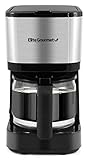
The Elite Gourmet EHC9420 is a second 5-cup entry from Elite Gourmet, and functionally it sits very close to the EHC-5055. It is an automatic drip brewer with a 5-cup glass carafe, pause ‘n serve, a reusable filter basket, and a warming plate. If you are comparing the two side by side, the honest answer is that the difference comes down to styling and availability rather than brewing performance.
- Capacity: 5-cup rating (approximately 25 oz brewed)
- Carafe: Glass with lid and pour spout
- Filter: Reusable filter basket included
- Controls: Simple brew switch with warming plate
- Features: Pause ‘n serve, automatic drip cycle
- Housing: Compact body designed for limited counter space
This machine makes sense for a household that wants a reliable, cheap, no-features 5-cup pot and does not want to spend time comparing models. It brews the same 25-ounce batch as the rest of the 5-cup class, uses the same reusable-filter approach, and cleans up the same way. The one differentiation worth noting is that the EHC9420’s styling tends to read slightly more modern than the older EHC-5055, which matters only if the machine will sit in plain view.
Because this is a budget machine, owners should expect the standard budget-machine maintenance rhythm: rinse the filter basket after every use so oils do not go rancid, wash the carafe with warm soapy water rather than scrubbing it, and descale periodically if the local water is hard. Mineral buildup is the single most common reason compact brewers start tasting off or brewing slower, and it is entirely preventable with a vinegar-and-water descaling cycle every one to three months depending on water hardness.
Small-portion performance is the same story as its sibling: fine for a full 5-cup batch, thinner for a single mug. Pause ‘n serve helps because you can grab a first cup before the cycle finishes, which means the coffee you actually drink first is freshly brewed rather than held on the plate.
Against the Elite Gourmet EHC-5055, there is no meaningful performance gap — choose on price and appearance. Against the Amazon Basics 5 Cup, the Amazon model adds advertised auto shut-off, which is a real functional advantage if you tend to walk away mid-brew.
Pros
- Dependable 5-cup format at a budget price
- Pause ‘n serve for grabbing a cup mid-cycle
- Reusable filter basket included
- Simple controls with nothing to program
Cons
- Essentially a duplicate of the EHC-5055 — no unique advantage
- No auto shut-off
- Budget plastic construction and a breakable glass carafe
- Not the best choice if you brew single mugs regularly
7. BLACK+DECKER Single-Serve Coffee Maker with 50oz Reservoir — Best for Single-Serve Without Pods

The BLACK+DECKER Single-Serve Coffee Maker takes a different approach: instead of a carafe, it brews one serving at a time directly into a mug, and it carries a large 50-ounce removable water reservoir so you are not refilling a tiny tank before every cup. It uses ground coffee rather than pods, which keeps it in the same supply chain as the drip machines above.
- Capacity: Single-serve brew into a mug or travel cup; no carafe
- Reservoir: 50 oz removable water reservoir — roughly ten 5-oz servings between refills
- Filter: Ground-coffee compatible filter system; pods are not the format
- Footprint: Vertical, narrow — occupies mug-width counter space
- Cleanup: Rinse the brew basket; reservoir is removable for refilling and washing
The 50-ounce reservoir is the number that matters here. On most single-serve pod machines, the tank holds enough for one or two cups, so the machine only saves you time if you ignore the refilling. At 50 ounces, this brewer reaches roughly ten small servings per fill, which changes the daily routine entirely — you can make a cup in the time it takes to fill a mug, with no tank top-up. The reservoir is removable, so you can carry it to the sink rather than pouring water into a fixed tank.
Brewing into a mug rather than a carafe also removes the warming-plate problem that affects every drip machine in this list. Coffee never sits on a hot plate, so it never develops the stale, over-cooked character that a 25-ounce batch acquires after fifteen minutes. For someone who drinks exactly one cup at a time, all day, this is the structurally better design.
The tradeoff is that you cannot brew for two people at once, and a single-serve brew has a narrower margin for error — the ratio of coffee to water is set by the machine, so if the resulting cup is too weak or too strong, you adjust with grind and dose rather than a strength setting. Counter footprint is small but tall, so check cabinet clearance. Against the Keurig K-Mini Mate, this machine wins on reservoir capacity and on avoiding pod costs; the Keurig wins on pure simplicity and the smallest possible footprint.
Pros
- 50 oz reservoir means about ten servings per refill
- No pods — use standard ground coffee
- No carafe and no warming plate, so no stale held coffee
- Very small counter footprint, vertically oriented
Cons
- Cannot brew more than one mug at a time
- Taller profile may need cabinet clearance
- No strength control — ratio is machine-determined
- Single-serve brewing is less forgiving of a bad grind
8. Mr. Coffee 5-Cup Mini Brew Switch Coffee Maker (White) — Best for Matching a Light Kitchen
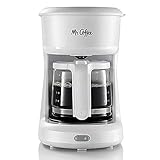
This is the white-finish version of the Mr. Coffee 5-Cup Mini Brew Switch covered above, and its inclusion here is about fit rather than function. The internals, capacity, and brewing behavior are the same: a 5-cup glass carafe, switch-based brewing, pause-and-serve, a warming plate, and a basket filter. If you want the best overall compact drip machine and your kitchen is white or light-toned, this is the finish to choose.
- Capacity: 5-cup rating (approximately 25 oz brewed)
- Carafe: Glass with lid and pour spout
- Filter: Basket-style; accepts small basket paper filters and reusable baskets
- Controls: Single switch with warming plate
- Features: Pause-and-serve, compact footprint, white housing
Because the underlying machine is the same as the black version, everything said there applies: the 25-ounce capacity suits one or two people, pause-and-serve is genuinely useful at this volume, and the wide availability of replacement carafes and filter baskets is the key long-term ownership advantage. The white housing shows coffee splatter more readily than black, which is worth knowing if you tend to pour quickly or if the carafe spout sits close to the housing when docked.
On price, this finish is positioned at the premium tier in this roundup even though the machine is functionally the mid-range model. If budget matters more than appearance, the black version is the better purchase, and the difference between them is purely cosmetic. If the brewer will sit on an open counter in a bright kitchen and you care how it looks, the premium is defensible.
Against the black Mr. Coffee 5-Cup Mini Brew Switch, this model is a colorway, not an upgrade — buy whichever matches your space and costs less on the day you order. Against the KRUPS Simply Brew Compact, the Mr. Coffee is cheaper and easier to keep supplied with replacement parts, while the KRUPS has the sturdier build and includes a reusable filter.
Pros
- Same proven compact platform as the black Mini Brew Switch
- 25 oz capacity suits one or two drinkers
- Easy replacement carafes and filters
- Light finish blends into white kitchens
Cons
- Premium-tier price for a cosmetic difference
- White housing shows splatter and stains more
- No timer, strength setting, or auto shut-off
- Glass carafe remains the breakable part
9. Gourmia 5-Cup Drip Coffee Maker with Glass Carafe — Best for an Affordable Clean-Looking 5-Cup Drip

The Gourmia Drip Coffee Maker is a 5-cup machine with a glass carafe, a black body, and a warming plate. Gourmia is known for value-priced kitchen appliances with simple, modern styling, and this model fits that pattern: it does the standard 5-cup job without extra features, at a mid-range price that undercuts the branded compact brewers.
- Capacity: 5-cup rating (approximately 25 oz brewed)
- Carafe: Glass with lid and pour spout
- Filter: Basket-style filter compatible; reusable or paper
- Controls: Simple brew switch with warming plate
- Housing: Black, compact, clean-lined design
This is the pick for someone who wants a 5-cup drip brewer that looks tidy on the counter and does not cost premium money. The brew cycle is standard drip: water heats, rises, and drips through the basket into the glass carafe, with the warming plate holding temperature afterward. There is nothing exotic to learn and nothing digital to fail.
Daily maintenance follows the class standard. Rinse the basket, wash the carafe by hand, wipe the plate, and descale periodically if your water is hard. The parts most likely to wear are the carafe lid, the switch, and the nonstick or coated surface of the warming plate, which can discolor over time if coffee drips onto it and bakes. Keeping the plate clean is the cheapest way to extend the machine’s usable life and keep it from smelling of old coffee.
Small-portion performance is typical for the format: fine at a full 5-cup batch, thinner at half batch. If you consistently brew two cups, use a slightly finer grind and a slightly higher dose to compensate for the shorter water contact. Because the machine lacks a programmable timer or strength control, all of your adjustment happens at the grinder and the scoop.
Against the KRUPS Simply Brew Compact 5 Cup, the Gourmia is the better value and the KRUPS is the better object; the KRUPS includes a reusable filter and feels more solidly built, while the Gourmia costs less and looks equally good in a black kitchen. Against the Mr. Coffee Mini Brew Switch, expect similar coffee with fewer replacement-parts options long term.
Pros
- Standard 5-cup format at a mid-range price
- Clean, compact black design
- Glass carafe with clear fill markings
- Simple operation with no learning curve
Cons
- No pause-and-serve advertised at the Mr. Coffee level
- No programmable timer or auto shut-off
- Fewer replacement parts than established drip brands
- Warming plate requires regular wiping to stay clean
10. OXO Brew Single Serve Pour-Over Coffee Maker with Water Tank — Best for Manual Pour-Over Control
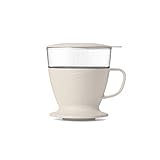
The OXO Brew Single Serve Pour-Over is the odd one out in this list, and deliberately so. It is not a drip machine with a heating element — it is a manual pour-over brewer with an integrated water tank, a 12-ounce brew capacity, and a showerhead-style water distribution design. It requires no electricity and brews directly into a mug.
- Capacity: 12 oz brew capacity — roughly one large mug
- Method: Manual pour-over with an integrated water tank and showerhead dispersion
- Power: None — no cord, no heating element
- Filter: Paper pour-over filters (cone style), or a reusable equivalent
- Footprint: Small and portable; stores in a cabinet or travels easily
The 12-ounce capacity is the key spec, and it is the smallest in this roundup. That makes it the right machine only for someone who drinks a single large mug at a time and wants control over the process. What you get in return is temperature control (you heat the water yourself, so you decide how hot it is), full control over pour timing, and a cleaner, brighter cup profile than most drip machines produce, because pour-over extraction is more even.
Cleanup is minimal — you discard the paper filter with the grounds and rinse the brewer. There is no warming plate to scrub and no carafe to wash. Ownership costs are dominated by paper filters, which is the one recurring consumable in this list, though a reusable cone filter can eliminate that. Durability is generally good because there are no electronics, no pump, and no heating element to fail; the wear points are the plastic body and the tank seal.
The obvious limitation is that it does not brew for two, and it requires you to boil water and pour it, which is a two-minute process rather than a switch. In a small kitchen where counter space is the constraint rather than time, that tradeoff is excellent. Against the BLACK+DECKER Single-Serve, the OXO wins on cup quality and portability and loses badly on convenience — the BLACK+DECKER is a push-button machine with a 50-ounce reservoir, the OXO is a manual ritual.
Pros
- Full control over water temperature and pour timing
- No electricity, no cord, no heating element to fail
- Very small, portable, and easy to store
- Cleaner-tasting cup than typical drip brewing
- Minimal cleanup — no carafe, no warming plate
Cons
- Only 12 oz per brew — one large mug
- Requires manually boiling and pouring water
- Paper filters are a recurring consumable
- Not suitable for serving two people at once
11. BELLA 12 Cup Programmable Coffee Maker — Best for Batch Brewing in a Small Kitchen

The BELLA 12 Cup Programmable Coffee Maker is not a mini brewer, and it is included because many “small space” shoppers eventually realize they need batch capacity rather than a smaller carafe. If you host often, work from home and drink four or five cups across a morning, or want coffee ready when you wake up, a programmable 12-cup machine is the correct answer even if it takes more counter space than everything else here.
- Capacity: 12-cup glass carafe
- Controls: Easy LCD display with programmable brew start
- Filter: Reusable dishwasher-safe accessories included
- Features: Auto shut-off, programmable timing, standard drip cycle
- Footprint: Full-size — the largest machine in this comparison
The programmable timer is the feature that mini brewers cannot offer at any price. Setting the machine the night before so coffee is waiting at a fixed time is a routine-changing convenience, and it only exists on full-size programmable models. Auto shut-off addresses the safety side, and the reusable dishwasher-safe accessories mean the filter and parts can go in the dishwasher rather than being hand-washed — a real ongoing time saving on a machine used daily.
The cost of that capability is space. A 12-cup brewer occupies substantially more counter depth and height than a 5-cup machine, and the carafe is large enough that brewing a single mug means a mostly empty pot sitting on a hot plate. Given that this roundup is about small spaces, the honest guidance is: buy this only if batch volume or programmable timing genuinely solves a problem for you. If you drink one or two cups a day, a 5-cup machine will give you better coffee in less space.
Maintenance scales with use. Because the machine brews larger volumes, it needs descaling more often in absolute terms, and the carafe and lid should be washed after each batch to avoid oils building up. Against the BELLA’s own smaller alternatives — really, against any 5-cup machine here — it trades footprint and small-batch quality for capacity, programmability, and dishwasher-safe parts.
Pros
- Programmable brew start — coffee ready at a set time
- 12-cup capacity for households and entertaining
- Auto shut-off
- Reusable dishwasher-safe accessories reduce hand washing
Cons
- Largest footprint in this roundup — not a small-space machine
- Poor fit for brewing one or two cups
- Requires more frequent descaling at higher volumes
- Overkill for a single daily drinker
12. Keurig K-Mini Mate Single Serve — Best for the Smallest Possible Footprint

The Keurig K-Mini Mate is the smallest machine in this roundup in terms of counter footprint. It is a single-serve pod brewer designed to be slim enough to slot into a narrow gap, brewing one K-Cup pod at a time into a mug or travel cup. Keurig is the dominant brand in pod brewing, and the K-Mini line exists specifically for tight spaces, dorm rooms, hotel-style setups, and offices.
- Capacity: Single serve — one cup at a time
- Format: K-Cup pods; brews into a mug or travel mug
- Reservoir: Small single-serve water reservoir
- Footprint: The narrowest and shortest profile in this comparison
- Cleanup: Eject and discard the pod; wipe the drip tray
If counter width is the binding constraint — say, a two-foot strip of counter between a sink and a wall — the K-Mini Mate will fit where a 5-cup drip machine will not. The single-serve reservoir also means you are not maintaining a large tank of standing water, which is a modest freshness and cleanliness advantage.
Cleanup is the simplest of any machine here: remove the pod, discard it, wipe the tray. There is no carafe, no filter basket, and no grounds to knock out. That is a genuine daily-life benefit for someone who hates cleaning coffee gear, and it is the main reason pod machines persist despite costing more per cup.
The structural tradeoffs are cost per cup and waste. Pods cost meaningfully more per serving than bulk ground coffee, and each cup produces a used pod. Some pods are recyclable and reusable pod inserts exist, but the default routine produces more waste than a drip machine with a reusable filter. Cup quality is also more variable and generally less nuanced than a well-made drip or pour-over cup.
Against the BLACK+DECKER Single-Serve, the tradeoff is stark: the BLACK+DECKER uses ground coffee and holds 50 ounces in its reservoir, so it costs less per cup and needs refilling far less often, but it is taller and requires handling loose grounds. The Keurig is smaller, faster to clean, and simpler; the BLACK+DECKER is cheaper to run and produces better coffee from fresh grounds.
Pros
- Smallest counter footprint of any machine in this roundup
- Simplest cleanup — no carafe, no loose grounds
- Single-serve brewing with no batch decisions
- Fits gaps, shelves, and dorm setups that rule out drip machines
Cons
- Highest cost per cup of any option here
- Pod waste is inherent to the format
- Cannot brew for two people at once
- Limited control over strength and cup profile
How to Choose
Choosing a mini drip coffee maker comes down to four numbers and one habit. The numbers are brew capacity, counter footprint, brew time, and the carafe’s usable volume. The habit is how many cups you actually drink before the coffee goes cold. Get those right and the decision is mostly made.
Start with capacity, and be honest about what a “cup” means. On drip machines, the industry’s cup is 5 ounces. That means a “4-cup” brewer makes about 20 ounces and a “5-cup” brewer makes about 25 ounces. In mug terms, a 4-cup machine fills roughly two 10-ounce mugs, and a 5-cup machine fills two mugs with a few ounces left over. If your daily ritual is one large 14-ounce travel mug, a 4-cup machine will just barely cover it; a 5-cup machine gives you margin. If two people drink coffee each morning, 5 cups is the practical minimum, and a 4-cup machine will feel cramped. Do not buy a 12-cup machine “just in case” — a small household brewing small batches in a big machine gets worse coffee and wastes counter space.
Measure your counter before you buy. Mini drip brewers generally fall into a narrow footprint class, but they are not identical. What matters most is height under upper cabinets and depth from the wall. A typical compact brewer needs enough vertical clearance to lift the carafe lid and enough depth that the carafe can slide out without hitting the wall behind it. Single-serve vertical machines like the BLACK+DECKER and the Keurig need mug clearance at the front instead, and they are taller than they are wide, which is an advantage on a narrow strip of counter but a problem under a low cabinet. Pour-over brewers like the OXO take the least space of all because they can be stored in a cabinet and set on the counter only when used. Measure the gap, then compare it to the machine’s listed dimensions rather than trusting the word “compact.”
Decide whether you want pause-and-serve. Pause-and-serve is a small feature with outsized daily impact on a mini brewer. Because the total brew volume is only 20 to 25 ounces, the brew cycle is short — often under five minutes on a 5-cup machine — and being able to slide the carafe out for a moment to pour the first cup means you drink that cup fresh instead of after it has sat on a warming plate. On a large machine, pause-and-serve is a convenience. On a 5-cup machine, it is arguably the difference between “the coffee tastes good” and “the coffee tastes like it sat on heat.” If you drink your coffee immediately, prioritize machines that advertise it.
Understand the warming plate tradeoff. Every drip machine here keeps coffee warm on a heated plate. That is convenient and also why small-batch coffee degrades fast: 25 ounces of liquid on a hot surface has little thermal mass to buffer it, so it continues to cook. The practical rule is to drink a mini brewer’s output within about 20 to 30 minutes, or transfer it to a thermal carafe or travel mug. This is one reason single-serve brewing into a mug (the BLACK+DECKER, the Keurig, the OXO) often tastes better in practice than drip coffee from the same beans: there is no holding period at all. If you tend to brew and forget, either choose a machine with auto shut-off like the Amazon Basics model, or train yourself to pour the whole batch into an insulated mug as soon as it finishes.
Carafe design matters more than you think. Glass carafes are the standard in this class because glass is flavor-neutral, easy to see through, and inexpensive to replace. Their weakness is fragility, and the failure mode is nearly always the same: a knock against the sink while washing, or a drop of the lid. When comparing machines, look at three things — whether the pour spout is drip-free, whether the lid attaches with a hinge you can actually clean, and whether replacement carafes are easy to source. That last point is the strongest argument for choosing a widely sold model such as the Mr. Coffee Mini Brew Switch over an obscure one: a $15 replacement carafe turns a broken machine back into a working one, whereas an unsupported model becomes e-waste. There are no thermal carafe options in this compact price class, so plan on glass and treat it gently.
Filter type is a recurring cost decision. Three options exist here: paper basket filters, reusable basket filters, and pod formats. Paper basket filters cost a few cents each and must be restocked, but they make cleanup trivial and produce a clean cup. Reusable filters — included with the KRUPS, the Elite Gourmet models, and the BELLA — eliminate the recurring cost entirely and reduce waste, at the price of rinsing them after each use and occasionally deep-cleaning them to remove oils. Over a year of daily brewing, the savings are modest but real, and the environmental difference is not. Pods, as on the Keurig, are the most expensive per cup and generate the most waste. If cost per cup is your primary concern, a reusable filter on a budget drip machine is the cheapest way to drink coffee from this list.
Brew time and small-batch performance. A 5-cup drip machine typically completes a cycle in four to six minutes; a 4-cup machine is slightly faster; a single-serve machine is fastest at one to two minutes; a manual pour-over takes as long as your kettle takes to boil plus two or three minutes of pouring. Speed is rarely the limiting factor — flavor at small volumes is. Drip brewing extracts less efficiently when the water volume is small, so a half batch of a 5-cup machine will taste thinner than a full batch unless you compensate. The compensation is straightforward: use about one extra tablespoon of coffee per cup you brew, and grind slightly finer than you would for a full pot. This is the single most useful adjustment an owner of a mini drip machine can make, and it applies to every model in this roundup.
Match the machine to frequency of use. If you brew daily and drink two mugs, the mid-range 5-cup drip machines are the right answer: the Mr. Coffee Mini Brew Switch as the default, the KRUPS if you want a reusable filter and better materials. If you brew daily but only one mug, a single-serve machine like the BLACK+DECKER, or the OXO if you enjoy the manual process, will produce better coffee and less waste. If you brew a few times a week — a guest room, an office, a vacation rental — a budget 5-cup machine like the Elite Gourmet or Amazon Basics models is the rational purchase; there is no reason to spend premium money on an appliance that runs twice a week. If you brew for a household of three or more, or want coffee waiting at a set time, skip the mini category entirely and choose a programmable 12-cup machine like the BELLA.
Plan the upgrade path before you buy. A mini drip brewer is a starter appliance, not a forever appliance. The realistic sequence is: single-serve pod machine for the smallest footprint, then a 5-cup drip machine once you want to brew for two without pods, then a 12-cup programmable machine if your household grows or you start hosting. Each step up costs counter space. Understanding which step you are on prevents the common mistake of buying a 12-cup machine for one person, or buying a 4-cup machine for a household of three and then brewing two cycles every morning.
Durability and ownership realities. In this category, the parts that wear first are consistent: the glass carafe, the carafe lid hinge, the reusable filter basket, and the warming plate surface, in roughly that order. The electronics — a switch and a simple heating element — are the most reliable components on a non-programmable drip machine, which is why these brewers often outlive their carafes. Owner mistakes that shorten life are also consistent: leaving wet grounds in the basket so oils and mold develop, letting mineral scale build up until the brew cycle slows and the coffee tastes metallic, and washing a glass carafe in hot water immediately after it has been on a hot plate — thermal shock is a real cause of cracking. Descale with a vinegar-and-water cycle every one to three months depending on water hardness, rinse the basket daily, and hand-wash the carafe in warm rather than scalding water, and a budget mini brewer can reasonably serve several years.
Cost per use, worked out. Suppose you drink two 10-ounce cups a day, 365 days a year, which is about 60 pounds of brewed coffee. At a typical bulk ground coffee price, that works out to a modest monthly coffee expense. Add the machine cost amortized over three years, plus either a few dollars a month in paper filters or nothing at all with a reusable filter, and the total cost of a drip setup is quite low per cup. A pod machine using single-serve pods costs noticeably more per cup on the same routine — often several times as much, depending on the pod brand — because you are paying for packaging, portioning, and convenience. That gap is the strongest financial argument for a mini drip brewer over a pod machine if you drink coffee daily.
Frequently Asked Questions
What does “5-cup” actually mean on a mini drip coffee maker?
On drip coffee makers, a “cup” is conventionally 5 ounces of brewed coffee, not the 8- to 12-ounce mug most people drink from. A 5-cup machine therefore produces about 25 ounces total, which fills two standard 10-ounce mugs with a few ounces left over, or roughly one very large travel mug plus a small refill. If you drink from oversized mugs, size up in your head: a 4-cup machine covers about one and a half large mugs.
Do I need a programmable timer on a small coffee maker?
Most compact 4- and 5-cup drip machines are switch-operated with no programmable start, and that is usually fine because the brew cycle is short and the batch is small. A programmable timer is worth paying for when you want coffee ready at a fixed time before you wake up, which generally means moving up to a full-size 12-cup model like the BELLA. If you just want a fast cup, a switch machine is simpler and has fewer parts to fail.
Is a single-serve machine better than a 5-cup drip maker for one person?
If you drink exactly one mug at a time and never brew for anyone else, a single-serve brewer is often the better choice — it avoids held coffee on a warming plate and can be smaller. If you sometimes have a second cup, or you want to avoid pod costs and waste, a 5-cup drip machine with a reusable filter is more economical. The deciding factor is usually cost per cup and waste, not speed.
How often should I clean and descale a mini drip coffee maker?
Rinse the filter basket and wash the carafe after every use, and wipe the warming plate so drips do not bake on. Descale every one to three months depending on water hardness — monthly in hard-water areas, every two to three months with soft water. Descaling with a vinegar-and-water cycle restores brew speed and flavor, and it is the single most neglected maintenance task on compact brewers.
Why does my coffee taste weak when I brew a small batch?
Drip brewing extracts less efficiently when the water volume is low, because there is less water passing through the grounds over a shorter contact time. You can compensate by using about one extra tablespoon of coffee per cup and grinding slightly finer than you would for a full pot. This is normal behavior for every model in this roundup, not a defect in a specific machine.
Will a mini drip coffee maker fit under my kitchen cabinets?
It depends on the machine’s height plus the clearance needed to lift the carafe lid and slide the carafe out. Compact 5-cup brewers are shorter than full-size models but still need several inches of vertical room above the housing. Single-serve vertical machines are taller but narrower. Measure the gap between your counter and the cabinet above before ordering, and compare it to the listed dimensions rather than assuming “compact” means it fits anywhere.
Are reusable filters as good as paper filters?
Reusable filters eliminate recurring filter purchases and reduce waste, and they allow a slightly finer grind because they do not tear like thin paper. Paper filters, on the other hand, trap more fine sediment and oils, producing a cleaner, brighter cup with less sludge at the bottom of the carafe. Neither is strictly better; the tradeoff is cost and waste versus clarity in the cup.
Can I use pre-ground supermarket coffee in these machines?
Yes. All the drip machines here are designed for standard basket-style ground coffee, and a medium grind works for both paper and reusable filters. If you brew small batches and find the result thin, switch to a slightly finer grind or a slightly darker roast, and add a little more coffee per cup. Pod machines like the Keurig require pods unless a reusable pod insert is used.
The Bottom Line
For most small kitchens and one- or two-person households, the Mr. Coffee 5-Cup Mini Brew Switch is the best mini drip coffee maker: a 25-ounce glass carafe, pause-and-serve, a narrow footprint, and replacement parts that are easy to find for years. Buy the Elite Gourmet EHC4128 if you drink a single mug a day and want the lowest possible spend, or the Amazon Basics 5 Cup if auto shut-off matters at a budget price. Step up to the KRUPS Simply Brew Compact 5 Cup if you want a reusable filter and a machine that feels built to last. If you never brew more than one mug at a time, choose the BLACK+DECKER Single-Serve with the 50 oz reservoir for ground-coffee convenience, the OXO Brew Pour-Over if you enjoy manual control, or the Keurig K-Mini Mate if floor-to-counter space is the tightest constraint of all. Finally, if your household needs more than 25 ounces at a time or coffee waiting at a set hour, skip the mini category and go straight to a programmable 12-cup machine like the BELLA.