Key takeaways
- Dipole speakers fire two sets of drivers in opposite phase to the sides. This produces a diffuse field with no obvious source, and is the classic design for movie rooms, where listeners sit between the surrounds and the sound should envelop them.
- Bipole speakers fire the same phase both ways, which gives a wide, diffuse field with more directness.
- Direct-radiating speakers face the listener like a normal bookshelf speaker. They localize effects better and are the recommended choice for Dolby Atmos and DTS:X, which place discrete objects behind and beside you.
The best rear speakers for surround sound depend on what is already in your system. Sonos owners should buy a pair of Era 100 or Era 300, Sony soundbar owners should buy Sony’s matching rear speakers, Bose soundbar owners should buy the Bose Surround Speakers, and anyone with a traditional AV receiver should look at Klipsch’s RP-502S II dipole/bipole pair, a Polk Signature Elite ES10 pair, or small direct-radiating SVS Prime satellites. Mixing brands rarely works with wireless systems, so compatibility decides the answer before sound quality does.
This guide covers real surround speaker options currently sold, explains the difference between dipole, bipole and direct-radiating designs, and gives placement numbers so the rears actually add something. The analysis relies on published specifications and professional reviews, not on personal listening.
Our top picks


As an Amazon Associate we earn from qualifying purchases at no extra cost to you.
Surround speaker comparison at a glance
| Speaker | Type | Works with | Key detail (per maker) | Price tier |
|---|---|---|---|---|
| Klipsch RP-502S II | Passive bipole/dipole switchable surround | Any AV receiver | Two 5.25-inch woofers and two horn tweeters per speaker, cerametallic woofers | Premium |
| Polk Signature Elite ES10 | Passive wall-mount surround | Any AV receiver | Hi-Res certified, Dolby Atmos and DTS:X compatible, wall-mountable | Entry to mid |
| SVS Prime Satellite | Passive direct-radiating satellite | Any AV receiver | Compact sealed satellite, stand or wall mount | Mid |
| Sonos Era 100 (or Era 100 SL) | Wireless, Wi-Fi | Sonos Arc, Arc Ultra, Beam | Stereo-spread tweeters, Trueplay tuning, Bluetooth, line-in adapter option | Mid |
| Sonos Era 300 | Wireless Atmos-capable | Sonos soundbars that support it (Arc series, Beam Gen 2) | Six drivers including up-firing and side-firing | Premium |
| Sony SA-RS5 / SA-RS3S | Wireless rear speakers | Compatible Sony soundbars (HT-A7000 family and similar) | Wireless link to the bar, battery or mains depending on model | Mid to premium |
| Bose Surround Speakers | Wireless rear speakers | Bose Smart Soundbar, Smart Ultra Soundbar | Wireless, mains-powered, App-based setup | Mid |
Match the speaker to the system first
There are two completely different markets inside “rear speakers,” and buying from the wrong one wastes money.
- Soundbar ecosystems (Sonos, Sony, Bose, and some Samsung and LG models) accept only their own wireless rears. The bar is the amplifier and the processor, so the rears join automatically in the app.
- AV receiver systems accept any passive speaker with matching impedance (usually 4 to 8 ohms). Here you choose by sound, size and finish.
If your system is a soundbar, skip to the soundbar picks. If you have a receiver, read on about speaker design first.
Dipole, bipole or direct radiating: which design fits your room
Surround speakers radiate sound in three ways, and each suits a different room.
- Dipole speakers fire two sets of drivers in opposite phase to the sides. This produces a diffuse field with no obvious source, and is the classic design for movie rooms, where listeners sit between the surrounds and the sound should envelop them.
- Bipole speakers fire the same phase both ways, which gives a wide, diffuse field with more directness.
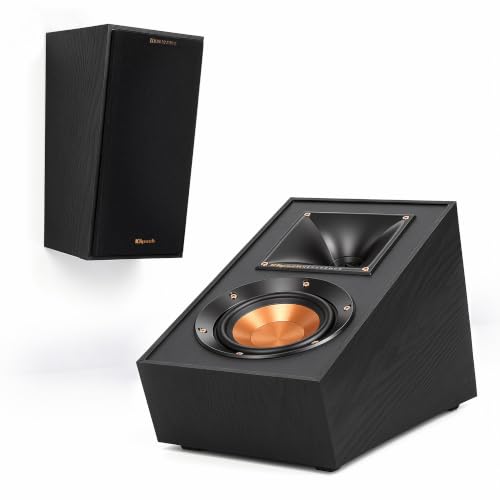
- Direct-radiating speakers face the listener like a normal bookshelf speaker. They localize effects better and are the recommended choice for Dolby Atmos and DTS:X, which place discrete objects behind and beside you.
Atmos-era guidance favors direct radiators, or switchable dipole/bipole models, because the format expects each surround to be a full-range, locatable source. A switchable design, such as the Klipsch RP-502S II, handles both.
Klipsch RP-502S II: best passive surround for a dedicated room
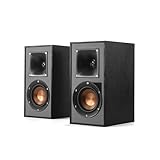
The RP-502S II belongs to Klipsch’s Reference Premiere line. Each speaker has two 5.25-inch cerametallic woofers and two horn-loaded tweeters, and a rear switch that sets dipole or bipole behaviour. The wide, even dispersion covers the whole seating area, not just one seat, which is the reason many surround roundups recommend them for rooms with several rows or sofas. They also work well with Klipsch’s own Reference II and Reference Premiere fronts, since the horn tweeters share the same voicing.
Spec line: two 5.25-inch woofers, two horn tweeters, switchable dipole/bipole. Best for: medium to large rooms and multi-seat layouts. Skip if: your fronts are warm, soft-voiced speakers, or the wall is too thin to bear the weight.
- Wide coverage reduces the “sweet spot” problem in surround.
- Switchable mode lets you change between diffuse and focused sound.
- Matches Klipsch front and center speakers closely.
Cons: premium cost for rears, and the horn tweeters can sound brighter than soft-dome fronts.
Polk Signature Elite ES10: best value passive pair
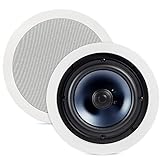
The ES10 is Polk’s surround companion to the Signature Elite ES60 tower and ES35 center. It is Hi-Res Audio certified, Dolby Atmos and DTS:X compatible, and designed for wall mounting. It is the common budget recommendation for a rear pair because it matches a Polk front stage and keeps the cost low. Another affordable Polk option often mentioned is the T15, a small bookshelf speaker that works as a rear channel when mounted high on the wall.
Spec line: wall-mount design, Hi-Res certified, Atmos and DTS:X compatible. Best for: first-time 5.1 builders on a budget. Skip if: you want switchable dipole behaviour.
- Keeps the total set cost low.
- Flat-back design sits close to the wall.
- Matches the rest of the Polk Signature Elite range.
Cons: less output than larger rears in big rooms, and only a one-size finish choice.
SVS Prime Satellite: best compact direct-radiating rears
The SVS Prime Satellite is a small sealed speaker designed for surround use, with the same house voicing as the larger Prime bookshelf and center speakers. Its direct-radiating layout suits Atmos and 7.1 setups, where each rear needs to sound like a real point source. It can sit on stands or mount on the wall and works especially well in a system that already uses SVS fronts and an SVS subwoofer.
Spec line: compact sealed satellite, direct radiating. Best for: small and medium rooms, Atmos-ready systems. Skip if: you want the large, diffuse effect of a dipole in a big room.
- Neutral tone blends with many front speakers.
- Small footprint for tight rooms.
- Strong localization of effects behind the listener.
Cons: costs more than similarly sized budget satellites, and needs a sub to cover the low bass.
Sonos Era 100 and Era 300: best wireless rears for Sonos soundbars
The Era 100 is the standard rear speaker for a Sonos soundbar system; the Sonos bundle packages that include a bar and a sub use two Era 100 speakers for the rears. The Era 100 SL has no microphone, which suits households with privacy concerns. The Era 300 adds up-firing and side-firing drivers and works as a surround only with certain bars, so check compatibility with your bar, such as the Arc or Beam (Gen 2), before buying. Both double as full music speakers when not in movie mode, so the cost buys more than surround effects.
Spec line: Wi-Fi rear speakers, Trueplay tuning, app setup. Best for: Sonos soundbar owners. Skip if: you own a non-Sonos bar, because these will not pair as rears.
- Easy app setup with automatic room tuning.
- Useful as music speakers when not in use for movies.
- Era 300 supports spatial effects.
Cons: each rear needs a power outlet, and costs add up quickly.
Sony SA-RS5 and SA-RS3S: best matching rears for Sony bars
Sony sells wireless rear speakers designed for its Atmos soundbars. They connect to the bar wirelessly, which avoids long cable runs behind the sofa, and they are tuned to blend with the bar’s drivers. Check the model compatibility list for your bar, because older and newer Sony bars use different rear kits.
Spec line: wireless link to the soundbar, model-specific compatibility. Best for: Sony soundbar owners who want a matching upgrade. Skip if: you own a bar from another brand.
- Automatic pairing with the bar.
- Designed to fit with Sony’s calibration process.
- Slim cases suit rooms with limited space behind the sofa.
Cons: only works within the Sony family, and some rear kits require a specific bar model.
Bose Surround Speakers: best matching rears for Bose bars
Bose sells wireless Surround Speakers that pair with its Smart Soundbar and Smart Ultra Soundbar. They connect via the Bose app, run from mains power and complement the bar’s own processing. Bose also sells the Bass Module for low-frequency support, which together makes a modular system you can grow in stages.
Spec line: wireless mains-powered rears, app setup. Best for: Bose bar owners. Skip if: you use a non-Bose bar or want an AV receiver with passive speakers.
- Simple setup through the Bose app.
- Cohesive look with the bar.
- Easy to add the bass module later.
Cons: proprietary, and the price per speaker is high versus passive options.
How to choose rear speakers with numbers
Placement distances and angles
| Layout | Position | Angle from the main seat | Height |
|---|---|---|---|
| 5.1 side surrounds | Beside the seating | 90 to 110 degrees | 2 to 3 feet above seated ear height |
| 7.1 side surrounds | Beside the seating | 90 to 110 degrees | Same as above |
| 7.1 rear surrounds | Behind the seating | 135 to 150 degrees | Same height as sides or slightly higher |
| Atmos (5.1.2) | Ceiling or up-firing | 30 to 55 degrees above the listener | Overhead |
Match output to the room
Rears do not need to be as large as the fronts, but they should be within about 2 dB of sensitivity of the fronts. In a 300 square foot room with fronts rated 90 dB, rears rated 86 dB or better work. If rears are much less sensitive, the receiver’s level trim compensates, but at the cost of headroom when the film puts loud effects behind you.
Cable and power planning
For a passive set, use 16 AWG speaker cable for runs up to 50 feet and 14 AWG beyond that. A 40-foot run from the receiver to a rear speaker in 16 AWG has a resistance near 0.16 ohm per conductor pair, small against an 8 ohm speaker. For wireless rears, plan the power outlet before buying, because a wireless speaker still needs mains power, and that often means a cable runs to the wall anyway.
Decision matrix: which rears fit your situation
| Your situation | Best fit | Why |
|---|---|---|
| Sonos Arc, Arc Ultra or Beam owner | Two Era 100 (or Era 100 SL) | Pairs in the app, no extra hub, doubles as music speakers |
| Sony Atmos soundbar owner | Sony’s matching rear kit | Wireless link and calibration designed for the bar |
| Bose Smart or Smart Ultra soundbar owner | Bose Surround Speakers | Only brand-matched rears integrate with the bar |
| AV receiver, large room, several seats | Klipsch RP-502S II | Wide dispersion covers the whole sofa |
| AV receiver, tight budget | Polk Signature Elite ES10 | Low cost, wall-mount, matches the Polk range |
| AV receiver, Atmos, small room | SVS Prime Satellite | Direct radiating, small, neutral tone |
Wired versus wireless rears: the trade-offs
Wired passive rears give the lowest latency, no battery or Wi-Fi dependency, and almost unlimited choice, but they need a cable path from the receiver to the rear wall. In many living rooms that means an in-wall run, a cable cover along the baseboard, or a flat speaker cable under the rug. A flat cable under a carpet edge is the cheapest fix and works for stereo runs of up to about 30 feet.
Wireless rears remove the audio cable but add dependencies. They rely on your Wi-Fi network or the bar’s own wireless link, so a congested router can cause dropouts, and a firmware update can briefly take them offline. Sound quality is usually fine for movies, but each rear carries its own amplifier, so the cost per speaker is higher than a passive pair of similar size. If you move often, rent, or cannot drill walls, the extra cost is usually justified.
A practical rule is to count the cable path. If it is under 15 feet and can be hidden, go passive. If it crosses a doorway or a walkway, go wireless.
Common surround setup mistakes
- Placing rears at ear height facing the listener. Dipole rears should point so the null faces the listener. Raise them slightly and aim across the room.
- Using different brands in a wireless system. Soundbar rears do not work cross-brand.
- Leaving auto calibration off. The receiver’s room correction sets distance and level automatically, and gives a better first result than manual guesses.
- Setting rears to “large”. Keep a crossover near 80 Hz so small rears do not strain.
Frequently Asked Questions
Do rear speakers need to match the front speakers?
For the best result, they should match in tonal voicing, ideally from the same brand and series. They do not have to be the same size, but a quite different tweeter character becomes obvious when a sound moves from front to back.
Are wireless rear speakers truly wireless?
No. Wireless rears receive audio without cable but still require mains power through a cord to the wall, except for a few battery models. Plan an outlet near each rear position.
What is the difference between surround and rear surround speakers?
In a 7.1 system, the surround speakers go at the sides, and the rear surround (or surround back) speakers go behind the seating. In a 5.1 system, the surrounds can be at the sides or slightly behind, around 100 to 120 degrees.
Can I use bookshelf speakers as rears?
Yes. Small bookshelf speakers such as the Polk T15 or SVS Prime Satellite work well, especially with Atmos, which prefers direct-radiating speakers. Mount them on stands or the wall at above ear height.
Can satellite speakers work as surrounds for a large room?
They can in rooms up to roughly 300 square feet when paired with a capable subwoofer. In larger rooms, choose larger rears with more output, such as the Klipsch RP-502S II.
Do I need Atmos-enabled rear speakers?
No. Standard rears work with any surround system. Atmos-enabled speakers add up-firing drivers for height effects, which only help if the ceiling is flat and between 8 and 10 feet high.
More from Amazon
Programs that pair well with the guide above. Offers and eligibility are set by Amazon and may change.
Free shipping on eligible items, Prime Video and more. Eligible new members can start with a free trial.
Start a Prime free trialAd-free music streaming. Eligible new subscribers can start with a free trial.
Try Music Unlimited freeA Prime membership for ages 18-24 with a trial period. Eligibility is set by Amazon.
See Prime for Young AdultsAudiobooks and podcasts to listen to on the go. Eligible new members can start with a free trial.
Try Audible freeAs an Amazon Associate we earn from qualifying purchases.