Our Top Picks
 RUISHAN Lab Scale 5000gx0.01g High Precision Scientific Electronic5000 g / 0.01 g (Standard)11 x 7.5 x 3 inches4.4 poundsCheck on Amazon
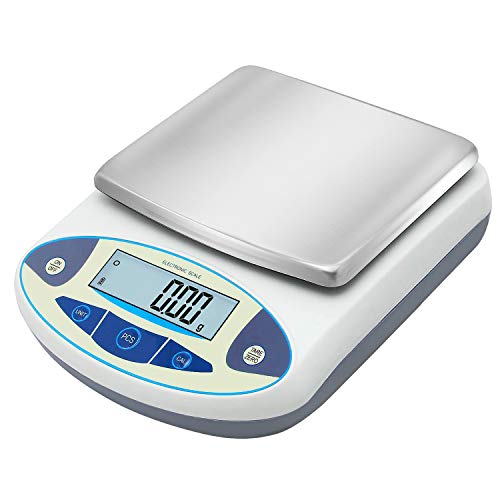 Bonvoisin Lab Scale 3000gx0.01g High Precision Electronic Analytical3000g, with Calibration Weights4.4 PoundsCheck on Amazon
 Ohaus Scout SJX1502N/E Portable Balance 1500 Gram Accuracy11.8 x 9.8 x 3.4 inches9.8 x 11.8 x 3.4 inchesCheck on Amazon
The best lab scales in this comparison depend on how fine a reading you really need, and for most small-lab, hobby and classroom jobs a 0.01 g model such as the Bonvoisin 600 g or the UXILAII 5000 g gives the most flexibility per dollar. If you need milligram resolution, the LACHOI listing is the only 0.001 g option here, and if you need trade-approved weighing, the Ohaus Scout is the one to read.
All ten listings below were compared using what each seller title states. Specs are seller claims, and we point out where wording is vague or misleading.
Top picks at a glance
Bonvoisin Lab Scale 5000gx0.01g High Precision Electronic Analytical Balance 0.01g Accuracy Laboratory Precision Digital Scientific Scale (5000g)


As an Amazon Associate we earn from qualifying purchases. Product prices and availability are accurate as of the date/time indicated.

Bonvoisin Lab Scale 600g x 0.01g Accuracy Digital Gram Scientific Scale | Precision Balance with 6 Units, Tare, Counting, AC Adapter or Battery Power, Adjustable Auto-Off for Lab & Jewelry


As an Amazon Associate we earn from qualifying purchases. Product prices and availability are accurate as of the date/time indicated.

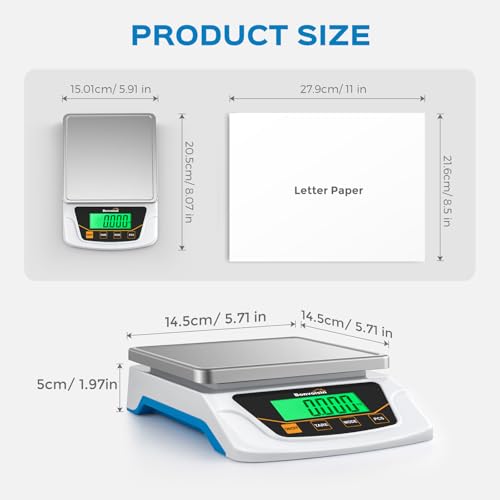
Bonvoisin Digital Gram Scale 6000g x 0.1g Lab Scale with 6 Units



As an Amazon Associate we earn from qualifying purchases. Product prices and availability are accurate as of the date/time indicated.
RUISHAN Lab Scale 5000gx0.01g High Precision Scientific Electronic Digital Laboratory Lab Weight Analytical Balance Scale .01g Accuracy Jewelry Pharmacy Chemistry Industria Calibrated Gram Scale


As an Amazon Associate we earn from qualifying purchases. Product prices and availability are accurate as of the date/time indicated.
Bonvoisin Lab Scale 3000gx0.01g High Precision Electronic Analytical Balance 0.01g Accuracy Laboratory Precision Digital Scientific Scale (3000g, 0.01g)
As an Amazon Associate we earn from qualifying purchases. Product prices and availability are accurate as of the date/time indicated.
Ohaus Scout SJX1502N/E Portable Balance 1500 Gram Accuracy 0.01 Gram (NTEP 0.1 Gram), Class II, Legal for Trade Scale

As an Amazon Associate we earn from qualifying purchases. Product prices and availability are accurate as of the date/time indicated.

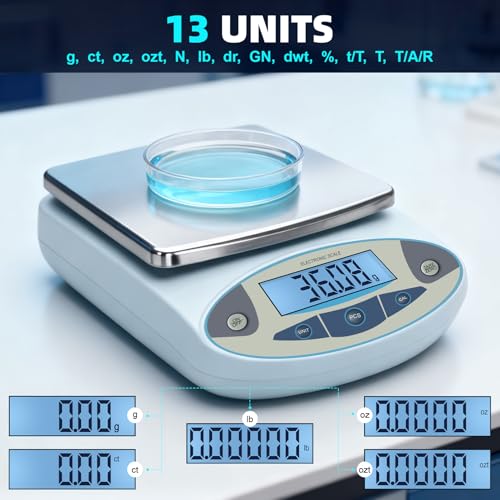
Lab Scale 5000g x 0.01g,13 Unit 0.01g Accuracy High Precision Digital Analytical Balance, Electronic Laboratory Precision Gram Scale Digital Kitchen/Jewelry/Scientific Scale



As an Amazon Associate we earn from qualifying purchases. Product prices and availability are accurate as of the date/time indicated.

SASVY Digital Lab Scale 1000g x 0.01g oz/g/ct/DWT/tl/gn/ozt Precision Electronic Scientific Scale Analytical Balance for Laboratory Jewelry Kitchen, Includes 100g Weight and 2 x AAA Batteries


As an Amazon Associate we earn from qualifying purchases. Product prices and availability are accurate as of the date/time indicated.

UXILAII Lab Scale 5000g x 0.01g Analytical Balance with 1kg Calibration | 17 Units, PCS Counting, Tare, RS232 Output,Aluminum base, Ideal for Laboratories, Schools, Jewelers and Pharmacies


As an Amazon Associate we earn from qualifying purchases. Product prices and availability are accurate as of the date/time indicated.

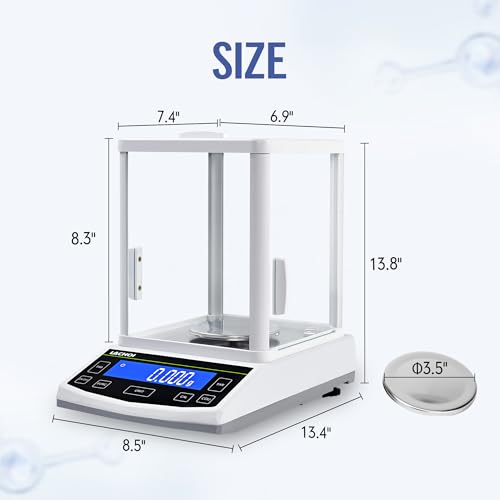
LACHOI Analytical Balance 500g*0.001g Lab Scale 0.001g Accuracy (500g,1mg) | with Windshield with RS232 Interface High-sensitivity sensor High Precision Laboratory Scale Laboratory Balance




As an Amazon Associate we earn from qualifying purchases. Product prices and availability are accurate as of the date/time indicated.
| Model | Key point from the title | Price tier | Best for |
|---|---|---|---|
| Bonvoisin 5000 g x 0.01 g | Labeled analytical balance, 0.01 g | Mid-range | General bench weighing |
| Bonvoisin 600 g x 0.01 g | 6 units, counting, AC or battery | Budget | Small parts and jewelry |
| Bonvoisin 6000 g x 0.1 g | 6 units, 0.1 g step | Budget | Heavier, coarser weighing |
| RUISHAN 5000 g x 0.01 g | Calibrated gram scale claim | Mid-range | Mixed lab and trade use |
| Bonvoisin 3000 g x 0.01 g | 3000 g capacity, 0.01 g | Mid-range | Mid-capacity bench use |
| Ohaus Scout SJX1502N/E | Class II, legal for trade | Premium | Regulated weighing |
| Srora 5000 g x 0.01 g | 13 units | Mid-range | Many unit options |
| SASVY 1000 g x 0.01 g | Includes 100 g weight and batteries | Budget | Starter calibration kit |
| UXILAII 5000 g x 0.01 g | RS232, 17 units, aluminum base | Mid-range | Data output and schools |
| LACHOI 500 g x 0.001 g | Windshield, RS232 | Premium | Milligram-level work |
What is changing in this category
Lab scales used to be a purchase made through scientific suppliers, with a clear line between laboratory balances and kitchen or jewelry scales. Online listings have blurred that line. Many titles now combine words like lab, analytical, jewelry, kitchen and pharmacy, which means the same low-cost scale is marketed to quite different users. That makes it more important to read the actual capacity and readability figures.
One notable trend is the use of the phrase analytical balance for scales that read to 0.01 g. In general, analytical balances are a class that reads much finer, so this is mostly marketing. Another trend is the inclusion of many measurement units, from grams to carats and grains. Titles mention six, thirteen or seventeen units. That is helpful for jewelers and hobbyists, though a lab user may only need grams and milligrams.
Connectivity is moving down-market too. RS232 output appears on two listings here, which lets the scale send readings to a computer or printer. Not everyone needs that, but it matters if you record weights for a class, a quality log or a small production run. Windshields are another feature, and they exist because air movement affects fine readings.
At the top end, regulated products remain separate. The Ohaus Scout lists a legal-for-trade rating, which depends on approval schemes and not only on the electronics. The wider point is that some features, such as legal approval, cannot be assumed from a generic scale, no matter how precise the display looks. Always confirm requirements with the relevant authority.
One more shift is how sellers describe quality. Words like industrial, scientific and high-precision appear in titles without any supporting figures, while the useful details, such as repeatability, linearity and warm-up time, are usually missing. Buyers who rely on those words alone end up guessing. A better habit is to look for the numbers a listing does provide and to ask for the ones it does not.
How we picked these
We began with the ten listings in this set and read each title for stated capacity, readability, units, calibration support, connectivity and intended use. We assigned price tiers relative to each other, grouped near-duplicates and noted where terms such as accuracy were used loosely. Nobody on the team used or measured these units. Our basis is published specifications, manufacturer documentation and buyer reviews, and we include no star ratings or review counts.
Bonvoisin Lab Scale 5000 g x 0.01 g
The title describes a 5000 g capacity with 0.01 g readability, calls it a high-precision electronic analytical balance, and states 0.01 g accuracy. It sits in the middle of the price range. The analytical label is generous, since in general that term implies finer readability than 0.01 g.
It could suit a school prep room or a hobby lab that weighs everything from a few grams up to several kilograms. The scale pairs a wide range with a fine step, but that combination can be hard to deliver in a low-cost design, so ask about repeatability. The title does not list units, tare, counting, calibration weight or power.
- Pros: wide capacity range with 0.01 g display step; mid-range price; familiar brand across several listings.
- Cons: analytical label is loose; accuracy wording merges readability and accuracy; features not in title.
Ask whether a calibration weight is included, and whether the scale can be recalibrated by the user. Also check the pan size, because a small pan makes bulky containers awkward and larger samples can tip off the edge.
Bonvoisin Lab Scale 600 g x 0.01 g
A smaller-capacity sibling with six units, tare, counting, AC adapter or battery power and adjustable auto-off, marketed for lab and jewelry use. The price is among the lowest in the set.
Picture a hobbyist weighing small parts, spices for a craft recipe or beads. A 600 g capacity is enough for small items but not for larger containers, and a heavy beaker plus sample may exceed it. Having both AC and battery power is helpful for a bench that is not near an outlet. The title does not mention a windshield or data output.
- Pros: low price; tare and counting stated; flexible power.
- Cons: limited capacity; no calibration weight mentioned; jewelry and lab wording is broad.
Ask what the maximum container weight is once you add the tare, since the 600 g limit is easy to exceed. Auto-off is handy for saving batteries, but check that it can be adjusted so the scale does not shut off mid-session.
Bonvoisin Digital Gram Scale 6000 g x 0.1 g
This one is a lower-resolution product: 6000 g capacity but a 0.1 g step, with six units. It is described as a lab scale, but with a 0.1 g step it is better described as a general-purpose gram scale. It is in the budget tier.
For weighing flour, soil, shipping items or bulky samples, a 0.1 g step is often enough, and a higher capacity is more useful than fine resolution. For anything that requires 0.01 g, it is the wrong class. The title does not list tare, counting or calibration weight.
- Pros: large capacity; low price; six units.
- Cons: coarse readability; weaker class for lab work; sparse features in title.
Ask what you will actually weigh, because if the smallest sample is only a few grams, 0.1 g is too coarse. If you only occasionally need finer readings, a second smaller scale may be a better pairing than one compromise unit.
RUISHAN Lab Scale 5000 g x 0.01 g
The RUISHAN title states 5000 g by 0.01 g, calls it an analytical balance, lists use in jewelry, pharmacy, chemistry and industry, and says it is a calibrated gram scale. It is the most expensive of the 5000 g class models here.
The word calibrated deserves a follow-up: the listing does not say how it was calibrated, whether a certificate is included or how often it needs re-checking. A buyer who needs traceable calibration should ask for documentation. The title is also broad about uses, including pharmacy, and a general scale should not be treated as suitable for dosing.
- Pros: calibrated claim; wide capacity; broad use cases.
- Cons: calibration details unknown; highest price among the 5000 g models; pharmacy wording is a caution.
Ask for any calibration documentation and what the warranty covers. It is also fair to ask who handles service, because broad use claims do not guarantee support for a lab setting.
Bonvoisin Lab Scale 3000 g x 0.01 g
This 3000 g version has the same 0.01 g step and the same price tier as the 5000 g model, and the title again labels it analytical balance with 0.01 g accuracy. It is a near-duplicate in style of the 5000 g listing.
It makes sense only if you know you will never exceed 3000 g, because it does not appear to be cheaper than the larger version. The title is otherwise sparse, with no units, tare, counting or calibration information. A shopper comparing the two should check the images and bullet points for differences, since the price gap, if any, may be small.
- Pros: 0.01 g display step; mid-range price; same brand family.
- Cons: little reason to choose over the 5000 g version; analytical label is loose; features unlisted.
Ask whether the lower capacity brings any benefit in resolution or stability, because the title does not explain one. If the images show identical hardware, you may simply be choosing a capacity label.
Ohaus Scout SJX1502N/E Portable Balance
The most expensive listing, with 1500 g capacity, 0.01 g accuracy and an NTEP step of 0.1 g, Class II and a legal-for-trade statement. It is the only listing here with a regulatory rating.
It fits a small business that sells goods by weight and has to comply with local rules, or a lab that wants a more formal instrument. The 0.01 g display step and 0.1 g legal-for-trade division are different, and in trade use the legal division is usually what applies. The title does not list connectivity, units or power. Confirm approval and sealing requirements with your local authority.
- Pros: legal-for-trade claim; Class II stated; portable.
- Cons: highest price tier; modest 1500 g capacity; many practical details not in title.
Ask what the legal-for-trade approval covers and whether it applies in your region. It is also worth asking how the approval is maintained, since sealing, inspection and recertification rules vary by region.
Srora Lab Scale 5000 g x 0.01 g
A 5000 g by 0.01 g model with 13 units, billed as high-precision digital analytical balance for kitchen, jewelry and scientific use. It sits in the mid-range tier and has a lower price than the Bonvoisin 5000 g.
The wide unit list is helpful for a mixed household: kitchen grams, jewelry carats and science grains in one tool. A teacher who wants one scale for several activities might like it. The title does not list tare, counting, windshield or connectivity, and kitchen and scientific uses are different jobs that need different care.
- Pros: many units; lower price than the Bonvoisin 5000 g; wide capacity.
- Cons: little else listed; analytical label is loose; generic brand details.
Ask for a user manual or the listing images, because the title leaves out controls and calibration. Because the price is lower than the Bonvoisin, compare both listings side by side before assuming the same quality.
SASVY Digital Lab Scale 1000 g x 0.01 g
One of the cheapest listings, with a 1000 g by 0.01 g range, a unit list written as oz, g, ct, DWT, tl, gn and ozt, a 100 g weight and two AAA batteries included for lab, jewelry and kitchen. It is a practical starter bundle.
A buyer who wants to learn how to calibrate a scale will like the included 100 g weight, which lets you check the reading at the start. The 1000 g limit suits small samples and personal projects but not bulk. The title does not describe a windshield, tare function or connectivity.
- Pros: calibration weight and batteries included; low price; many units.
- Cons: modest capacity; title mentions batteries but no adapter; lab claim is broad.
Ask whether the included weight is traceable or just a reference piece, and how it should be stored. A small bench scale with AAA cells is also easy to move, but fresh batteries matter for stable readings.
UXILAII Lab Scale 5000 g x 0.01 g
This listing has an aluminum base, 17 units, piece counting, tare, RS232 output and a 1 kg calibration mention, aimed at labs, schools, jewelers and pharmacies. It costs about the same as the standard Bonvoisin 5000 g model but lists far more features.
RS232 is the standout: it lets the scale send data to a computer or a printer, which is useful in a classroom or a small production line. The 1 kg calibration wording is unclear about whether a weight is in the box. Pharmacy is listed, but this is not a medical device, and it should not be used for dosing.
- Pros: RS232 output; counting and tare; aluminum base.
- Cons: calibration weight unclear; RS232 needs the right cable or adapter; pharmacy wording is a caution.
Ask which cable and software are needed for RS232 and whether the calibration weight is included. Many modern computers lack a serial port, so a USB adapter may be needed.
LACHOI Analytical Balance 500 g x 0.001 g
The finest readability in this set: 500 g capacity with a 0.001 g (1 mg) step, a windshield, an RS232 interface and a high-sensitivity sensor. The price tier is premium, though far below the Ohaus.
This is the listing to read if you are measuring small chemical samples, weighing reagents or checking tiny parts. A windshield matters at this level because drafts alter the reading. The title does not give repeatability or linearity, so ask for them, and avoid assuming 1 mg readability means 1 mg accuracy. Always follow lab safety procedures and the safety data sheet for any chemical.
- Pros: 0.001 g step; windshield included; RS232.
- Cons: lower capacity; sensitive to environment; repeatability not stated.
Ask for the repeatability, warm-up time and calibration method. Also confirm that the windshield is part of the product and not a separate accessory, and whether the pan can be removed for cleaning.
Buying guide
Capacity versus readability
Capacity is the heaviest load the scale can weigh, and readability is the smallest step on the display. There is usually a trade-off: a scale with a large capacity and a fine step needs a more capable sensor. In this set, the 5000 g models read to 0.01 g, the 600 g and 1000 g models do too, and the LACHOI reads to 0.001 g at only 500 g capacity. Start from your smallest and largest sample and make sure both fit the range.
Readability, accuracy, repeatability and linearity
Titles often write accuracy when they mean readability. Accuracy depends on calibration and the quality of the load cell. Repeatability describes whether the same load gives the same reading each time. Linearity describes error across the range. A scale can display 0.01 g and still be off by more than that. Check the manufacturer documentation for these specifications before using results for anything important.
Calibration
Scales drift with temperature, wear and moving. A calibration weight lets you check and adjust the reading. The SASVY title includes a 100 g weight. For any scale, ask how calibration works, which weight value is needed and whether the weight is included. If your work needs traceable records, look for documentation and a calibration schedule.
Environment and setup
Place the scale on a solid, level bench away from drafts, vibration, air vents and direct sun. Allow it to warm up per the instructions, and keep the pan clean. A windshield, as on the LACHOI, reduces air movement at fine readability. Static electricity can also disturb light samples, so avoid dry plastic containers where possible.
Units, counting and tare
Tare lets you zero a container before weighing a sample, and counting helps with identical small parts. Unit lists range from six to seventeen. Choose the units you will use, because extras add menu clutter. For lab work, grams and milligrams matter most; jewelers also use carats and pennyweight.
Connectivity and power
RS232 output appears on the UXILAII and LACHOI listings. If you need to log data, check what cable, adapter and software are required. For power, some scales run on batteries, others on an adapter, and a few on both. If you use the scale in several places, battery or dual power is useful.
Safety and fit for purpose
These listings mention chemistry, pharmacy and jewelry, but a general scale is not a substitute for certified equipment where regulations apply. Follow the manufacturer’s instructions, lab safety procedures and the safety data sheet of any chemical you weigh. This guide offers no medical or legal advice. For trade use, confirm requirements with your local weights and measures authority.
Care, cleaning and storage
Keep the pan and the area around it clean and dry. Wipe spills right away with a lightly damp cloth, and never pour liquids over the scale, because moisture can damage the sensor. Do not overload it, even briefly, since sudden impacts are a common cause of drift. When storing, cover it or use the original case, keep it level and avoid stacking items on the pan. Replace batteries when readings become unstable, and follow the manufacturer’s instructions for cleaning products and for any chemicals you handle.
Worked example
Say you need to weigh a 2 g sample with a target error of no more than 1 percent, which is 0.02 g. Assume a scale that can be off by up to two display steps, our assumption for illustration. A 0.01 g scale could then be off by 0.02 g, right at your limit with no margin. A 0.001 g scale could be off by 0.002 g, or 0.1 percent. For a 200 g sample at the same 1 percent target, the limit is 2 g, and either a 0.01 g or a 0.1 g scale works easily. The sample size, not the headline resolution, drives the choice.
| Spec concept | What to look for | Why |
|---|---|---|
| Capacity | Heaviest sample plus container | Avoids overload |
| Readability | 0.001 g, 0.01 g or 0.1 g | Sets the smallest visible step |
| Calibration | Weight included, method documented | Keeps readings trustworthy |
| Connectivity | RS232 and cable needs | Logging and records |
| Approval | Legal-for-trade or Class rating | Required for selling by weight |
Mistakes buyers make
The most common mistake is buying on readability alone. A four-digit display does not guarantee accuracy, and a cheap 0.01 g scale can drift. The next is ignoring capacity: a 600 g scale is easy to overload once you add a beaker. Another is assuming that the word analytical means the same as in a professional lab. In these titles, it is mostly a label.
Buyers also skip calibration. Without a reference weight, you have no way of checking drift. Another error is poor placement: a scale on a wobbly table near a fan will give unsteady readings regardless of price. Some buyers use the same general scale for dosing supplements or medicine, which is not appropriate. And finally, those who sell by weight sometimes overlook legal approval, which only the Ohaus title mentions. A last pitfall is buying on the unit count: seventeen units sound impressive, but if you only ever weigh in grams the extra modes just add menu steps. Pick the simplest scale that covers your smallest and largest sample, then spend any savings on a proper calibration weight and a stable bench.
Verdict by use case
- Cheapest starter with calibration weight: SASVY.
- Small parts and jewelry: Bonvoisin 600 g.
- Heavier items with coarse resolution: Bonvoisin 6000 g x 0.1 g.
- General bench work to 5 kg: Srora, Bonvoisin 5000 g or RUISHAN, depending on which documentation convinces you.
- School or data logging: UXILAII.
- Milligram-level work: LACHOI.
- Regulated weighing: Ohaus Scout.
If two listings look equal on paper, favor the one with clearer documentation, a stated calibration method and a return policy you are comfortable with. The right model comes down to your smallest sample, your biggest load and whether you need calibration, data output or legal approval.
Related guides
- Black Friday And Cyber Monday Deals
- Mechanical Keyboard For Programming
- How To Set Up A Home Media Server
Frequently asked questions
What is the difference between readability and accuracy on a lab scale?
Readability is the smallest increment the display shows, such as 0.01 g. Accuracy describes how close a reading is to the true value, and it depends on calibration, linearity, repeatability and the environment. Many listings here write 0.01g accuracy in the title, which merges the two ideas. Treat the number as the display step and check the manufacturer documentation for repeatability and linearity specifications before relying on it.
Is a 0.01 g scale an analytical balance?
Several titles here call a 0.01 g scale an analytical balance, but in general the term is reserved for balances that read much finer, often to 0.1 mg or 0.0001 g. The LACHOI listing at 0.001 g is closer to that world but still not at the finest level. Use the term as a marketing label and focus on the stated readability, capacity and calibration options.
Do I need an included calibration weight?
If you want to check or adjust the scale yourself, yes. The SASVY title says it includes a 100 g weight, and the UXILAII title mentions a 1 kg calibration but does not make clear whether a weight is in the box. Check the listing. A calibration weight must also be appropriate for the scale’s capacity and treated carefully, since fingerprints and dents change its mass.
Can I use these scales for medication or supplements?
You should not rely on a general-purpose lab or jewelry scale to dose medicine or supplements. Titles mention pharmacy and chemistry use, but those are seller claims. Dosing needs appropriate certified equipment, procedures and, where relevant, professional guidance. This article offers no medical or legal advice. Follow the manufacturer’s instructions, the safety data sheet for any chemical, and local regulations.
What does legal for trade mean?
It means the scale is approved for commercial sale by weight under a local weights and measures scheme. The Ohaus Scout listing says legal for trade and Class II with an NTEP division of 0.1 gram, which differs from its 0.01 gram display step. If you plan to sell goods by weight, confirm the approval and any inspection or sealing requirements with your local authority before buying.
How do I keep readings stable?
Put the scale on a firm, level surface away from drafts, vents, vibration and direct sun. Let it warm up as the instructions say, tare the container, and add the sample gently. For fine readability, use a windshield and avoid touching the pan. If readings drift, recalibrate with the correct weight and check the batteries or adapter, following the manufacturer’s instructions.