
Key takeaways
- The best indoor smokeless grills are the Ninja Foodi Smart XL Indoor Grill for maximum control, the Hamilton Beach Electric Indoor Searing Grill for straightforward everyday grilling, and a George Foreman Smokeless-Digital model for compact, inexpensive cooking. “Smokeless” means smoke…
The best indoor smokeless grills are the Ninja Foodi Smart XL Indoor Grill for maximum control, the Hamilton Beach Electric Indoor Searing Grill for straightforward everyday grilling, and a George Foreman Smokeless-Digital model for compact, inexpensive cooking.
“Smokeless” means smoke reduction, not smoke elimination. These appliances limit flare-ups with a lidded design, drip tray, water reservoir, or grease shield, but high-fat foods can still produce smoke. Your choice should therefore depend on how much food you cook, how easily the grill can be cleaned, and whether your kitchen has effective ventilation.
Our top picks
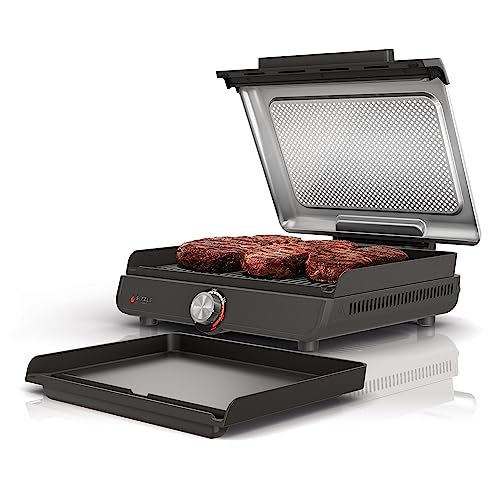


As an Amazon Associate we earn from qualifying purchases at no extra cost to you. Ratings are shown as listed on Amazon.
Best indoor smokeless grills by situation
| Best for | Recommended type or model | Typical cooking area | Typical price range | Main compromise |
|---|---|---|---|---|
| Most precise cooking | Ninja Foodi Smart XL Indoor Grill AG551 | About 100 sq. in. grill surface | $180–$280 | Large, heavy, and has several parts to clean |
| Families and regular use | Hamilton Beach Electric Indoor Searing Grill 25361 | About 118 sq. in. | $70–$130 | Less automated temperature guidance |
| Small kitchens and beginners | George Foreman Smokeless-Digital Smart Select GR150B or similar | About 90 sq. in. | $45–$90 | Less room for thick or irregular food |
| Lowest-cost large cooking area | Open electric smokeless-grill design | Roughly 120–150 sq. in. | $50–$100 | Usually needs more counter ventilation and wiping |
1. Ninja Foodi Smart XL Indoor Grill: best for control and heat recovery
The Ninja Foodi Smart XL Indoor Grill AG551 is the strongest choice when cooking accuracy matters more than size or simplicity. It combines a grill grate with air-frying and roasting functions, reaches temperatures up to approximately 500°F, and uses a temperature probe to guide cooking.
Its covered design helps contain grease and reduces the amount of airborne smoke compared with an uncovered skillet. The lid also retains heat when food is added, although recovery still depends on how much cold food is loaded at once. A few burgers will recover more quickly than a full load of refrigerated steaks.
The grill surface is suitable for several portions, but the appliance occupies substantial counter space and weighs considerably more than a basic electric grill. It is best for cooks who grill at least once a week and will use the additional cooking modes. If you only want chicken breasts or sandwiches, the extra electronics and accessories may not justify the cost.
Smoke and grease performance
The removable splatter shield, cooking basket, grill grate, and grease-management components are the key ownership advantages. They keep fat away from the main heating element and make the unit easier to maintain than a grill with a fixed interior. However, grease can accumulate on the shield, where it eventually becomes smoky if it is not washed regularly.
2. Hamilton Beach Electric Indoor Searing Grill: best balance for families
The Hamilton Beach Electric Indoor Searing Grill 25361 is a better fit for someone who wants a dedicated grill rather than a multifunction countertop oven. Its cooking area is about 118 square inches, large enough for several burgers, chicken portions, or vegetables without moving to a second batch immediately.
A viewing window reduces the temptation to lift the lid repeatedly. That matters because opening the lid releases heat and lengthens recovery time. The adjustable temperature control reaches roughly 450°F, giving it enough heat for searing while remaining simpler than a digitally controlled smart grill.
The water-filled drip tray is central to its smoke-reduction strategy. It catches drippings and helps cool grease before it burns. Fill it to the indicated level, but do not overfill: too much water can make cleanup messy and may interfere with moving the tray safely.
This model is a practical middle ground. It has more surface area than many compact grills, removable cooking parts, and a relatively accessible price. Its limitation is that temperature feedback is less sophisticated, so the user needs to judge doneness with timing, appearance, or a separate food thermometer.
3. George Foreman Smokeless-Digital Smart Select: best for small spaces and easy routines
A George Foreman Smokeless-Digital Smart Select model such as the GR150B suits apartments, dorm-style kitchens, and cooks who value uncomplicated cleanup. Its approximately 90-square-inch surface is enough for a couple of servings, but it becomes crowded when cooking thick steaks or multiple large chicken pieces.
The sloped nonstick plates direct fat toward the drip area, and the compact footprint is easier to store than a large lidded grill. Some versions include digital controls and removable dishwasher-safe plates; confirm the exact configuration before buying because accessories and cleaning instructions vary between models.
The smaller surface heats quickly but has less thermal reserve. Adding a large amount of cold food can lower the grate temperature more noticeably than it would on a heavier grill. For best results, cook in a single uncrowded layer and allow the plates to preheat fully.
What “smokeless” performance actually depends on
Smoke reduction
Covered grills generally control smoke better than open griddles because the lid traps splatter and directs hot air through a more controlled path. Water-tray models can reduce burning grease, while lidded convection grills often use a splatter screen. Neither approach removes the need for ventilation.
Heat recovery
Heat recovery is influenced by wattage, plate mass, lid design, and how much food is added. A grill that reaches a high advertised temperature may still struggle after loading six cold portions. Avoid crowding, bring food close to room temperature when food-safety practices allow, and keep the lid closed during cooking.
Grease management
Look for a deep, removable drip tray rather than a shallow channel that must be wiped from inside the appliance. Sloped plates help with fatty foods, but they can also dry lean foods if the slope is steep. A water reservoir reduces burning drippings but creates another part to fill, carry, and wash.
Decision matrix: which grill fits your routine?
| Your situation | Prioritize | Best fit | Why |
|---|---|---|---|
| One or two users, limited counter space | Small footprint and quick cleanup | George Foreman smokeless model | Compact surface and simple grease drainage |
| Three or four servings several times weekly | Surface area and stable heat | Hamilton Beach Electric Indoor Searing Grill | Dedicated grill layout with about 118 sq. in. of space |
| Beginner who wants doneness guidance | Probe and automated programs | Ninja Foodi Smart XL Indoor Grill | Temperature probe and broader cooking modes |
| Very smoke-sensitive apartment | Covered design and low-fat foods | Lidded indoor grill, preferably with a splatter shield | Contains grease better than an open grill |
| Occasional use under a strict budget | Few parts and low purchase cost | Basic removable-plate electric grill | Less expensive and easier to store |
Apartment-friendly setup and cleanup
- Position the grill under active ventilation. Use a range hood that vents outdoors if available. Otherwise open a nearby window and use a fan to move air out, not directly across the food.
- Install the drip tray or water reservoir before preheating. This prevents grease from reaching hot internal surfaces and avoids handling a hot tray later.
- Preheat with the lid closed. Preheating typically takes about 5–10 minutes, depending on the model and target temperature. A fully heated surface improves browning and reduces the time food releases moisture.
- Trim excess fat and avoid aerosol cooking sprays. Aerosols can leave residue on nonstick surfaces. Use a small amount of oil applied to the food or a compatible brush instead.
- Cool the appliance before washing removable parts. Wipe grease while it is still soft, but never immerse an electrical base or pour water into its interior.
- Clean the splatter shield every few uses. This is often the first overlooked component to become smoky. A film of old grease can burn even when the current meal is lean.
Ownership costs and durability
For a simple cost-per-use estimate, a $100 grill used twice a week for three years provides about 312 uses, or roughly $0.32 per use before electricity and food. A $230 multifunction grill used once weekly for the same period provides about 156 uses, or approximately $1.47 per use. The cheaper grill is not automatically better value if it is too small and forces frequent batches.
Nonstick coatings and removable drip trays usually wear before the heating element. Metal utensils, abrasive scrubbers, dishwasher heat, and stacking heavy cookware on the plates can shorten their life. Replacement plates, shields, and trays may not be available indefinitely, so check parts support before purchasing an unusual model.
Do not use an indoor grill outdoors, on an unstable surface, or beneath a cabinet with insufficient clearance. For the least smoke, choose leaner cuts, keep grease channels clear, and treat “smokeless” as a smoke-reduction feature rather than a promise of completely emission-free cooking.
Final recommendation
Choose the Ninja Foodi Smart XL Indoor Grill if temperature guidance, covered cooking, and multifunction use are worth its size and cleaning workload. Choose the Hamilton Beach Electric Indoor Searing Grill for the best balance of cooking area, price, and dedicated-grill simplicity. Choose a George Foreman Smokeless-Digital model when storage space, low cost, and quick apartment cleanup matter most.


