
Key takeaways
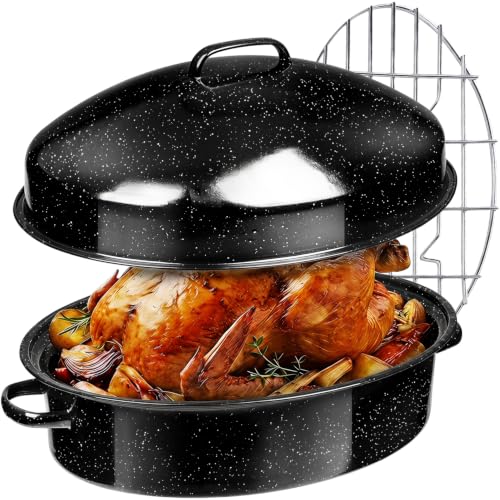
- Best overall for occasional holiday cooking: Granite Ware 18-Quart Covered Oval Roaster. It is inexpensive to operate, light enough to handle when empty, and its close-fitting lid helps a pre-cooked ham stay moist.
- Best electric option: Nesco 18-Quart Roaster Oven. It frees the main oven for side dishes and provides a separate thermostat, although its heating pattern is better suited to gentle reheating than aggressive browning.
- Best for a large gathering: Hamilton Beach 28-Quart Turkey Roaster. The extra headroom and domed lid are useful for a large whole ham, but measure your counter and storage cabinet first.
- Best for browning and long-term durability: A heavy-duty stainless-steel roasting pan with a substantial rack. Metal construction distributes heat predictably in an oven and tolerates repeated use, but you may need foil for a tighter cover.
The best ham roaster for holiday cooking is the Granite Ware 18-Quart Covered Oval Roaster for a traditional whole ham, while the Hamilton Beach 28-Quart Turkey Roaster is the more useful choice for oversized hams, frequent entertaining, and cooks who want electric temperature control.
Ham roasting is less about maximum capacity than about matching the pan’s interior shape, lid clearance, rack support, and heat behavior to the ham you buy. A whole bone-in ham needs length and vertical clearance; a spiral-cut ham is usually easier to fit but benefits from a tight lid that limits moisture loss.
Our top picks


As an Amazon Associate we earn from qualifying purchases at no extra cost to you. Ratings are shown as listed on Amazon.
Best ham roasters compared
| Roaster | Capacity and construction | Temperature control | Best ham type | Main limitation |
|---|---|---|---|---|
| Granite Ware 18-Quart Covered Oval Roaster | 18 qt; carbon-steel core with porcelain enamel; removable rack | Oven-controlled | Medium whole or spiral-cut ham | Requires oven space and has no independent thermostat |
| Nesco 18-Quart Roaster Oven | 18 qt; electric roaster with removable cookwell and rack | Adjustable electric heat control, generally 200–450°F | Medium whole or spiral-cut ham | Oval footprint can be tight for very long hams |
| Hamilton Beach 28-Quart Turkey Roaster | 28 qt; electric cookwell, domed lid, rack | Adjustable electric control, generally up to 450°F | Large whole ham or multiple smaller cuts | Bulky to store and uses more counter space |
| Heavy-duty stainless-steel roasting pan, 16–18 in. | Usually 12–20 qt equivalent; stainless steel with V-rack or flat rack | Oven-controlled | Whole ham, especially when browning matters | Lid may be absent or loosely fitting |
Capacity figures describe the nominal vessel size, not the amount of ham it can safely hold. The rack, lid shape, and clearance above the ham reduce usable space. Check interior measurements before buying, particularly for a bone-in ham.
Best choices by cooking situation
- Best overall for occasional holiday cooking: Granite Ware 18-Quart Covered Oval Roaster. It is inexpensive to operate, light enough to handle when empty, and its close-fitting lid helps a pre-cooked ham stay moist.
- Best electric option: Nesco 18-Quart Roaster Oven. It frees the main oven for side dishes and provides a separate thermostat, although its heating pattern is better suited to gentle reheating than aggressive browning.
- Best for a large gathering: Hamilton Beach 28-Quart Turkey Roaster. The extra headroom and domed lid are useful for a large whole ham, but measure your counter and storage cabinet first.
- Best for browning and long-term durability: A heavy-duty stainless-steel roasting pan with a substantial rack. Metal construction distributes heat predictably in an oven and tolerates repeated use, but you may need foil for a tighter cover.
Granite Ware 18-Quart Covered Oval Roaster: the practical traditional pick
The Granite Ware oval roaster is a strong match for a roughly 8–15 pound ham, depending on its actual length and height. Its dark porcelain-enamel surface absorbs heat efficiently, and the oval form follows the shape of many bone-in hams better than a rectangular casserole dish.
The removable rack keeps the ham above its juices, which improves heat circulation and makes it easier to lift the finished ham out. The rack is more important than it may appear: placing the ham directly on the bottom can cause the underside to sit in liquid, soften the glaze, and make removal awkward.
Its covered design is particularly helpful for spiral-cut ham. Spiral slices expose more surface area and can dry out at the edges. A snug lid reduces evaporation, while the lid’s height still needs to clear the ham’s highest point without pressing on the glaze.
The compromise is browning. Enclosed roasting traps moisture, so the exterior may remain softer than it would in an open stainless pan. For a darker finish, remove the lid for the final 15–25 minutes and apply glaze only after the surface has warmed.
Nesco 18-Quart Roaster Oven: best when oven space is the problem
The Nesco 18-quart electric roaster is useful when holiday timing is crowded. It can reheat the ham while the kitchen oven handles rolls, vegetables, and casseroles. The removable cookwell also makes serving and cleanup less cumbersome than washing a fixed appliance interior.
Its adjustable thermostat gives more control than a passive covered pan, but the unit is primarily a moist-heat roaster. The lid and enclosed heating environment favor tenderness and heat retention rather than a deeply browned crust. If appearance is important, transfer the ham to a shallow oven-safe pan for a short finishing stage under the main oven’s heat.
Plan for approximately 2–3 inches of clearance around the appliance’s vents and keep it on a heat-resistant, stable surface. An electric roaster is not a good choice if it must be squeezed tightly between cabinets or placed where its cord can be pulled.
Hamilton Beach 28-Quart Turkey Roaster: room for the largest hams
The 28-quart Hamilton Beach model is designed around large holiday roasts and has more useful vertical clearance than a standard 18-quart vessel. That makes it the safer choice when a whole ham is long, tall, or still has a prominent bone and uneven shape.
The domed lid reduces the chance that the ham will touch the cover, and the included rack supports larger cuts above the cooking liquid. It is also useful for entertaining because the extra capacity allows a generous layer of liquid without crowding the meat.
Its disadvantages are practical rather than culinary. A large electric roaster can weigh more than 20 pounds once the cookwell, rack, lid, and food are assembled. It needs a permanent storage plan, and its large lid is awkward to wash in a small sink. Choose it for capacity you will use, not simply because the number is larger.
When a stainless-steel roasting pan is better
A 16–18-inch stainless-steel pan with a V-shaped or flat roasting rack is the strongest option for cooks who prioritize exterior color, pan longevity, and versatility. Stainless steel is nonreactive, resists chipping, and works well for making pan juices or glaze reductions after the ham is removed.
Look for a pan with sides at least 2½–3 inches high, two sturdy handles, and a rack that leaves at least ½ inch of clearance beneath the meat. A rack with broad supports is preferable to thin wires that can press into a soft ham or bend under its weight.
The lid fit varies widely. A fitted lid retains moisture better than foil, but foil can still work if it is tented above the glaze rather than pressed against it. For a spiral-cut ham, seal the foil around the pan rim during the main heating period and uncover it only for glazing.
Whole ham versus spiral-cut ham
Whole bone-in ham
Measure the ham from end to end, then measure its height at the tallest point. Add about 2 inches to the length and 1 inch to the height for comfortable handling and heat circulation. For example, a ham measuring 14 inches long and 6 inches high should go into a pan with at least 16 inches of usable length and approximately 7 inches of lid clearance.
Whole hams are less uniform than spiral-cut products, so rack stability matters. A flat rack is often easier for a large, irregular ham, while a V-rack centers a narrower ham and leaves more room for liquid underneath.
Spiral-cut ham
Spiral-cut hams usually fit smaller roasters because they are more compact and are often sold fully cooked. Their cut surfaces make moisture retention the priority. Choose a covered roaster, keep the ham cut-side down when possible, and avoid repeatedly opening the lid.
Do not assume a spiral-cut ham needs high heat for browning. Excessive heat can darken the glaze before the interior is warm. Use the package’s heating instructions and confirm the center with an instant-read thermometer rather than relying on the exterior appearance.
How to set up and clean a ham roaster
- Measure before unwrapping. Confirm the ham, rack, and lid fit together. A lid that touches the meat can strip away glaze and interfere with even heating.
- Use a shallow amount of liquid. Add roughly ½–1 inch of water, cider, or stock, keeping the liquid below the rack. Too much liquid steams the exterior and dilutes drippings.
- Cover during reheating. Keep the lid closed for most of the cooking time. Add glaze near the end, when it has less time to burn.
- Finish uncovered if needed. Remove the lid for 15–25 minutes to set the glaze, or move the ham to a shallow pan for stronger browning.
- Soak before scrubbing. Let the pan cool, pour off fat, and soak stuck-on glaze in warm water. Nylon utensils are safer than metal tools on porcelain enamel and nonstick cookwells.
- Inspect the rack and lid seal. Bent rack wires, chipped enamel, and distorted lids are the parts most likely to reduce performance over time.
Final buying decision
Choose the Granite Ware 18-quart roaster if you cook one medium ham once or twice a year and already have a reliable oven. Choose the Nesco 18-quart model if freeing oven space is more valuable than maximum browning. Choose the Hamilton Beach 28-quart roaster for a large, tall whole ham or frequent holiday hosting. For the best crust, pan juices, and long-term versatility, select a heavy stainless-steel pan with a well-supported rack and use foil as a temporary lid.
The right fit matters more than the largest capacity: a close lid for spiral-cut ham, adequate clearance for a whole ham, and a stable rack will do more for the finished result than an extra several quarts of nominal volume.


