Key takeaways
- Use a roof, trunk-lip, or other mechanically sound mounting point rather than leaving the antenna inside the cabin.
- Route coaxial cable away from sharp bends, hinges, and hot engine components.
- Connect power with an appropriately fused lead close to the battery.
- Check the antenna system with an SWR meter or antenna analyzer before extended transmitting.
- Use a genuine external speaker or remote head when road noise makes the built-in speaker difficult to hear.
The best ham radios for most beginners are the Yaesu FT-60R for a durable handheld, the Icom IC-2730A for a dependable mobile installation, and the Icom IC-7300 for operators ready to explore HF from a home station; the right choice depends more on antenna space, operating bands, and emergency range than on transmitter wattage alone.
Our top picks


As an Amazon Associate we earn from qualifying purchases at no extra cost to you. Ratings are shown as listed on Amazon.
Quick comparison: handheld, mobile, and base-station radios
| Radio type and example | Typical output | Frequency coverage | Antenna setup | Programming difficulty | Practical emergency range |
|---|---|---|---|---|---|
| Yaesu FT-60R handheld | 5 W maximum; lower power settings available | Receive coverage across much of 108–999 MHz; transmit on supported 2 m and 70 cm amateur bands | Removable 2 m/70 cm whip; optional outdoor or vehicle antenna | Moderate from the keypad; easier with a programming cable and software | About 1–5 miles handheld-to-handheld; more with elevation or a repeater |
| Icom IC-2730A mobile | 50 W on VHF and UHF, with lower power settings | Dual-band 2 m and 70 cm FM | Vehicle-mounted dual-band antenna or a fixed outdoor antenna | Moderate; front-panel menus are manageable after setup | About 5–25 miles simplex in favorable terrain; substantially farther through repeaters |
| Yaesu FTM-500DR mobile | Up to 50 W on VHF/UHF | 2 m and 70 cm, including digital C4FM features | Permanent vehicle or base antenna recommended | Moderate to high because of digital and memory options | Comparable to other 50 W VHF/UHF radios on simplex; digital repeater coverage varies |
| Icom IC-7300 base station | 100 W maximum | HF amateur bands from 160 through 6 meters, depending on operating mode and configuration | Dipole, end-fed wire, vertical, or other resonant/tuned HF antenna | Moderate; touchscreen controls reduce menu hunting | Regional to worldwide on HF when propagation and antenna conditions cooperate |
These ranges are planning estimates, not guarantees. Terrain, buildings, antenna height, interference, weather, frequency, repeater access, and the other station’s equipment can matter more than the nominal wattage.
Best ham radios by situation
| Your situation | Best fit | Why | Important limitation |
|---|---|---|---|
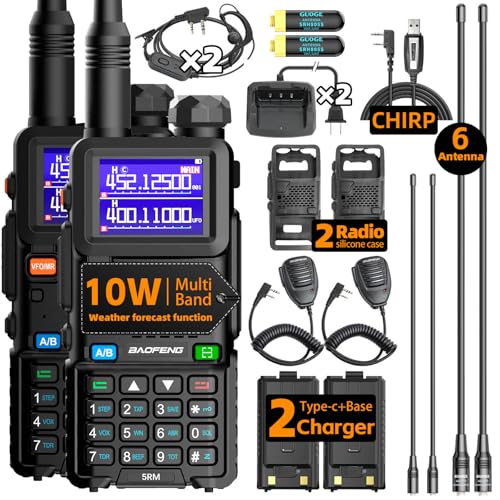
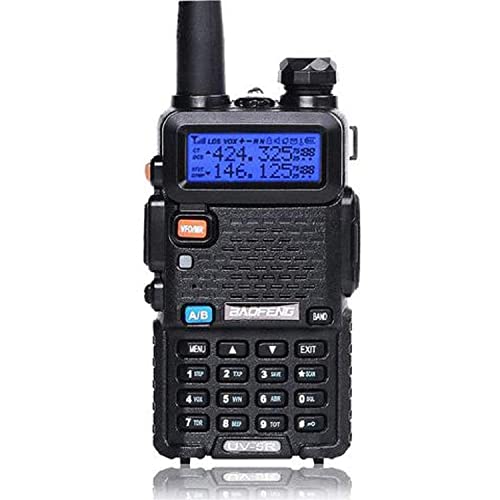
| Lowest-cost introduction to local VHF/UHF | Basic dual-band handheld, such as the Baofeng UV-5R family | Low purchase cost, removable battery, widespread accessories | Quality control, receiver performance, documentation, and user interface vary; verify programming and legal settings carefully |
| One durable handheld for hiking and emergency preparation | Yaesu FT-60R | Rugged construction, straightforward analog operation, and a strong accessory ecosystem | It is not a modern digital-mode handheld and its standard battery is modest by current high-capacity standards |
| Reliable communication around a vehicle or property | Icom IC-2730A | 50 W, dual-band operation, and a simpler feature set than many digital radios | Requires a properly installed antenna, power wiring, and a suitable mounting location |
| Digital repeater and APRS-oriented mobile operation | Yaesu FTM-500DR | High-quality display, dual-receive features, and Yaesu System Fusion C4FM support | Digital benefits depend on compatible repeaters and other operators |
| First serious home station for local and long-distance work | Icom IC-7300 | 100 W HF output, effective spectrum display, and a relatively approachable control layout | Needs an HF antenna, feed line, grounding strategy, and more operating knowledge than a VHF handheld |
Handheld radios: portable and inexpensive, but antenna-limited
Handhelds are the easiest entry point because they combine the transceiver, battery, controls, and antenna in one package. They are well suited to neighborhood communication, organized events, hiking groups, and reaching local repeaters.
The main weakness is not usually the transmitter. A 5 W handheld connected to a short rubber antenna is an inefficient station compared with a lower-power radio connected to a full-size antenna outdoors. Holding the radio against your body, operating indoors, or standing behind a hill can reduce the usable signal dramatically.
Yaesu FT-60R: the dependable analog choice
The FT-60R is a sensible choice for beginners who value durability and conventional controls over digital features. It operates on the common 2-meter and 70-centimeter amateur bands, offers up to 5 W, and uses a removable 1,400 mAh-class battery. Its receiver covers a broad range, but receive capability does not mean that the radio can transmit on every frequency it receives.
Its programming is more manual than modern menu-driven radios. Entering a few local repeater memories from the keypad is reasonable; loading dozens of channels is much easier with a computer, a compatible cable, and software such as CHIRP or the manufacturer’s programming tools.
Low-cost handhelds: useful learning tools with caveats
Models in the Baofeng UV-5R family are attractive because they are inexpensive and widely supported. They can be practical for learning basic VHF/UHF operation, but owners should confirm the exact model, use a reputable programming procedure, and avoid transmitting outside authorized amateur frequencies. Some inexpensive radios have less selective receivers and less consistent filtering than established-brand alternatives, which can matter in crowded urban areas.
Mobile radios: the best range-per-dollar upgrade
A mobile radio usually delivers 25–50 W and can use a properly mounted quarter-wave, half-wave, or gain antenna. That combination normally provides a bigger real-world improvement than simply replacing a 5 W handheld with another handheld.
The Icom IC-2730A is a strong analog choice for a vehicle or fixed station. It provides 50 W on VHF and UHF and can monitor both bands. Its operation is less complicated than that of a feature-heavy digital radio, making it suitable for a driver who wants dependable local communication without learning several digital ecosystems.
The Yaesu FTM-500DR is better suited to operators who specifically want C4FM digital features, a modern display, and more advanced memory and scanning options. Digital voice can sound clear at the edge of coverage, but it does not create extra radio horizon. If the repeater is unreachable, digital mode cannot compensate for missing signal.
Installation matters more than the advertised wattage
- Use a roof, trunk-lip, or other mechanically sound mounting point rather than leaving the antenna inside the cabin.
- Route coaxial cable away from sharp bends, hinges, and hot engine components.
- Connect power with an appropriately fused lead close to the battery.
- Check the antenna system with an SWR meter or antenna analyzer before extended transmitting.
- Use a genuine external speaker or remote head when road noise makes the built-in speaker difficult to hear.
A 50 W transmitter draws substantially more current than a handheld. For a 50 W VHF/UHF radio, allow roughly 10–12 amps of supply capacity, following the manufacturer’s specifications. A vehicle battery is not a substitute for a regulated power supply or a backup power plan.
Base stations: the widest range, with the most planning
A base station is the best option when you want reliable operation from home, access to HF, or a permanent antenna mounted above nearby obstructions. The Icom IC-7300 is a popular first HF transceiver because its 100 W output, touchscreen interface, and real-time spectrum display make band activity easier to understand.
HF range is different from VHF/UHF range. A VHF handheld generally depends on line of sight or a repeater. An HF station can communicate hundreds or thousands of miles through ionospheric propagation, but performance changes by time of day, solar conditions, frequency, antenna, and operating mode. A 100 W radio with a poor or badly installed antenna may perform worse than a lower-powered station with an efficient antenna.
For limited space, an end-fed wire or compact vertical can be workable, but each has trade-offs in efficiency, grounding, tuning, and noise pickup. A simple resonant dipole often offers an excellent balance if you have enough room to install it safely.
Programming difficulty and ownership costs
Radio programming is often the first frustration for new operators. Start with a small channel list: local repeaters, national calling frequencies, simplex channels, and receive-only emergency information channels where appropriate. Record the frequency, offset, tone, mode, and bandwidth for every memory. Never assume a downloaded codeplug is correct for your region.
A realistic starter budget illustrates why the antenna should not be an afterthought:
- Handheld: approximately $30–$250, depending on brand and features.
- Programming cable and spare battery: approximately $20–$80.
- Mobile radio: approximately $180–$600.
- Mobile antenna, mount, coax, and installation materials: approximately $50–$250.
- HF base station: approximately $700–$1,500 for the transceiver, before antenna and feed-line costs.
For example, a 5 W handheld costing $100 may appear cheaper than a $300 mobile radio, but adding a $40 programming cable, $35 spare battery, and $70 outdoor antenna can bring the handheld setup to $245. If the mobile radio and installation total $450, the extra $205 buys a substantially better antenna system and roughly ten times the transmitter output. That does not guarantee ten times the range, but it often improves reliability far more than a second handheld upgrade.
What wears out first
- Batteries: Lithium-ion packs commonly lose useful capacity after several years or hundreds of charge cycles. Store them partly charged and away from extreme heat.
- Antenna connectors: Repeatedly bending a handheld whip or tightening a vehicle connector can loosen or damage the connector.
- Coax and mounts: Water intrusion, crushed coax, rust, and vibration are common causes of declining mobile performance.
- Keypads and displays: Dust, moisture, and impact are more damaging than normal transmission time.
- Memory configuration: Incorrect offsets and tones create more failed contacts than most radio hardware faults.
Clean contacts with appropriate electronics-safe methods, inspect outdoor connectors periodically, and keep a printed channel list with your emergency equipment. Transmit only where your license and local regulations allow, and remember that amateur radio is not automatically private or encrypted.
Final recommendation
Choose a durable analog handheld such as the Yaesu FT-60R if portability and simplicity come first. Choose the Icom IC-2730A when dependable local coverage from a vehicle or property matters more than pocket size. Choose the Yaesu FTM-500DR for a VHF/UHF mobile station centered on modern digital features. Choose the Icom IC-7300 when your goal is a permanent station capable of regional and worldwide HF communication. In every category, prioritize a correctly installed antenna, accurate programming, spare power, and practice before an emergency occurs.