Key takeaways
- Pressed audio CDs: the safest choice and usually the fastest to navigate.
- CD-R: generally more reliable than CD-RW, especially when recorded once and finalised.
- CD-RW: useful for rewriting discs but more dependent on the player and disc quality.
- MP3 and WMA: widely supported by these models, but folder depth, bitrate and filename limits vary.
- FLAC, WAV and AAC: more relevant to USB playback; do not assume that a player will decode them from a data CD.
The best CD players in 2026 are the Marantz CD6007 for a serious hi-fi system, the Yamaha CD-S303 for dependable all-round value, the Cambridge Audio AXC35 for a simple separates system, and the TEAC PD-301DAB-X when shelf space matters most.
Our top picks


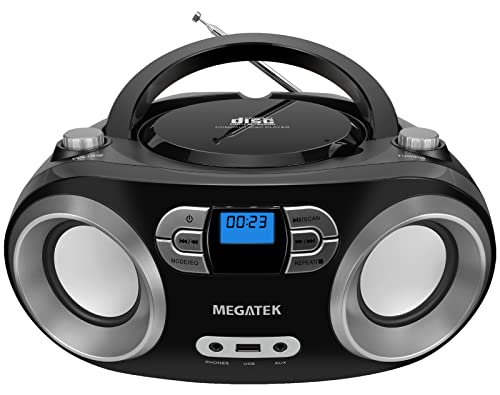

As an Amazon Associate we earn from qualifying purchases at no extra cost to you. Ratings are shown as listed on Amazon.
Best CD players at a glance
| Player | Best for | Disc and file compatibility | Main outputs | Approx. size and weight |
|---|---|---|---|---|
| Marantz CD6007 | Detailed hi-fi listening | Audio CD, CD-R/RW, MP3, WMA; front USB supports MP3, WMA, AAC, WAV and FLAC | RCA line, coaxial digital | 439 × 104 × 328 mm; 6.5 kg |
| Yamaha CD-S303 | Reliable everyday use | Audio CD, CD-R/RW, MP3, WMA; front USB for compatible files | RCA line, optical digital, coaxial digital | 435 × 87 × 260 mm; 3.5 kg |
| Cambridge Audio AXC35 | Affordable hi-fi separates | Audio CD, CD-R/RW, MP3, WMA | RCA line, coaxial digital | 430 × 75 × 305 mm; 4.3 kg |
| Denon DCD-900NE | CD plus USB playback | Audio CD, CD-R/RW, MP3, WMA, AAC and WAV/FLAC through USB, subject to file limits | RCA line, optical digital, coaxial digital | 434 × 107 × 328 mm; 4.9 kg |
| TEAC PD-301DAB-X | Compact systems and small rooms | Audio CD, CD-R/RW, MP3 and WMA; USB playback; also includes DAB/DAB+ and FM radio | RCA line, coaxial digital | 215 × 110 × 290 mm; about 2.1 kg |
Dimensions are approximate manufacturer figures and may exclude protruding controls or cables. Compatibility can also vary with disc-finalisation, recording software, file format and USB storage.
Our picks by listening situation
Best overall for a traditional hi-fi system: Marantz CD6007
The Marantz CD6007 is the strongest choice when the CD player is an important source rather than an occasional accessory. Its full-width 439 mm chassis matches most integrated amplifiers, while its front USB input adds playback from compatible flash drives. The player provides both analogue RCA and coaxial digital output, so it can feed either an amplifier directly or an external DAC.
Its remote is more useful than a basic transport remote because it includes direct track selection, repeat, random playback and programming controls. The trade-off is size: at roughly 6.5 kg, it is designed for a stable hi-fi rack rather than a narrow shelf. It is also typically priced in the upper mid-range, often around £450–£600, $550–$700 or equivalent depending on region and discounts.
Best value for mixed CD and USB listening: Yamaha CD-S303
The Yamaha CD-S303 is a sensible choice for listeners who want a conventional CD player with straightforward operation and modern connections. It has analogue RCA, optical and coaxial digital outputs, making it unusually flexible at its general market price of about £250–£350 or $300–$400.
Yamaha’s Pure Direct mode disables unnecessary display and digital circuitry when using the analogue output. This is not a guarantee of a dramatic audible improvement, but it can be useful if the player is connected directly to an integrated amplifier and you prefer the shortest practical signal path. The front USB port is convenient for MP3 and WMA files, although it is not a replacement for a network streamer: USB navigation is based on folders and filenames, not a streaming-library interface.
Best simple separates player: Cambridge Audio AXC35
The Cambridge Audio AXC35 suits someone who wants a clean, uncomplicated disc player for a stereo amplifier. It reads standard audio CDs and compatible CD-R/RW discs, including MP3 and WMA data discs, and offers both RCA analogue and coaxial digital output. Its slim 75 mm height makes it easier to position than taller full-size players.
This is the pick for an owner who mostly plays commercially pressed CDs and does not need USB, Bluetooth, radio or an optical output. Fewer features also mean fewer menu decisions. The remote handles the essentials, including track selection, repeat, shuffle and programming. Expect a typical market range of roughly £250–£350 or $300–$400.
Best for a small cabinet: TEAC PD-301DAB-X
The TEAC PD-301DAB-X is substantially narrower than standard hi-fi components, measuring about 215 mm across. It is suitable for a compact stereo arrangement, desktop system or second room where a 430–440 mm component will not fit. In addition to CD and USB playback, it includes DAB/DAB+ and FM radio.
Its smaller chassis does not mean it is a portable player: it still needs mains power and a suitable amplifier or powered speaker system. Check the rear-panel connections before buying, particularly if your amplifier accepts only optical digital input. The compact remote has more buttons packed into a smaller layout than a full-size hi-fi remote, so it is functional rather than especially luxurious.
Disc compatibility matters more than the logo on the tray
Every player listed here handles standard pressed audio CDs, but recordable discs are less predictable. CD-R and CD-RW discs may fail to load when they were recorded in an unsupported format, left unfinalised, written at poor quality or degraded with age. A disc containing MP3 files is not the same as a normal audio CD: it relies on the player reading a data directory and decoding the file type.
- Pressed audio CDs: the safest choice and usually the fastest to navigate.
- CD-R: generally more reliable than CD-RW, especially when recorded once and finalised.
- CD-RW: useful for rewriting discs but more dependent on the player and disc quality.
- MP3 and WMA: widely supported by these models, but folder depth, bitrate and filename limits vary.
- FLAC, WAV and AAC: more relevant to USB playback; do not assume that a player will decode them from a data CD.
If you have a large collection of home-recorded discs, prioritise a retailer with a clear returns policy and buy a player with a readable display and responsive track navigation. For ordinary commercial CDs, all five options should be much less demanding.
Choose the output before choosing the player
Use the analogue RCA output when connecting directly to an integrated amplifier, stereo receiver or powered speakers with analogue inputs. This is the normal, simplest arrangement: red to red, white to white, then select the corresponding input on the amplifier.
Use coaxial or optical digital output when an external DAC, AV receiver or digital amplifier will perform the conversion. Coaxial often supports a more robust physical connector, while optical avoids an electrical connection between components and can help with ground-loop problems. Neither connection automatically sounds better; the receiving DAC and the quality of the entire system matter more.
Do not buy a player with only digital output if your amplifier has only analogue inputs. Conversely, avoid paying extra for a high-end analogue stage if you already intend to use an external DAC and the player has a suitable digital output.
A practical decision matrix
| Your situation | Best direction | Why |
|---|---|---|
| Mostly commercial CDs, modest budget | Cambridge Audio AXC35 or Yamaha CD-S303 | Reliable core playback without paying for networking features |
| CDs plus USB files | Yamaha CD-S303 or Marantz CD6007 | Front USB and broader everyday file flexibility |
| High-resolution USB library | Marantz CD6007 or Denon DCD-900NE | More capable USB decoding than a basic CD-only design |
| Less than 300 mm of shelf width | TEAC PD-301DAB-X | Compact footprint with CD, USB and radio in one chassis |
| External DAC or AV receiver | Yamaha CD-S303 or Denon DCD-900NE | Optical and coaxial digital choices provide easier system matching |
| Several hours of daily use | Marantz CD6007 or Yamaha CD-S303 | Full-size controls, stable chassis and easier long-term servicing |
Reliability, maintenance and ownership costs
The optical pickup and loading mechanism are the parts most likely to wear first. A tray that opens slowly, a disc that repeatedly skips at the same point, or a player that struggles to recognise clean discs can indicate mechanical or optical problems. These faults are not always fixed by cleaning, and replacing an ageing pickup may cost enough to make a new player more sensible.
Keep discs clean by wiping from the centre outward with a soft, lint-free cloth. Do not use circular rubbing motions or household solvents. Keep the player ventilated, avoid stacking hot equipment directly on top, and do not force a tray that is obstructed. A laser-cleaning disc is not a universal cure and can create more confusion when the real problem is a worn mechanism or damaged disc.
A simple ownership calculation illustrates the value of choosing for frequency of use. If a £300 player is used for one CD every day over five years, that is about 1,825 listening sessions, or approximately 16 pence per session before electricity and discs. If it is used only twice a month, the same player provides about 120 sessions in five years, or £2.50 per session. Frequent listeners should therefore prioritise quiet operation, dependable transport mechanics and a comfortable remote; occasional listeners may get better value from the Yamaha or Cambridge model that fits the system without unnecessary features.
Final buying advice
Choose the Marantz CD6007 when analogue sound quality, a substantial chassis and USB flexibility are priorities. Choose the Yamaha CD-S303 for the broadest connection options and dependable everyday value. Pick the Cambridge Audio AXC35 for a straightforward CD-only separates system, the Denon DCD-900NE for a CD-and-USB library with digital-output flexibility, and the TEAC PD-301DAB-X when compact dimensions are the deciding factor.
Before ordering, measure the shelf including space for cables, confirm whether your amplifier needs RCA, optical or coaxial connection, and check the exact file formats used in your home-recorded collection. Those practical details matter more than small differences in advertised specifications.