Key takeaways
- Turntable: Confirm the cartridge type. MM and moving-coil (MC) cartridges require different phono compatibility; an MM-only input will not directly serve every MC cartridge.
- TV: HDMI ARC is convenient, but check that your TV supports ARC and configure audio output correctly. Optical is a useful alternative when HDMI control is unnecessary.
- Subwoofer: A subwoofer output does not always mean the amplifier applies a high-pass filter to the main speakers. Check whether bass management is available if you want the subwoofer to take over low frequencies.
- Heat and placement: Leave ventilation space above and around the chassis. Enclosed shelves can trap heat and shorten component life; do not stack other warm equipment on top.
- Streaming support: Services and software features can change. Verify support for your preferred app, multiroom platform, and connection method before buying rather than assuming every “network” amplifier works with every service.
Best Integrated Amplifiers for Stereo Music Systems
The best integrated amplifier depends on your speakers and room: choose the WiiM Amp Pro for an affordable streaming system, the Yamaha A-S501 for a flexible conventional setup, the Marantz Model 40n for a polished streaming-and-vinyl system, or the Hegel H190v for demanding speakers and larger rooms.
An integrated amplifier combines a preamplifier and power amplifier in one chassis, often adding a digital converter, phono input, or network streaming. The right choice is not simply the model with the biggest wattage. Check power at your speakers’ impedance, the inputs you actually need, and whether the amp’s streaming and phono features replace equipment you would otherwise buy.
Our top picks

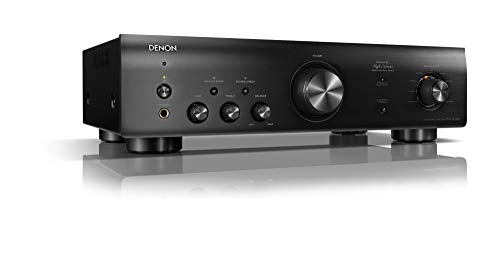
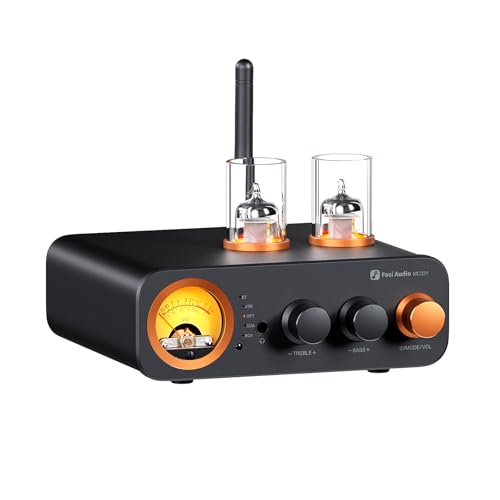

As an Amazon Associate we earn from qualifying purchases at no extra cost to you. Ratings are shown as listed on Amazon.
Quick comparison
Power ratings are not perfectly comparable: manufacturers may use different test conditions, distortion limits, and channels. Treat the figures below as a starting point, then check the manual for the rating at your speakers’ impedance.
| Model | Rated power | Impedance guidance | Useful features | Best fit |
|---|---|---|---|---|
| WiiM Amp Pro | Up to 60 W/channel at 8 ohms; up to 120 W/channel at 4 ohms | Designed for 4–8-ohm passive speakers | Wi-Fi streaming, HDMI ARC, subwoofer output, room correction | Compact, budget streaming systems |
| Yamaha A-S501 | 85 W/channel at 8 ohms | Supports 4-ohm speakers under specified conditions; consult the manual | Optical and coaxial digital inputs, analog inputs, subwoofer output | Traditional systems with several sources |
| Marantz Model 40n | 70 W/channel at 8 ohms; 100 W/channel at 4 ohms | Suitable for a range of 4–8-ohm speakers | HEOS streaming, HDMI ARC, MM phono input, subwoofer output | One-box streaming and vinyl setup |
| Hegel H190v | 150 W/channel at 8 ohms | High-current design; suited to demanding loads, but check speaker compatibility | Network streaming, digital inputs, MM phono stage | Large rooms or less-sensitive speakers |
Specifications can vary by region or product revision. Confirm the exact version’s manual before buying, particularly if you have low-impedance speakers.
Choose by your stereo setup
Small room, simple streaming: WiiM Amp Pro
For a desk, bedroom, or modest living room, the WiiM Amp Pro keeps the system compact and adds network streaming and HDMI ARC for TV sound. Its subwoofer output makes it easier to add bass without replacing the amplifier. It is a sensible match for efficient bookshelf speakers at ordinary listening levels; it is less compelling if you need a built-in phono stage or multiple high-end analog inputs.
Check speaker sensitivity as well as wattage. A speaker rated around 88 dB sensitivity generally needs less power for a given listening level than a similarly sized speaker rated around 84 dB. Room size, listening distance, and musical peaks also matter, so a small amplifier is not automatically enough just because the speakers are compact.
Several sources, no need for network streaming: Yamaha A-S501
The Yamaha A-S501 suits listeners connecting a CD player, TV, game console, or other digital source alongside analog gear. Its optical and coaxial inputs accept digital audio, while the subwoofer output supports a 2.1 system. If your music already comes from a separate streamer, this model avoids paying extra for overlapping network features.
It is also a practical choice when you want physical controls and a familiar stereo layout. If you plan to connect a turntable, verify whether it has a moving-magnet cartridge: the A-S501’s phono input is intended for MM cartridges, not every cartridge type.
Vinyl and streaming in one system: Marantz Model 40n
The Marantz Model 40n brings network streaming, HDMI ARC, and an MM phono input together. That combination makes it a good fit for a living room where music comes from both a turntable and online services, and the TV is part of the system. Its rated output is ample for many average-sized rooms and reasonably sensitive speakers.
Its main trade-off is cost: if you will use only one digital source and never stream, a simpler integrated amplifier may deliver better value. Its phono stage also does not remove the need to match the turntable’s cartridge type to the input.
Harder-to-drive speakers or a larger room: Hegel H190v
The Hegel H190v is the high-power option here, aimed at systems where speakers need more current or listening takes place farther away. Its network and digital inputs can also reduce the need for separate digital components. More power provides headroom for peaks, but it does not guarantee better sound in every system: speaker sensitivity, placement, room acoustics, and listening habits still determine whether that capacity is useful.
Before pairing any amplifier with a demanding speaker, check the speaker’s minimum impedance and the amplifier’s specified load limits. A nominal 8-ohm rating does not mean a speaker stays at 8 ohms at every frequency.
Match power to room and listening level
A rough estimate can help compare speaker sensitivity and amplifier power. For a speaker rated at 88 dB SPL at 1 watt and 1 metre, doubling power adds about 3 dB under idealized conditions: 1 W gives roughly 88 dB, 2 W about 91 dB, 4 W about 94 dB, and 8 W about 97 dB at 1 metre. Listening from farther away reduces the level, while two speakers, room reflections, and music dynamics complicate the estimate.
This is not a promise of actual room volume or a reason to push speakers to their limits. It illustrates why a sensitive speaker can work well with moderate power, while a less-sensitive model, long listening distance, or loud playback may call for more headroom. If you often hear harshness or distortion, turn down the volume; a larger amplifier is not a substitute for safe, sensible listening levels.
Use this decision matrix before buying
| Your situation | Prioritize | Shortlist |
|---|---|---|
| Small room, mostly streaming, limited budget | Compact size, network playback, simple setup | WiiM Amp Pro |
| Several wired sources and a separate streamer | Useful analog and digital inputs; avoid duplicate features | Yamaha A-S501 |
| Turntable, TV, and streaming in one living-room system | MM phono, HDMI ARC, built-in network audio | Marantz Model 40n |
| Large room or speakers that are difficult to drive | Power headroom and verified impedance compatibility | Hegel H190v |
These are starting points rather than guarantees. If a speaker has an unusually low impedance dip, or you listen loudly across a large room, ask the speaker or amplifier manufacturer about compatibility.
Check connections and ownership details
- Turntable: Confirm the cartridge type. MM and moving-coil (MC) cartridges require different phono compatibility; an MM-only input will not directly serve every MC cartridge.
- TV: HDMI ARC is convenient, but check that your TV supports ARC and configure audio output correctly. Optical is a useful alternative when HDMI control is unnecessary.
- Subwoofer: A subwoofer output does not always mean the amplifier applies a high-pass filter to the main speakers. Check whether bass management is available if you want the subwoofer to take over low frequencies.
- Heat and placement: Leave ventilation space above and around the chassis. Enclosed shelves can trap heat and shorten component life; do not stack other warm equipment on top.
- Streaming support: Services and software features can change. Verify support for your preferred app, multiroom platform, and connection method before buying rather than assuming every “network” amplifier works with every service.
Bottom line
Choose the WiiM Amp Pro for a compact, streaming-first system; the Yamaha A-S501 for straightforward wired flexibility; the Marantz Model 40n when built-in streaming, TV audio, and MM vinyl matter together; and the Hegel H190v when your speakers and room justify substantial power headroom. Before deciding, match impedance, confirm the phono cartridge and input types, and count the connections you will actually use.