Key takeaways
- Preamp gain: Condenser microphones are easy for nearly all current interfaces. Low-output dynamic and ribbon microphones may benefit from roughly 60–70 dB of clean gain, or from an inline booster that does not add excessive noise.
- Headphone drive: High-impedance headphones are not automatically difficult, but low-sensitivity models can require more voltage and current. If a headphone sounds quiet or loses bass impact, compare the interface’s output capability rather than relying only on the impedance number.
- Direct monitoring: A simple direct-monitor switch is enough for one performer hearing a dry signal. Software mixers are preferable when the singer needs reverb, the guitarist needs a cue effect, or two performers require different balances.
- Loopback: Loopback routes computer playback back into recording software for streaming, tutorials, or remote collaboration. Verify that it does not unintentionally record the DAW master back into itself.
- Phantom power: 48-volt phantom power should be used for condenser microphones as required, but turn it off before connecting equipment that is not designed for it. Follow the microphone manufacturer’s instructions, especially with vintage or active ribbon microphones.
The best audio interfaces for most home studios are the MOTU M4 for flexible value, the Focusrite Scarlett 4i4 4th Gen for general-purpose recording, the Audient iD14 MkII for strong preamps and headphone output, and the RME Babyface Pro FS for dependable low-latency work and long-term ownership.
Our top picks


As an Amazon Associate we earn from qualifying purchases at no extra cost to you. Ratings are shown as listed on Amazon.
Quick recommendations by recording situation
| Recording situation | Best fit | Why it makes sense | Typical market range |
|---|---|---|---|
| Solo songwriter with guitar, vocal, or keyboard | Focusrite Scarlett 4i4 4th Gen | Two mic/line inputs, MIDI, loopback, and useful independent routing | About $220–$280 |
| Beginner needing the most visible metering and connectivity | MOTU M4 | Clear front-panel LCD meters, four inputs, MIDI, and low-latency monitoring | About $260–$320 |
| Vocal recording with demanding headphones | Audient iD14 MkII | High-quality preamps, strong headphone amplifier, and ADAT expansion | About $280–$350 |
| Two performers recording together | Universal Audio Volt 476 | Four analog inputs, two headphone outputs, and simple monitor control | About $300–$400 |
| Professional editing, overdubbing, and reliability-first work | RME Babyface Pro FS | Excellent driver support, TotalMix routing, low practical latency, and ADAT | About $750–$900 |
What matters more than the headline sample rate
For home recording, a stable driver and a usable headphone output usually matter more than a specification such as 192 kHz support. At 48 kHz, a 64-sample buffer represents about 1.33 milliseconds of one-way audio before the computer, while a 128-sample buffer represents about 2.67 milliseconds. The real round-trip figure also includes converter, USB, driver, and plug-in processing delays.
In practice, a modern interface may feel responsive at a 64-sample buffer on a modest session, but software instruments, linear-phase processors, oversampling, and large track counts can force a 128- or 256-sample buffer. Direct monitoring avoids the computer round trip for live vocals or guitar, but it cannot let a performer hear computer-generated effects unless the interface or software provides a suitable low-latency path.
Best audio interfaces compared
MOTU M4: the best all-round value
The MOTU M4 combines two front-panel mic/line/instrument inputs with two rear line inputs, giving it four analog inputs without requiring a larger rack-style unit. Its color LCD meters make gain staging easier than on interfaces that provide only small LEDs. MIDI input and output, loopback channels, two headphone outputs, and balanced monitor outputs make it useful for musicians, streamers, and small project studios.
Its main limitation is that the two rear inputs are line-level rather than microphone inputs. A four-microphone recording therefore requires an external preamp or a different interface. The two headphone outputs are convenient, but users should check how independently they need to control cue mixes before buying.
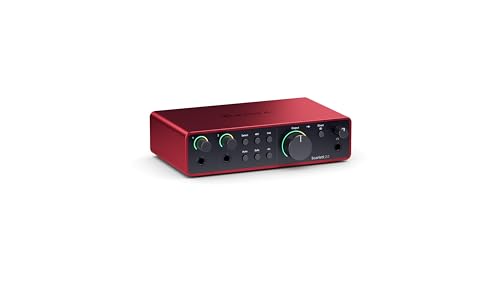
Focusrite Scarlett 4i4 4th Gen: the flexible home-studio choice
The Scarlett 4i4 4th Gen offers two front-panel microphone/instrument inputs and two additional line inputs, plus MIDI I/O and loopback functionality. Its 4th-generation preamps provide substantial gain, and Auto Gain and Clip Safe features can help beginners avoid badly set levels during a session.
It is particularly well suited to a vocalist who also uses a stereo synthesizer, a songwriter who alternates between guitar and keyboard, or a creator who needs software playback routed into a stream. Focusrite Control 2 handles routing and setup, though its software workflow is less deep than RME’s TotalMix FX. The interface has one main headphone output, so it is less convenient for two performers unless a separate headphone amplifier is added.
Audient iD14 MkII: best for preamps and headphones
The Audient iD14 MkII has two analog inputs: a mic/line input and a JFET instrument input, with an optical input that can add up to eight channels through an ADAT-equipped preamp at compatible sample rates. That makes it a compact two-input interface with a realistic upgrade path for drum recording or a multi-microphone setup.
Its console-derived microphone preamps offer ample gain for common condensers and dynamic microphones, while the headphone amplifier is a strong reason to consider it over cheaper interfaces. The large multifunction encoder and software-controlled monitor features are well suited to a desk-based studio. Its limitation is immediate input capacity: without an ADAT unit, it cannot record four microphones at once.
Universal Audio Volt 476: practical for small ensembles
The Volt 476 supplies four analog inputs, two headphone outputs, MIDI, and a built-in monitor section in a desktop format. Its Vintage Mic Preamp mode adds a deliberately colored character, and the compressor section on two channels can help control peaks while recording. These features are useful when the goal is quick, hands-on tracking rather than extensive software routing.
It is less compelling for users who need sophisticated cue-mix management, multiple independent headphone mixes, or the lowest possible computer round-trip latency. The included software bundle can be useful, but check license requirements and operating-system compatibility before treating bundled plug-ins as part of the long-term value.
RME Babyface Pro FS: the reliability and latency specialist
The Babyface Pro FS is a compact bus-powered interface with two mic/line inputs, two additional line outputs, MIDI through a breakout cable, and optical I/O that can provide ADAT expansion. Its major advantage is not simply converter resolution: RME’s driver support and TotalMix FX routing are designed for demanding, repeatable sessions.
TotalMix can create separate monitor and headphone mixes, route software playback flexibly, and support complex overdubbing workflows. The interface is more expensive and less immediately simple than a basic two-input unit, and its breakout cables can be inconvenient in a permanently installed setup. For frequent recording, remote work, or a system expected to remain useful for many computer upgrades, those trade-offs are easier to justify.
Preamp, headphone, and monitoring differences
- Preamp gain: Condenser microphones are easy for nearly all current interfaces. Low-output dynamic and ribbon microphones may benefit from roughly 60–70 dB of clean gain, or from an inline booster that does not add excessive noise.
- Headphone drive: High-impedance headphones are not automatically difficult, but low-sensitivity models can require more voltage and current. If a headphone sounds quiet or loses bass impact, compare the interface’s output capability rather than relying only on the impedance number.
- Direct monitoring: A simple direct-monitor switch is enough for one performer hearing a dry signal. Software mixers are preferable when the singer needs reverb, the guitarist needs a cue effect, or two performers require different balances.
- Loopback: Loopback routes computer playback back into recording software for streaming, tutorials, or remote collaboration. Verify that it does not unintentionally record the DAW master back into itself.
- Phantom power: 48-volt phantom power should be used for condenser microphones as required, but turn it off before connecting equipment that is not designed for it. Follow the microphone manufacturer’s instructions, especially with vintage or active ribbon microphones.
How much input capacity do you actually need?
Count simultaneous sound sources, not the number of instruments owned. A solo vocal-and-guitar session needs two inputs. A vocalist with a stereo keyboard needs four. A drum kit commonly needs four to eight microphones, and a band recording live may need eight or more. If expansion matters, choose an interface with ADAT input; an eight-channel optical preamp can add up to eight channels at 44.1 or 48 kHz, although higher sample rates may reduce the channel count.
Also distinguish microphone inputs from line inputs. Two microphone preamps plus two line inputs is excellent for a home studio, but it is not equivalent to four microphone preamps. External mixers can add apparent inputs but often complicate gain staging and monitoring compared with a proper multichannel interface.
Setup choices that prevent common problems
- Install the manufacturer’s driver and control application before connecting microphones. Class-compliant operation may work, but the dedicated driver often provides better latency and routing.
- Set the project to 24-bit and 44.1 or 48 kHz unless a specific video, archival, or production requirement calls for something else. Higher sample rates increase CPU and storage demands.
- Begin with a 128-sample buffer. Reduce it to 64 for live software instruments or monitoring if the system remains stable; increase it for mixing with heavy plug-ins.
- Record peaks around -12 to -6 dBFS. Modern 24-bit recording leaves ample headroom, so forcing peaks close to 0 dBFS creates clipping risk without improving quality.
- Make one monitoring path active. If direct monitoring and software monitoring are both enabled, the performer may hear a delayed doubled signal.
- Test every output and headphone mix. A routing error can leave a recording apparently silent even while the meters show signal.
Ownership realities and durability
Interfaces rarely wear out because of the converters. The most vulnerable parts are USB-C or USB ports, headphone sockets, gain encoders, and breakout cables repeatedly moved between locations. Keep the unit powered and connected where practical, avoid hanging heavy cables from the sockets, and use a short, good-quality USB cable rather than repeatedly bending a long one.
Dust can enter headphone and combination jacks, while aggressive cleaners can damage labels and finishes. Disconnect power before cleaning and use a dry, soft brush or compressed air held at a safe distance; do not spray liquid into the chassis. Keep phantom power off when changing microphone connections, and leave enough ventilation around bus-powered interfaces that become warm during long sessions.
Final buying decision
Choose the MOTU M4 if you want the clearest meters and broadest connectivity at a moderate price. Choose the Scarlett 4i4 4th Gen for a flexible two-mic home studio with useful automatic gain and loopback tools. Choose the Audient iD14 MkII when preamp quality, headphone drive, and future ADAT expansion matter more than having four inputs immediately. Choose the Volt 476 for straightforward four-input tracking with two headphone outputs. If low-latency routing, driver longevity, and multiple monitoring mixes are central to your work, the RME Babyface Pro FS remains the stronger long-term investment.