Key takeaways
- Best Overall: MakerHawk Battery Load Tester 180W, four-wire with four modes and app control.
- Best Value High-Power: Eyes.sys Electronic Load Tester 180W, with temperature probe.
- Best Mid-Power Pack Tester: Treedix 120W Mini Electronic Load Tester, compact with color screen.
- Best Basic 150W Option: KooingTech Battery Load Tester 150W.
- Best USB Power Bank Tester: UCTRONICS 35W USB Load Tester with fast-charge trigger.
- Best Budget: DROK LD25 25W USB Load Tester.
The MakerHawk 180W Battery Load Tester is the best electronic load tester for battery packs if you want accuracy: it is a four-wire design with constant current, constant voltage, constant power and constant resistance modes, plus app control. The Eyes.sys 180W Electronic Load Tester is the runner-up and a very similar unit with a temperature probe and PC cable. If your goal is only to check the capacity of a USB power bank, a small USB-C load such as the UCTRONICS 35W or DROK LD25 is cheaper and easier to use.
People search for a “USB-C electronic load tester for battery packs” because they have two different jobs in mind. One is checking a power bank or fast charger through its USB-C port. The other is discharging a raw lithium pack, such as a 12V or 24V battery built from 18650 cells, to measure real capacity. These are not the same job, and the tools are not interchangeable. A USB-C load only works at 5 to 25 volts and a few amps. A DC electronic load accepts a wide voltage range and tens of watts or more, but typically connects through terminals and clips. This guide covers both and tells you which to buy for which task.
Our top picks
As an Amazon Associate we earn from qualifying purchases at no extra cost to you.
Top Picks at a Glance
- Best Overall: MakerHawk Battery Load Tester 180W, four-wire with four modes and app control.
- Best Value High-Power: Eyes.sys Electronic Load Tester 180W, with temperature probe.
- Best Mid-Power Pack Tester: Treedix 120W Mini Electronic Load Tester, compact with color screen.
- Best Basic 150W Option: KooingTech Battery Load Tester 150W.
- Best USB Power Bank Tester: UCTRONICS 35W USB Load Tester with fast-charge trigger.
- Best Budget: DROK LD25 25W USB Load Tester.
Comparison Table
| Product | Best for | Key specs | Watch for | Price tier |
|---|---|---|---|---|
| MakerHawk 180W Battery Load Tester | Accurate pack capacity tests | 180W, 200V, 20A, 4-wire, 4 modes, 2.4″ screen, app | Larger unit with clip leads | Mid-range |
| Eyes.sys 180W Electronic Load | High power with temperature probe | 180W, 2-200V, 0.2-20A, 4 modes, 2.4″ screen | Variant ratings differ (20A vs 30A) | Mid-range |
| Treedix 120W Mini Load | Small packs, bench use | 120W, 50V, 15A, 1.54″ screen, 12V DC or USB-C PD power | Low voltage ceiling | Budget to Mid-range |
| KooingTech 150W Load Tester | Simple 2-wire discharge | 150W, 200V, 20A, fan cooled | 2-wire; slow refresh | Mid-range |
| UCTRONICS 35W USB Load | Power banks and chargers | 4-25V, 0.03-5A, USB-C and Micro USB, fast-charge trigger | 35W limit | Budget |
| DROK LD25 25W USB Load | Basic USB power checks | 4-25V, 0.25-4A, USB-C and Micro USB, fan | No reverse-polarity protection | Budget |
1. MakerHawk Battery Load Tester 180W: Best Overall
- 180W maximum, 200V and 20A (a 30A variant is also sold, so check the listing).
- Four-wire (Kelvin) connection that cancels lead resistance; two-wire hookup also works.
- Four discharge modes: constant current, constant power, constant resistance and constant voltage.
- 2.4 inch color screen; Android and iOS apps; PC connection by Bluetooth or wire.
- Overload, overcurrent and over-temperature protection with a temperature-controlled fan.
Best for: measuring real capacity of lithium packs, LiFePO4 batteries and power supplies. Skip if: you only test USB power banks.
The reason to pay for a four-wire tester is voltage accuracy. When you pull 10A through thin leads, the leads themselves drop a measurable amount of voltage, and a two-wire tester reads the wrong battery voltage as a result. A four-wire connection uses a separate pair of sense wires, so the tester sees the voltage at the battery terminals. For capacity tests that end when the pack drops to a cutoff voltage, that accuracy changes your result, because the test stops at the right moment rather than too early.
The four modes are useful in practice. Constant current is the classic capacity test: set 5A, discharge to cutoff, read amp-hours. Constant power matches how a device like an inverter or e-bike controller actually draws. Constant resistance simulates a fixed load such as a heater. Constant voltage helps when testing a power supply or a charger. The apps let you log curves, which is the best way to spot a weak cell group.
Pros: four-wire accuracy; four modes; app and PC logging; protections. Cons: bigger than USB-only testers; more setup; 180W ceiling means big packs need staged tests.
2. Eyes.sys Electronic Load Tester 180W: Best Value High-Power Alternative
- Up to 180W with a voltage range of 2 to 200V and current of 0.2 to 20A on the standard listing.
- Constant current, constant voltage, constant power and constant resistance modes.
- 2.4 inch color screen with automatic data reports.
- External NTC probe for temperature measurement; three protection functions.
- Package lists a power supply, a 2 m PC cable and crocodile clip leads.
Best for: bench testing with included cables and a temperature probe. Skip if: you need verified four-wire sensing.
The Eyes.sys is part of a popular family of 180W DC loads sold under many brand names. Listings vary: one retailer shows 0.2 to 20A, others show a 30A version, and the Bluetooth app appears on some pages but not others. Confirm the exact variant, including current rating, before you buy. The included temperature probe is a safety feature worth using: clip it to the cell or pack surface and watch the temperature curve, since a cell that heats unusually fast during discharge is telling you something.
Pros: useful accessories; four modes; large voltage range; reports. Cons: variant differences; no confirmed four-wire; documentation varies by seller.
3. Treedix 120W Mini Electronic Load Tester: Best Compact Mid-Power Option
- 120W maximum, up to 50V and 15A.
- 1.54 inch color screen; about 10 x 8 x 5 cm.
- Powered from 12V DC or a USB-C to USB-C PD source at 12V (not Type-C to Type-A).
- Lets you set discharge energy, capacity and time; supports manual calibration.
- Over-voltage, under-voltage, over-current and over-power protection, plus a temperature-controlled fan.
Best for: small packs up to 50V, such as 3S to 12S lithium packs, and bench use in a small space. Skip if: you test high-voltage packs above 50V.
The Treedix is the most approachable 120W tester here. It is small, runs from a PD source, and the interface is straightforward. The 50V ceiling covers most hobby packs: a 12S lithium pack tops out at 50.4V when fully charged, which is right at the edge, so measure carefully before connecting. The ability to set a stopping point for energy, capacity or time is helpful for repeatable tests. Note that one listing shows a confusing “minimum 50V” statement; other sources make clear 50V is the maximum.
Pros: compact; PD-powered; configurable stop conditions; calibration. Cons: 50V limit; small screen; 120W ceiling.
4. KooingTech Battery Load Tester 150W: Best Basic 150W Option
- Maximum 150W, 200V and 20A; two-wire connection.
- Over-voltage alert range 1-200V; over-current alert range listed 0.2-100A.
- Cooling fan; refresh around half a second.
- Rotary knob to adjust current.
Best for: straightforward discharge tests where you adjust a knob and read the result. Skip if: you need logging or four-wire accuracy.
This is a no-frills tester in the same vein as the classic 150W boards. The key limit to remember is that 150W is a power ceiling, not just a current ceiling. At 10V you can draw about 15A, but at 30V the ceiling drops to about 5A, because 30V times 5A already equals 150W. Exceeding the power limit risks burning out the load, so always compute watts before you set the current. Listings advise turning the knob fully counterclockwise before connecting and then raising the current slowly.
Pros: simple operation; wide voltage range; fan-cooled. Cons: two-wire only; slow refresh; basic documentation.
5. UCTRONICS 35W USB Load Tester: Best for Power Banks and Chargers
- Rated DC 4-25V, up to 35W, 0.03-5A.
- USB, Micro USB, Type-C and external wire inputs.
- Can test and trigger QC2.0, QC3.0, AFC and FCP fast charge at 5, 9, 12 or 20V.
- Protections include anti-reverse, over-voltage, over-current, over-power, low-voltage and over-temperature.
- Temperature-controlled fan.
Best for: checking power banks, wall chargers and car chargers. Skip if: you need to test raw lithium packs or loads above 35W.
A USB load tester is a small resistor you plug into a power bank to draw a controlled current. Set 2A, plug it in, and the display shows voltage, current and accumulated capacity as the bank discharges. The trigger function is a bonus: many fast chargers only output 9V or 12V after a handshake, and this tester can request those voltages. The anti-reverse protection is welcome on a unit with bare wire inputs.
Pros: fast-charge triggering; multiple connectors; broad protection; low cost tier. Cons: 35W ceiling; not for large packs; basic display.
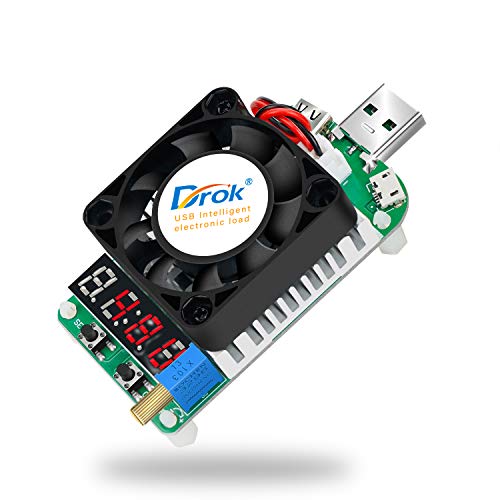
6. DROK LD25 25W USB Load Tester: Best Budget
- Rated DC 4-25V and 25W maximum; current 0.25-4A.
- Micro USB and Type-C ports; four-digit LED display.
- Multi-turn knob for current; temperature-controlled fan with aluminum heat sink.
- Over-voltage, over-power and over-temperature protection.
- No reverse-polarity protection; reversing the input can permanently damage it.
Best for: cheap checks of USB power banks and chargers. Skip if: you might connect it backwards, or need over 25W.
The LD25 is a modest, purpose-built tool. It does one thing: draw a set current from a USB source so you can see whether the source holds its voltage. For checking that a charger holds 5V under a 2A load, or that a power bank delivers roughly the capacity on its label, it is plenty. The missing reverse-polarity protection means you should only use it through its USB-C or Micro USB ports, not with loose clips, unless you are careful.
Pros: very low cost tier; compact; fan and heat sink. Cons: 25W ceiling; no reverse protection; limited feedback beyond voltage and current.
Also Consider
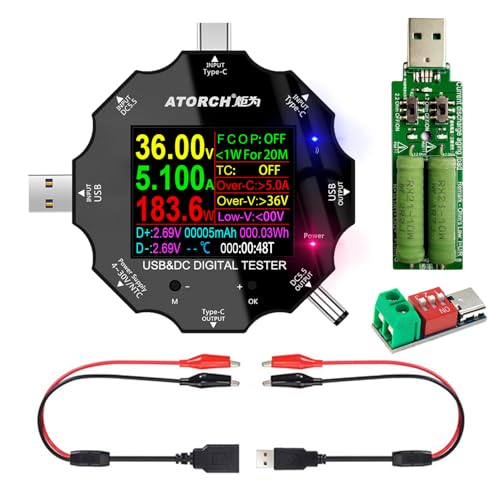
AVHzY USB-C Tester (3-in-1 USB / Type-C / DC5.5 meter with load function)
A USB-C meter that reads voltage, current, power and resistance and includes a load function. Detailed load ratings are not listed on the listing summary, so verify before relying on it for heavy discharge tests.
DWEII 18650 Lithium Battery Capacity Tester Module
A small module that reports mAh and mWh for single 18650-type cells, handy if all you need is a quick check of loose cells rather than a pack.
YEREADW USB-C Tester Power Meter
A passive USB-C meter (4-30V, up to 12A) that reads what flows through a cable. It does not load the source, so treat it as a meter rather than a discharge tester.
How We Chose
This is a research-based guide. We did not physically test any of these instruments and we do not report lab measurements. We started from electronic load testers and USB testers currently sold in our product store, then compared specs from the product listings and manufacturer or retailer spec pages: voltage and current ranges, connectors, number of modes, wire configuration, protections and software. We favored tools that document their limits clearly, and we flagged variants with conflicting specs. We do not quote prices; tier words only. Always read the exact manual for your unit before connecting a battery.
Buying Guide
Match the tester to the task
For power banks and chargers, choose a USB load rated 25 to 35W. For loose cells and small packs up to 50V and 120W, choose a compact DC load like the Treedix. For larger packs, LiFePO4 batteries and power supplies up to 180W, choose a 180W DC load. Above that, you need a bigger electronic load or a staged test.
Voltage, current and the power ceiling
An electronic load has three limits: maximum voltage, maximum current and maximum power. The lowest limit wins. A 150W tester at 30V can only draw 5A. Always calculate power as volts times amps before setting the current. A 24V pack at 8A is 192W, which exceeds a 180W tester, so you would test at 6A instead (144W).
Two-wire vs four-wire
Four-wire sensing measures voltage at the battery terminals instead of at the tester, removing lead drop. At 10A, 50 milliohms of lead and clip resistance costs 0.5V, enough to end a low-voltage cutoff test early. If you care about capacity within a few percent, use four-wire.
Modes and logging
Constant current is the standard capacity test. Constant power matches real devices. Constant resistance and constant voltage are handy for power supplies. An app or PC software that logs the curve helps you compare the same pack across months.
Worked example: capacity of a power bank
A 20,000mAh power bank stores about 74Wh at the 3.7V cell voltage (20Ah x 3.7V). Delivered at 5V, real output is typically lower because of conversion losses, so a result of about 12,000 to 14,000mAh at 5V is not unusual. If you set the load to 2A at 5V (10W), a healthy bank should run roughly six to seven hours. Compare the tester’s accumulated mAh with the label to judge how far the pack has aged.
Safety Notes for Lithium Packs
- Never discharge a lithium cell below its rated cutoff voltage; set the low-voltage cutoff on the tester first.
- Watch temperature. Stop the test if a cell becomes hot to the touch or swells.
- Use a fire-safe surface and never leave a discharge test unattended.
- Check polarity twice, especially on units without reverse protection.
- Do not exceed the tester’s power rating; excess power can destroy the load.
How to Run a Capacity Test Step by Step
- Charge the pack fully and let it rest. Wait 30 to 60 minutes after charging so the voltage settles. Testing straight off the charger inflates the starting voltage and can skew the first minutes of the curve.
- Write down the pack facts. Note the nominal voltage, the full-charge voltage, the manufacturer’s cutoff voltage and the rated capacity. For a 3S lithium-ion pack, for example, the full-charge voltage is about 12.6V and a typical cutoff is around 9V, but always use your pack’s own datasheet.
- Choose the discharge current. A common choice is about 0.2C to 0.5C, meaning 20 to 50 percent of the rated capacity per hour. For a 10Ah pack that is 2 to 5A. Slower discharge gives a capacity figure closer to the label; faster discharge shows how the pack behaves under real load.
- Check the power. Multiply the voltage at the start of the test by the current. A 12.6V pack at 5A is 63W, comfortable on every 120W or 180W unit here. Recheck if you test at higher voltages.
- Connect with the tester switched off and current at minimum. Use short, thick leads, tight clips and the correct polarity. If your tester has sense leads, attach them directly to the battery terminals.
- Set the low-voltage cutoff. This is the single most important setting. It stops the test before the pack is over-discharged.
- Start the test and watch the first five minutes. Confirm that the current is steady, the fan runs and nothing gets unusually warm. Then check back at intervals rather than leaving the room.
- Record the result. When the test ends, note the amp-hours, watt-hours and time. Repeat the test a few months later under the same conditions so the comparison means something.
Reading the Results
A healthy pack delivers close to its label capacity at a gentle discharge rate. Many used packs deliver 70 to 90 percent, and a pack below about 60 to 70 percent of its rating is often considered near the end of its useful life for demanding uses. These figures are rules of thumb, not guarantees, because capacity depends on temperature, discharge rate and cutoff voltage.
The shape of the curve matters as much as the final number. A pack whose voltage drops sharply in the first minutes of discharge probably has high internal resistance. A pack that runs flat and then falls off a cliff near the end is behaving normally for lithium chemistry. If a multi-cell pack ends early because one cell group hits the cutoff first, the pack is imbalanced; charging with a balancing charger and retesting may help, but a persistent gap usually means one weak cell.
Finally, compare like with like. If you test the same pack at 2A in one session and 5A in the next, the capacity will differ, and that difference is normal. Keep the current, the cutoff voltage and the room temperature the same, and keep a simple log. A spreadsheet with the date, pack name, current, cutoff, amp-hours and watt-hours is enough to show a trend over a year.
One last practical tip: keep a small notebook or spreadsheet next to the tester. Record the pack name, the date, the temperature in the room, the discharge current, the cutoff voltage and the delivered amp-hours and watt-hours every time. After three or four tests you will see whether a pack is slowly losing capacity, and you will know when to retire it from demanding uses. A tester is only as useful as the consistency of the tests you run with it, and the habit of logging each run costs almost nothing.
Frequently Asked Questions
What is the best electronic load tester for battery packs?
For serious pack testing, the MakerHawk 180W four-wire tester is our top pick. For small packs under 50V the Treedix 120W is a compact alternative, and for USB power banks a 25 to 35W USB load is enough.
Can a USB-C load tester test a lithium battery pack?
Only if the pack outputs through USB-C within the tester’s 4 to 25V and low-power range. A raw 12V or 24V pack needs a DC electronic load with terminals or clips.
What is the difference between two-wire and four-wire testers?
Four-wire testers use separate sense leads to measure voltage at the battery, which removes errors from lead resistance. Two-wire testers are simpler and fine for casual checks.
How do I measure the capacity of a power bank?
Fully charge it, connect a USB load, set a steady current such as 1 to 2A, and let it discharge until the output cuts off. The tester’s accumulated mAh or Wh is the delivered capacity.
Why does my tester say less capacity than the label?
Labels often state capacity at the cell voltage, around 3.7V, while the tester measures at 5V output after conversion losses. A result in the region of 60 to 70 percent of the label is common for power banks at 5V, though aged cells may show less.
Is it safe to leave a discharge test running?
No. Stay nearby, watch temperature, and use a fire-safe surface. Set the low-voltage cutoff before starting.
Do I need Bluetooth or an app?
Not strictly, but logging a discharge curve makes it easier to compare packs and to spot weak cells. If you test often, an app is worth having.
Which One Should You Buy?
Buy the MakerHawk 180W if you test real battery packs and want four-wire accuracy and logging. Buy the Eyes.sys 180W if you want similar power with a temperature probe and are happy to check the variant specs. Choose the Treedix 120W for compact bench work on packs up to 50V. Choose the KooingTech 150W for a basic knob-driven discharge. For power banks and chargers, choose the UCTRONICS 35W for fast-charge triggering or the DROK LD25 for the lowest cost.
Sources
- MakerHawk battery load tester product listing and maker site
- Eyes.sys 180W electronic load tester listing
- Treedix 120W mini electronic load tester listing
- KooingTech 150W battery load tester listing
- UCTRONICS and DROK USB load tester product pages
- AVHzY CT-3 documentation and independent USB tester reviews
Last updated: October 2026