Our Top Picks



The best motorcycle battery chargers with smart features in 2026 are the NOCO GENIUS5 for most riders who want a fast, future-proof maintainer and the Battery Tender Junior for anyone who just wants a dead-simple, set-and-forget trickle charger. Both handle the core job — charging, then holding a battery at a safe float voltage for months — but the GENIUS5 brings higher amperage, a wider temperature range, and force-mode recovery for a sulfated or deeply discharged pack. If you have one bike that sits through a four-month winter, a 1,000 mA budget unit will do the job comfortably; if you run lithium, ride year-round, or maintain several vehicles on one charger, the mid-range and premium tiers buy you comfort and speed rather than a different result.
That single distinction — how often your battery goes flat and what chemistry it uses — drives almost every other buying decision below.
Top 3 Picks
Best overall: NOCO GENIUS5. At 5 amps it charges a depleted motorcycle battery in well under two hours while still throttling down to a maintenance-safe trickle, and it covers 6V and 12V lead-acid plus 12V lithium in the same enclosure. It suits riders who own more than one battery, live somewhere cold, or want a charger that will still be useful when they move to lithium.
Best budget: MOTOPOWER MP00205A. An 800 mA automatic charger, maintainer and desulfator at a price that makes a second unit for a second bike painless. It is the pick for a single motorcycle on a Battery Tender–style pigtail that only needs top-ups and long-term storage, not rescue charging.
Best premium: NOCO GENIUS2. Same GENIUS platform, 2 amps, in a body small enough to sit permanently in a saddlebag or under a seat cowl. It is the choice for the rider who wants the NOCO diagnostics and 6V/12V flexibility without paying for 5-amp charging speed they will rarely use.
Quick Comparison
| Product | Best for | Key specs (per manufacturer class) | Price tier |
|---|---|---|---|
| NOCO GENIUS1 | Single bike, all-season topping up | 1 A; 6V & 12V lead-acid, AGM, gel, lithium; automatic multi-stage; desulfation; maintainer mode | Mid-range |
| Battery Tender Junior 12V | Simplest possible winter storage | 750 mA; 12V lead-acid only; automatic 4-step charge then float; ring-terminal harness included | Mid-range |
| NOCO GENIUS5 | Most riders, multiple batteries, cold climates | 5 A; 6V & 12V lead-acid, AGM, gel, lithium; force/repair mode; temperature-compensated charging | Premium |
| Battery Tender Plus 12V | Long-term float on automotive-size packs | 1.25 A; 12V lead-acid/AGM; float charge; metal case; leads with fused ring or alligator clips | Premium |
| FOVAL Automatic Trickle Charger | Tightest budget, occasional top-ups | 1000 mA; 12V lead-acid; automatic trickle; LED status; compact plastic housing | Budget |
| MOTOPOWER MP00205A | One bike, storage-season maintenance | 800 mA; 12V lead-acid; automatic; desulfation pulse; trickle/maintainer output | Budget |
| NOCO GENIUS2 | Portable premium, 6V/12V flexibility | 2 A; 6V & 12V lead-acid, AGM, gel, lithium; multi-stage; repair mode; IP-rated enclosure | Premium |
| PZ.P 15-Amp 12V/24V | Lithium packs and mixed-voltage fleets | 15 A output; 12V & 24V; LiFePO4 plus lead-acid modes; full-automatic maintainer and trickle functions | Budget |
| YDBAO 12V 15A Smart Charger | Fast recovery on big or deeply drained batteries | 15 A output; 12V; fully automatic trickle/float behavior; digital display; multi-stage charging | Mid-range |
How We Chose
Selection was driven by what the product listing actually specifies, then filtered through the way a motorcycle battery lives in the real world: small capacity (typically 8–20 amp-hours on a standard bike), long idle periods, and a charging current that must never exceed roughly 10% of the battery’s amp-hour rating for safe long-term maintenance. That single rule of thumb eliminates the temptation to buy the biggest charger on the shelf — a 15-amp unit is genuinely useful for recovery and cars, but must be checked against your battery’s rating before you leave it connected for weeks.
From there we screened on category fit (does it actually do 6V and 12V, or lithium and lead-acid?), chemistry coverage, whether the maintainer/float stage is a true regulated float rather than a repeated on-off cycle, weather resistance for a garage or carport install, and safety protections such as reverse polarity and short-circuit cutoff. We also weighted the practical stuff an owner notices after a season: cable and lead length for reaching a tucked-in battery, housing material, whether an SAE pigtail is included, and the upgrade path if you later add a lithium pack or a second bike. We did not test, benchmark, or own any of these units; the ratings below reflect manufacturer specifications and the established behavior of these charger classes and brands.
1. NOCO GENIUS1 – Best for Single-Bike All-Season Topping Up
As an Amazon Associate we earn from qualifying purchases at no extra cost to you.
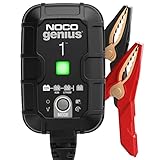
The GENIUS1 is the smallest of the NOCO smart chargers and the one most riders should look at first if they own exactly one motorcycle and just want it ready every spring. It is a 1-amp unit that handles 6V and 12V lead-acid, AGM, gel, and lithium batteries, and it is fully automatic — you connect it, it decides the charge stage, and it drops into maintenance mode when the battery is full. For a typical 8–14 amp-hour motorcycle battery, 1 amp sits squarely in the safe long-term window, which is why it is so often sold alongside battery pigtails.
Where the GENIUS platform earns its mid-range rather than budget placement is in the diagnostics and recovery side. It can desulfate a battery that has spent a winter flat, run a forced charge on a pack the charger initially refuses to recognize, and compensate its output for ambient temperature. That last point matters more than most buyers realize: a charger that ignores temperature will overcharge a battery on a hot day and undercharge it in a cold garage, and the GENIUS line adjusts for both.
Key specs
- Output: 1 amp — squarely in the safe maintenance band for motorcycle-size batteries
- Voltage: 6V and 12V
- Chemistries: lead-acid, AGM, gel, and lithium (12V)
- Automatic multi-stage charging with a regulated float/maintenance stage
- Desulfation and repair/force-charge functions
- Temperature-compensated charging output
- Ring-terminal or clamp lead options; rugged compact enclosure
Strengths
The charge profile is the headline. Rather than a fixed trickle, the GENIUS1 walks through stages — a soft start for deeply discharged batteries, a bulk charge, an absorption phase that tops the cell voltage up without cooking the electrolyte, and then a maintenance stage that only wakes when the battery’s voltage sags. That behavior is the difference between a charger you can leave on a bike in a shed for five months and one you have to think about. The small footprint also means it can live on a shelf or on top of a toolbox without becoming furniture.
Pros
- Handles 6V as well as 12V, so it covers older small-engine batteries too
- Lithium-compatible on 12V, so it survives a battery chemistry change
- Repair mode can revive a sulfated battery rather than condemning it
- Automatic — no amp selector or mode dial to get wrong
- Small and light enough to store anywhere
Cons
- 1 amp means a fully flat battery can take a full day to charge
- Costs more than a plain trickle charger that would cover the same single-bike job
- Multi-stage smarts are wasted if your only goal is topping up a healthy battery
Compared with the nearest alternative
Against the MOTOPOWER MP00205A, the GENIUS1 costs noticeably more for the same 12V motorcycle job, but it buys 6V capability, lithium support, and repair mode — three things the MOTOPOWER unit does not offer. If you will never own a lithium battery or a 6V application, the MOTOPOWER is the more honest spend. Against its own stablemate the GENIUS2, the GENIUS1 is the value pick: same platform and chemistry coverage, just 1 amp instead of 2, so charging takes about twice as long but long-term maintenance behavior is effectively identical.
2. Battery Tender Junior 12V – Best for the Simplest Possible Winter Storage

The Battery Tender Junior is the archetype of the automatic 12V powersports maintainer, and it remains the obvious recommendation for one specific reader: someone with a single 12V motorcycle, ATV, or mower battery who wants to plug in, walk away, and unplug in spring. At 750 mA it delivers a gentle charge current that is impossible to get badly wrong on a motorcycle-size battery, and it ships with a ring-terminal harness so you can permanently bolt a pigtail to the battery terminals and leave it hanging under the seat or behind a side panel.
It is not a fast charger and it is not a multi-chemistry charger. That is the point. The Junior exists so that a rider who does not want to think about amps, stages, or modes can still keep a battery alive indefinitely. The automatic sequence brings the battery up and then transitions to a float stage that holds it there without boiling off electrolyte.
Key specs
- Output: 750 mA — deliberately gentle for small powersports batteries
- Voltage: 12V only
- Chemistry: lead-acid, including sealed and AGM types
- Automatic multi-step charge, then float/maintenance
- Includes ring-terminal harness for permanent installation, plus a quick-connect plug
- LED indicator for charge and storage status
Strengths
Simplicity is genuinely a feature here. There is no 6V/12V switch, no chemistry button, no repair mode to accidentally trigger on a healthy battery. The included harness is the practical detail that matters most over a season: bolting the pigtail on once means every future connection is a single plug rather than wrestling with alligator clips in a cold garage. The brand’s long track record in the powersports maintainer category also means the Junior is well understood — replacement harnesses and extensions are easy to find, which is not true of every cheap charger.
Pros
- Extremely hard to misuse — no modes or amperage settings
- Ring-terminal harness included for permanent pigtail installation
- 750 mA is safe on even the smallest motorcycle batteries
- Compact and light for storage
Cons
- 12V only — no 6V support for older small engines
- No lithium mode, so a LiFePO4 upgrade means a new charger
- Slow: a deeply discharged battery may need overnight or longer
- No desulfation or repair function
Compared with the nearest alternative
Next to the Battery Tender Plus, the Junior is the lighter, cheaper, lower-current version of the same idea. The Plus runs 1.25 amps in a metal case and is aimed at automotive-size batteries as well as motorcycles, so it charges a bit faster and feels more substantial in the hand — but it is also more charger than a single motorcycle battery strictly needs. Against the FOVAL, the Junior gives up current (750 mA versus roughly 1000 mA) but gains the included permanent harness and a brand history in this exact niche, which is the trade most riders should accept.
3. NOCO GENIUS5 – Best Overall for Most Riders

If you own one bike but want a charger that also handles a car, a second motorcycle, or a jump-started neighbor’s battery, the GENIUS5 is where the line settles. At 5 amps it charges a drained motorcycle battery in roughly an hour to two hours rather than overnight, while still offering a properly regulated maintenance stage for indefinite connection. It covers 6V and 12V lead-acid, AGM, gel, and lithium, and it includes the repair and force-charge functions from the GENIUS platform.
The larger output is not just about speed. Higher current is what lets a charger push through a deeply sulfated battery that a 750 mA trickle unit would spend days failing to wake, and it is what makes the GENIUS5 usable on a car battery in winter without the charger spending two days on the job. For a rider who is also the household’s battery maintainer, that flexibility is the whole purchase.
Key specs
- Output: 5 A — charges motorcycle batteries quickly, still fine for car batteries
- Voltage: 6V and 12V
- Chemistries: lead-acid, AGM, gel, and lithium (12V)
- Multi-stage automatic charging with temperature compensation
- Force/repair mode for deeply discharged or sulfated batteries
- IP-rated enclosure for damp garages and sheds
- Designed to be left connected indefinitely in maintenance mode
Strengths
Speed and headroom are the two things you feel immediately. A motorcycle battery that the GENIUS1 would take most of a day to fill is done before lunch. The 5-amp ceiling also means the GENIUS5 will genuinely charge a car, truck, or tractor battery rather than merely maintain it, which is why it often replaces two cheaper chargers in a household. On top of that, the temperature-compensated output keeps the charge profile honest whether the bike is in a heated garage or an unheated shed in February.
One caution worth stating plainly: 5 amps is far above the safe continuous maintenance current for a small motorcycle battery. The GENIUS5 handles this automatically by tapering current as the battery fills, but the underlying rule still matters — if you are maintaining a tiny battery, the charger’s own regulation is doing the work, not your judgment.
Pros
- Fast enough to be a daily-driver charger, gentle enough to leave connected
- Covers 6V, 12V, lead-acid, AGM, gel, and lithium in one unit
- Repair mode rescues batteries a basic trickle charger cannot
- Doubles as a car and truck battery charger
- Weather-resistant housing suits a shed or open carport
Cons
- Premium price for a rider who only ever maintains one motorcycle
- Physically larger than the 1-amp and 2-amp NOCO units
- Its extra capability is wasted if the bike sees daily use and never sits
Compared with the nearest alternative
Against the GENIUS2, this is purely a question of amperage and use case. The GENIUS2 shares the chemistry coverage, diagnostics, and repair modes at 2 amps; the GENIUS5 costs more but charges about two and a half times faster and can realistically handle a car battery. If your bike is the only battery in your life and it never sits more than a few weeks, the GENIUS2 is the smarter buy. If the charger has to serve a household, the GENIUS5 is the one that avoids a second purchase.
4. Battery Tender Plus 12V – Best for Long-Term Float on Bigger Batteries

The Battery Tender Plus is the bigger, metal-cased sibling of the Junior, running 1.25 amps into 12V lead-acid and AGM batteries and holding them on a regulated float charge. It is a maintainer first and a charger second, which is exactly the right priority for anyone whose motorcycle sits for weeks at a time and whose real problem is slow self-discharge rather than a dead battery on a Sunday morning.
Its appeal over the Junior is capacity: 1.25 amps is enough to properly maintain and recharge automotive-size batteries as well as motorcycle ones, and the metal enclosure is more at home on a garage wall or bench than a plastic puck. For a rider with a bike and a car that both sit, the Plus does the job of two cheaper units without any mode juggling.
Key specs
- Output: 1.25 A — suitable for motorcycle through automotive-size batteries
- Voltage: 12V only
- Chemistry: lead-acid and AGM
- Automatic charge sequence ending in a regulated float/maintenance mode
- Metal housing for durability in a garage environment
- Ring-terminal leads with fused connection, plus optional alligator clip leads
Strengths
The float behavior is the reason to buy it. Battery Tender’s core design goal is a charger you can leave connected permanently without damaging the battery, and the Plus is the version that also has enough current to be useful on a car. The fused ring-terminal leads are a small but meaningful safety detail: if the pigtail gets pinched or shorted, the fuse protects the harness rather than the battery. The metal case also survives being knocked off a workbench better than a plastic shell.
What it does not do is adapt. There is no 6V option, no lithium setting, and no repair mode for a battery that has been flat since last winter. It assumes a healthy 12V lead-acid battery and then does an extremely good job of keeping it healthy.
Pros
- Regulated float charge designed for indefinite connection
- 1.25 A covers both motorcycle and automotive batteries
- Fused ring-terminal leads reduce short-circuit risk
- Durable metal housing
Cons
- No 6V or lithium support
- No desulfation or repair function
- Premium price for what is, functionally, a single-chemistry maintainer
- Slower than any 5-amp charger for recovery work
Compared with the nearest alternative
Against the Battery Tender Junior, the Plus is the upgrade for riders who want one charger to cover a car as well as a bike. The extra 500 mA does not sound like much, but on a 50 amp-hour car battery it is the difference between a maintainer that keeps up and one that never quite finishes. Against the NOCO GENIUS5, the Plus is the narrower tool: it wins on durability and simplicity but loses on chemistry coverage, repair capability, and outright speed. Choose the Plus if your batteries are already healthy and just need to stay that way.
5. FOVAL Automatic Trickle Battery Charger – Best for the Tightest Budget
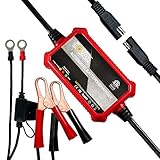
The FOVAL is a 12V, roughly 1000 mA automatic trickle charger built for the simplest possible job: keep a lead-acid battery topped up without overcharging it. It is fully automatic in the sense that it manages its own output and drops to a trickle as the battery fills, and it uses LED indicators to show charge state. For a rider on a strict budget who only needs a storage-season top-up, it covers the essential function at the lowest entry point in this list.
What it lacks is flexibility. There is no 6V mode, no lithium support, no repair function, and the current sits in a narrow band that is fine for motorcycle batteries but not much use for a large car battery or a deeply discharged pack. It is best understood as a storage maintainer rather than a recovery charger.
Key specs
- Output: 1000 mA (1 A class)
- Voltage: 12V only
- Chemistry: lead-acid
- Fully automatic trickle behavior with LED status indication
- Compact plastic housing
- Clamp-style or pigtail connection depending on variant
Strengths
Price and simplicity. For a rider who has one motorcycle, plugs it in each November, and unplugs it in March, the FOVAL does the job without any of the premium-tier features that only pay off in edge cases. The automatic behavior means there is nothing to set, and the current level is gentle enough that even a small motorcycle battery is unlikely to suffer.
The honest limitation is that this is a commodity-tier charger. Build quality and long-term reliability at this price point vary more than with the established maintainer brands, and there is no repair or diagnostic capability to fall back on if a battery has already gone flat. Treat it as a consumable-grade maintainer that you replace rather than repair.
Pros
- Lowest-cost way to keep a 12V motorcycle battery topped up
- Fully automatic — nothing to configure
- Compact and easy to store
- Adequate current for motorcycle-size batteries
Cons
- No 6V or lithium support
- No desulfation, repair, or diagnostic functions
- Not powerful enough for serious recovery or car batteries
- Build quality and durability are the most variable in this list
Compared with the nearest alternative
Against the MOTOPOWER MP00205A, the FOVAL is a near-direct competitor: both are budget 12V automatic maintainers in the 800–1000 mA range. The MOTOPOWER unit adds a desulfation function, which gives it a slight edge for batteries that have already been left flat. The FOVAL’s advantage is simply that it is the cheaper of the two and slightly higher current. If you can stretch to the MOTOPOWER, the desulfation feature is worth the small premium; if not, the FOVAL still does the core maintenance job.
6. MOTOPOWER MP00205A – Best Budget Pick With Desulfation
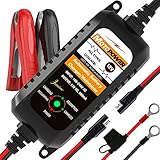
The MOTOPOWER MP00205A is an 800 mA automatic charger, maintainer, trickle charger, and desulfator in one small package. That combination — automatic charging plus a desulfation pulse — is what separates it from the cheapest tier of plain trickle chargers, because it offers at least a chance of recovering a battery that has been sitting flat rather than simply announcing that it is dead.
It is a 12V lead-acid only unit, so riders with 6V applications or lithium packs should look elsewhere. But for the single-bike owner who wants a low-cost maintainer with a bit of recovery capability, it is the most sensible budget recommendation in this list.
Key specs
- Output: 800 mA — safe for motorcycle and powersports batteries
- Voltage: 12V only
- Chemistry: lead-acid (including sealed and AGM)
- Automatic charge, maintainer, trickle, and desulfation modes
- Compact housing with status indication
- Typically supplied with clamp or ring-terminal leads
Strengths
The desulfation function is the differentiator at this price. Sulfation — the buildup of lead sulfate crystals on the plates — is the usual reason a stored battery loses capacity, and a charger that pulses to break that layer down has a real, if modest, chance of restoring some capacity. The automatic operation also means there is no amperage decision to make, which keeps the unit safe for a novice owner.
At 800 mA it will not charge quickly. A deeply discharged battery may take a full day or more, and the desulfation process itself is a slow background activity rather than a quick fix. It is a maintainer that can occasionally rescue a battery, not a recovery tool that reliably will.
Pros
- Desulfation mode at a budget price
- Automatic operation with no settings to misconfigure
- 800 mA is safe to leave connected on a motorcycle battery
- Combines charger, maintainer, trickle, and desulfator in one unit
Cons
- 12V lead-acid only — no 6V, no lithium
- Slow charging on a deeply drained battery
- Desulfation results are variable and depend on how far gone the battery is
- No temperature compensation
Compared with the nearest alternative
Against the FOVAL, the MOTOPOWER is the better-supported budget choice thanks to desulfation and a slightly more purposeful feature set, at a small price premium. Against the NOCO GENIUS1, it is the honest-budget alternative: the GENIUS1 adds 6V, lithium, temperature compensation, and repair/force mode for more money, and those features only matter if you actually have a 6V or lithium battery or a battery that has been flat for a long time. For a healthy 12V motorcycle battery on a storage plan, both will do the same job overnight.
7. NOCO GENIUS2 – Best Premium Pick for Portability
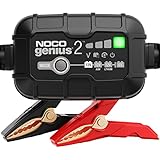
The GENIUS2 is the middle child of the NOCO smart charger line: 2 amps, 6V and 12V, lead-acid through lithium, with the same multi-stage profile and repair functions as its larger siblings in a body that is genuinely small enough to carry. It is the pick for a rider who wants premium features without the size or price of the 5-amp unit, and for anyone maintaining a battery in a location where they cannot leave a big charger permanently connected.
Two amps is roughly double the current of most budget maintainers and half that of the GENIUS5. On a motorcycle battery that means a reasonable charging window — fast enough to be useful, slow enough to be inherently safe — while still offering indefinite maintenance connection.
Key specs
- Output: 2 A — a practical middle ground for motorcycle batteries
- Voltage: 6V and 12V
- Chemistries: lead-acid, AGM, gel, and lithium (12V)
- Multi-stage automatic charging with temperature compensation
- Force/repair mode for deeply discharged batteries
- Compact, sealed, weather-resistant enclosure
- Suitable for permanent connection in maintenance mode
Strengths
Portability plus capability. Because it is small and sealed, the GENIUS2 can live in a tank bag or a top case and be used at a destination where the bike has been parked for weeks — a real advantage for riders who store bikes seasonally away from home. It also handles the full chemistry range, so it stays useful through a lithium conversion, and its temperature-compensated charging works correctly in a cold unheated storage unit.
The main trade is speed on larger batteries. Two amps is excellent for a motorcycle and merely adequate for a car battery, so if the charger has to serve a household fleet, the GENIUS5’s 5 amps will feel like a better fit. For motorcycle-only duties, 2 amps hits the sweet spot.
Pros
- Premium smart features in a genuinely portable package
- 6V, 12V, lead-acid, AGM, gel, and lithium all covered
- Temperature compensation and repair mode included
- Weather-resistant enclosure works in sheds and carports
- Ideal current level for motorcycle-size batteries
Cons
- Premium price relative to basic 1-amp maintainers
- Only half the output of the GENIUS5 at a similar tier
- Repair mode is slower than on the higher-amperage models
Compared with the nearest alternative
Against the GENIUS1, the GENIUS2 is the faster version of the same platform: same chemistry coverage and functions, double the current. If your battery is usually only lightly discharged, the GENIUS1 is the better value. Against the GENIUS5, the GENIUS2 is the portable choice — smaller, lighter, cheaper, at the cost of charging speed and the ability to comfortably handle a car battery. For a motorcycle-only household that values portability, the GENIUS2 is the sensible premium pick.
8. PZ.P 15-Amp 12V/24V Smart Charger – Best for Lithium Packs and Mixed-Voltage Fleets

The PZ.P is the outlier in this list: a 15-amp, 12V/24V fully automatic charger, maintainer, and trickle charger with explicit LiFePO4 support as well as lead-acid modes. It is aimed at riders and owners who have moved to lithium — or who maintain a mixed fleet of 12V and 24V equipment — and who need a charger that can recognize and safely charge those chemistries without a separate dedicated lithium unit.
Fifteen amps is a great deal of current for a motorcycle battery, and that is the central thing to understand about it. It is excellent for fast recovery on a car, truck, or large lithium pack, and it will charge a motorcycle battery very quickly, but it must not be left connected indefinitely to a small lead-acid battery without relying on its automatic regulation to taper current. For lithium motorcycle packs, whose charge behavior differs from lead-acid, the dedicated LiFePO4 mode is the reason to choose this unit.
Key specs
- Output: 15 A — high-current charging and recovery
- Voltage: 12V and 24V
- Chemistries: LiFePO4 lithium plus lead-acid modes
- Fully automatic operation with maintainer and trickle functions
- Multi-stage charging with automatic chemistry recognition
- Digital display showing voltage and charging status
Strengths
Chemistry coverage and voltage range. Being able to charge both 12V and 24V systems, and to handle LiFePO4 explicitly rather than as an afterthought, makes this one of the few budget-tier units that stays useful across a rider’s whole equipment collection — a motorcycle, a car, a lithium jump pack, a 24V mower or trolling setup. The 15-amp output also means recovery charging a deeply drained battery takes a fraction of the time a 1-amp maintainer would need.
The caveat is that 15 amps is roughly ten times the safe long-term maintenance current for a typical motorcycle battery. The automatic taper handles this in practice, but riders with small batteries should connect this unit for charging and recovery, and use a gentler 1–2 amp maintainer for indefinite storage connection.
Pros
- Explicit LiFePO4 support at a budget price point
- Covers both 12V and 24V systems
- 15 A output makes recovery charging fast
- Fully automatic with maintainer and trickle functions
- Digital display for voltage and status
Cons
- Far too much current to be an ideal permanent motorcycle maintainer
- Budget-tier build quality relative to premium brands
- Overkill for a single lead-acid motorcycle battery
- Automatic chemistry recognition should still be verified before first use
Compared with the nearest alternative
Against the YDBAO 12V 15A, this unit adds 24V capability and explicit LiFePO4 support at a similar output level, which makes it the better choice for anyone with lithium or mixed-voltage equipment. Against the NOCO GENIUS5, the PZ.P wins decisively on lithium handling and voltage range but loses on refinement, brand support, and suitability as a long-term motorcycle maintainer. If your bike runs a lithium pack, the PZ.P is the budget way to charge it properly.
9. YDBAO 12V 15A Smart Charger – Best for Fast Recovery on Large or Deeply Drained Batteries

The YDBAO is a 12V, 15-amp fully automatic smart trickle charger with a digital display, built for exactly one purpose: putting a lot of current into a large or badly drained 12V battery quickly and then backing off to a float. It is a car-and-truck-oriented unit that will also charge a motorcycle battery extremely fast, and its automatic trickle behavior means it can be left connected once charging is complete.
For a motorcycle owner, this is a specific tool rather than a general one. It shines when the bike has been forgotten for a year and the battery is flat but recoverable, or when the same charger has to serve a car, a boat, or a tractor. It is not the unit to buy for gentle indefinite maintenance of a small motorcycle battery.
Key specs
- Output: 15 A — high-current charging and recovery
- Voltage: 12V
- Chemistry: lead-acid (standard, sealed, AGM)
- Fully automatic multi-stage charging
- Automatic trickle/float behavior once charging completes
- Digital display showing voltage and charge status
Strengths
Raw recovery capability at a mid-range price. A 15-amp output can bring a large car battery back from a deep discharge in a few hours, which is far beyond what any 1–2 amp maintainer can do. The automatic multi-stage profile keeps the process safe without requiring the owner to select an amperage, and the digital display makes it easy to see whether the battery is accepting charge or just sitting at a surface voltage.
The limitation for motorcycle use is the current level. Fifteen amps into a small lead-acid motorcycle battery generates significant heat and gassing, and while the charger tapers as the battery fills, this is a unit to use for charging and recovery, not as a permanent maintainer on a bike. Owners of small batteries should pair it with a gentler maintainer for storage season.
Pros
- Very fast recovery on large or deeply discharged batteries
- Fully automatic with no amperage selection needed
- Digital display for voltage and status
- Mid-range price for a high-current charger
- Useful across cars, boats, and motorcycles
Cons
- 12V only — no 6V, no 24V
- No explicit lithium mode
- Too powerful to be an ideal permanent motorcycle maintainer
- Alkaline-electrolyte heat and gassing risk on small batteries if misused
Compared with the nearest alternative
Against the PZ.P 15-Amp, the YDBAO is the narrower unit: same output class, but 12V only and without the explicit LiFePO4 mode or 24V coverage. Choose the PZ.P if you have lithium or 24V equipment; choose the YDBAO if your needs are straightforward 12V lead-acid recovery. Against the NOCO GENIUS5, the YDBAO is faster on big batteries but offers no 6V, no lithium, no temperature compensation, and no repair logic — it is a blunt instrument where the GENIUS5 is a smart one.
How to Choose
The first number to work out is your battery’s amp-hour rating, because it sets the safe charging current. A typical motorcycle battery runs somewhere between 8 and 20 amp-hours depending on engine size, and the long-standing rule of thumb is that continuous maintenance current should not exceed about 10% of that rating — so 0.8 to 2 amps for most bikes. That single calculation explains why a 750 mA or 1-amp maintainer is the default recommendation for motorcycle storage, and why a 15-amp charger, excellent as it is for a car, needs to be treated with care on a bike.
Worked example: a 12 amp-hour AGM battery on a bike stored five months a year. Ten percent of 12 is 1.2 amps, so anything at or below roughly 1.2 amps is safe for indefinite connection — the Battery Tender Junior at 750 mA, the NOCO GENIUS1 at 1 amp, or the MOTOPOWER at 800 mA. A GENIUS2 at 2 amps slightly exceeds the guideline for continuous maintenance but is well within it for charging, and it tapers automatically as the battery fills. A 5-amp unit is a charging tool for that battery, not a maintenance tool, unless you trust its regulation completely.
Charging modes: what the stages actually do
Smart chargers advertise “multi-stage,” and it is worth knowing what the stages are for. A bulk stage delivers full current until the battery reaches a target voltage. An absorption stage holds that voltage while current tapers, letting the battery actually saturate rather than just reach surface voltage. A float or maintenance stage drops to a lower holding voltage and only supplies current to offset self-discharge. Cheap trickle chargers often skip the absorption nuance and go straight to a fixed low output, which is why a battery maintained on a basic trickle charger can still measure low when you reconnect the bike. Desulfation is a separate pulse mode some units run periodically to break down sulfate buildup on the plates.
Battery compatibility
Lead-acid, AGM, and gel batteries are all lead-acid variants and share charge voltage characteristics closely enough that most chargers cover them together. Lithium — specifically LiFePO4, which is what motorcycle lithium packs use — is different, and it needs a charger with an explicit lithium mode. The two things to check are whether a charger supports 6V as well as 12V (relevant only for older small-engine batteries) and whether it supports lithium. If you plan to convert to a lithium battery, buying a lithium-capable charger now avoids a second purchase later.
Automatic maintenance and float behavior
“Automatic” is the single most abused word in this category. What matters is whether the charger’s final state is a regulated float voltage or a repeating on-off cycle. A regulated float holds a constant, safe voltage indefinitely. A cycling charger lets the battery drift down and then hits it with a charge pulse repeatedly, which is harder on the battery over months. All the maintainer-branded units here are designed for indefinite connection; the higher-current recovery units are not, unless their automatic taper is doing the work.
Weather resistance
Most riders charge in a garage, shed, or carport rather than indoors, so enclosure sealing matters. Look for an IP rating if the charger will live somewhere damp or unheated, and prefer a metal or heavily sealed housing over thin plastic if it will be permanently mounted. A charger left on a concrete floor in an unheated shed will see condensation cycles, and the electronics need to tolerate that. Indoors-only chargers with open vents are the wrong choice for that environment.
Safety protections
The baseline features to insist on are reverse polarity protection (so connecting the leads backwards does not destroy the charger or the battery), short-circuit protection, overcharge protection, and overheat shutdown. Fused leads, as on the Battery Tender Plus, add a second layer by protecting the harness itself. Spark-free connection is another useful feature if you routinely connect and disconnect in a poorly ventilated space. None of these are exotic — but the cheapest units sometimes omit reverse polarity protection, and that is the single most common way a home charger dies.
Cable length and connection type
Cable length is the overlooked spec that determines whether you actually use the charger. A battery buried behind a side panel or under a seat needs either a long enough lead set to reach it with the charger sitting on the ground, or a permanently installed pigtail with a quick-connect plug. Ring-terminal pigtails — included with the Battery Tender Junior and available for most of the units here — are the practical solution: bolt them on once, route the connector to an accessible spot, and every future connection takes seconds. If you buy a charger with short leads and no pigtail, budget for an SAE extension lead as well.
Decision matrix by rider situation
| Your situation | Charging need | Best fit | Why |
|---|---|---|---|
| One 12V lead-acid bike, stored 4–6 months | Maintenance only | MOTOPOWER MP00205A or Battery Tender Junior | Sub-1-amp current is safe indefinitely; low cost |
| One bike, occasional flat battery | Charge + maintain | NOCO GENIUS1 | 1 A charges a small battery overnight, then floats |
| Bike plus car, one charger | Charge + maintain, larger packs | NOCO GENIUS5 or Battery Tender Plus | 5 A for speed, or 1.25 A for durability and float |
| Lithium (LiFePO4) motorcycle battery | Chemistry-specific charging | PZ.P 15-Amp or NOCO GENIUS2/GENIUS5 | Explicit lithium mode required; lead-acid modes are unsafe |
| Battery flat for a year, want to try recovery | Repair/desulfation | NOCO GENIUS5 (repair mode) or MOTOPOWER (desulfation) | Pulse/force modes have a chance of restoring capacity |
| Storage unit with no power nearby or travel use | Portable maintenance | NOCO GENIUS2 | Small sealed body, 2 A, full chemistry range |
| Mixed fleet: bike, car, 24V equipment | Multi-voltage charging | PZ.P 15-Amp | 12V/24V plus lead-acid and LiFePO4 modes |
| Very tight budget, healthy battery | Maintenance only | FOVAL Automatic Trickle Charger | Lowest entry cost; adequate for topping up |
Owning one: what wears out and what to avoid
Chargers themselves are fairly durable, but the accessories around them are not. The first things to fail are usually the connection points: alligator clips lose their spring and grip over a few seasons, and ring-terminal pigtails corrode at the battery post if they are not kept clean. Cleaning the terminals and applying a light dielectric grease before bolting on a pigtail is the difference between a harness that lasts five years and one that lasts one. If a charger’s leads are permanently exposed to weather, expect the insulation near the connector to stiffen and crack first.
The most common owner mistake is using a recovery charger as a maintainer. A 15-amp unit left on a 12 amp-hour battery for a whole winter is not a smart charger being smart — it is a mismatch, and the battery pays for it in heat, gassing, and shortened life. The second most common mistake is connecting backwards and assuming the charger is dead when it has simply gone into protection. The third is trusting a cheap charger’s “fully automatic” label without checking whether its final stage is a genuine regulated float; if the voltage drifts down and then jumps back up, it is cycling, not floating.
Budget, mid-range, and premium: what you actually pay for
At the budget tier you get automatic charging and a trickle or float stage, plus occasionally a desulfation pulse. At the mid-range tier you typically add 6V support or higher current, better build quality, and sometimes a repair mode. At the premium tier you get the full package: multi-chemistry including lithium, temperature compensation, diagnostics, weather-resistant housings, and the ability to serve more than one vehicle. The decision point is whether your situation needs any of those extras. A single healthy 12V motorcycle battery on a winter storage plan genuinely does not — which is why the budget and mid-range picks in this list are not compromises, they are the correct answer for a large share of riders.
Frequently Asked Questions
Can I leave a smart charger connected to my motorcycle battery all winter?
Yes, provided the charger’s final stage is a regulated float or maintenance mode and its current is appropriate for the battery. A 0.75–1.2 amp maintainer is safe for indefinite connection on a typical motorcycle battery. A 5-amp or 15-amp charger should generally not be left connected indefinitely to a small battery unless you are confident in its automatic taper.
Do I need a lithium-specific charger for a LiFePO4 motorcycle battery?
Yes. LiFePO4 batteries have different charge voltage requirements from lead-acid, and using a lead-acid-only charger can undercharge them or push them outside their safe voltage window. Look for a charger with an explicit lithium or LiFePO4 mode rather than assuming a general “smart” charger will handle it.
How long does it take to charge a flat motorcycle battery?
It depends almost entirely on charger current. A 750 mA maintainer might need 12–20 hours for a small fully discharged battery, a 1-amp unit roughly 10–15 hours, a 2-amp unit 5–8 hours, and a 5-amp unit about 2 hours. Batteries above roughly 80% charge take progressively longer to top off because the charger tapers current in the absorption stage.
Is a 15-amp charger too powerful for a motorcycle battery?
For charging, it is fast but usable if the charger regulates current automatically. For indefinite maintenance, it is far too much — roughly ten times the safe continuous current for a typical motorcycle battery. Use a high-current unit for recovery and a 1–2 amp maintainer for storage.
Do trickle chargers really desulfate batteries?
Some do, using a pulsed output intended to break down lead sulfate crystals on the plates. Results are genuinely variable: a lightly sulfated battery may recover noticeable capacity, while a battery that has been flat for years usually will not. Desulfation is worth having as a feature, but it is not a guarantee of resurrection.
What is the difference between a trickle charger and a maintainer?
In practice the terms overlap heavily. A trickle charger delivers a low, roughly constant current. A maintainer is designed to hold a battery at a target float voltage indefinitely, adjusting output as needed. The best units do both, and a true regulated float stage is what separates a good maintainer from a crude trickle charger.
Should I remove the battery from the bike to charge it?
Not necessarily. Most smart chargers are designed to be connected with the battery in place, and a permanently installed ring-terminal pigtail makes this easy. Removing the battery is still worthwhile if the terminals are corroded, if you want to clean and grease the connections, or if the bike is stored somewhere without power.
Why does my battery still go flat after using a maintainer?
The usual causes are a failed or aging battery, a parasitic drain on the bike that exceeds the maintainer’s output, or a charger whose final stage is cycling rather than holding a steady float voltage. Test the battery voltage a few hours after disconnecting the charger — if it drops quickly under no load, the battery is the problem, not the charger.
The Short Version
For most riders with a single 12V motorcycle battery, the NOCO GENIUS1 or the MOTOPOWER MP00205A covers the job completely: safe sub-1-amp charging, automatic maintenance, and no risk of leaving it connected too long. If the charger has to serve a car as well, or you want repair capability and temperature compensation, move up to the NOCO GENIUS5. If you run lithium, the PZ.P 15-Amp is the budget route into proper LiFePO4 charging, and if you want premium features in a portable body, the NOCO GENIUS2 is the one to carry.