Key takeaways
- Our Fujifilm X-T30 III review covers the 26.1MP sensor, 6.2K video and Film Simulation dial, plus how it compares with the X-S20, a6400 and EOS R50.
The real decision behind the Fujifilm X-T30 III is not whether the spec sheet improved, because it clearly did. The harder question is whether a small, dial-led stills camera with no in-body stabilization still fits how you shoot, now that the third generation adds a faster processor, subject-detection autofocus and much stronger video. Fujifilm kept the 26.1MP sensor, the compact shape and the analog control layout, then modernized almost everything happening behind the dials.

That mix suits some buyers far better than others. Photographers who love Fujifilm’s film simulations and JPEG color get the most from it, while video-first creators and handheld shooters may be better served by a stabilized body. This review looks at the X-T30 III body-only listing first and in most depth, then compares it with the Fujifilm X-S20, the Sony a6400 and the Canon EOS R50, three mirrorless cameras that answer the same everyday-carry question in different ways.
Quick Picks
As an Amazon Associate we earn from qualifying purchases.
| Product | Best for | Key spec from title |
|---|---|---|
| Fujifilm X-T30 III Mirrorless Camera Body, Black | Film Simulation fans and everyday carry | 26.1MP effective still resolution |
| Fujifilm X-S20 Mirrorless Camera Body | Handheld video and long shooting days | 26.1MP X-Trans CMOS 4 sensor |
| Sony Alpha a6400 Mirrorless Camera Body | Autofocus speed and tracking | Real-Time Eye Auto Focus |
| Canon EOS R50 Mirrorless Camera Body, Black | First-time mirrorless buyers | 24.2 MP sensor with 4K video |
How to Choose
Stabilization and How You Actually Shoot
Stabilization decides more real-world results than sensor size in this class. The X-T30 III has no in-body image stabilization; Fujifilm lists digital stabilization for movie mode only, so stills rely on stabilized lenses and faster shutter speeds. The X-S20 counters with a proper in-body system rated by Fujifilm at up to seven stops, which changes what is possible handheld at dusk. The a6400 and EOS R50 also skip in-body stabilization. If your shooting is mostly daylight stills, this matters little. If you walk-and-talk on video or shoot indoors without a tripod, it should be your first filter.
Dials, Menus and Handling Style
The X-T30 III keeps Fujifilm’s analog approach: dedicated shutter speed and exposure compensation dials, plus a new Film Simulation dial with three custom slots. You change core settings by touch, without opening a menu. The X-S20 uses a conventional mode dial with a deep grip, which many video shooters prefer, while the a6400 and R50 lean on screens and menus more heavily. None of these is objectively better. The right choice depends on whether you enjoy physical dials enough to accept a smaller grip, or prefer a modern control layout that stays out of the way.
Video Depth Beyond the Headline Number
All four cameras record 4K, but the ceilings differ. The X-T30 III and X-S20 reach 6.2K at 30p in 10-bit color, with 4K at 60p and high-frame-rate Full HD for slow motion, which gives editors real grading and reframing room. The a6400 tops out at 4K at 30p and the R50 at 4K at 30p oversampled from 6K, both perfectly usable for online video but with less headroom. Screen design matters just as much: the R50 and X-S20 have fully articulating screens, the X-T30 III tilts, and the a6400 flips up in a way a hot-shoe microphone can block.
Lens System, Battery and Total Kit Weight
A body-only price is only the starting point. Fujifilm’s X mount has the deepest native APS-C lens catalog here, and the X-T30 III weighs just 378 g with battery and card, so a small prime keeps the whole kit pocketable. Its NP-W126S battery is rated by Fujifilm at roughly 315 frames in Normal mode, though, while the X-S20’s larger battery is rated far higher. Sony’s E mount offers the widest third-party lens support, Canon’s RF-S range is still growing, and every system change means your existing lenses stop being an asset.
The 4 Best Options
Fujifilm X-T30 III Mirrorless Camera Body, Black
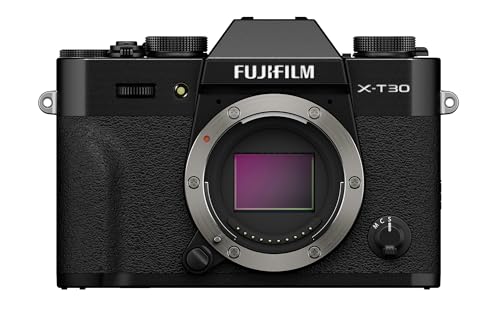
This listing is the camera body only, in Black, with no lens included. Fujifilm pairs the proven 26.1MP X-Trans CMOS 4 sensor with the X-Processor 5, bringing subject-detection autofocus for people, animals, birds and vehicles, plus 6.2K 30p recording in 10-bit color. The headline change is the dedicated Film Simulation dial, which puts 20 color profiles and three custom recipe slots on the top plate. At 378 g with battery and card, it stays a genuine everyday carry, and the tilting touchscreen and electronic viewfinder keep the classic X-T30 shooting posture intact.
Specs
- Brand: Fujifilm; model name X-T30 III; model number 16957841
- Configuration: camera body only, no lens included
- Effective still resolution: 26.1 MP
- Display: 3-inch LCD
- Special features listed: AI-based autofocus and 20 built-in Film Simulations
- Battery included: yes
- UPC: 074101212686
Best for: Photographers who shoot JPEGs with film recipes and want the smallest current Fujifilm body with dedicated dials.
Watch out for: No in-body stabilization, and this body-only listing needs a lens before you can shoot; the NP-W126S battery is rated around 315 frames per charge in Normal mode.
Fujifilm X-S20 Mirrorless Camera Body
The X-S20 shares the same 26.1MP X-Trans CMOS 4 sensor and X-Processor 5 as the X-T30 III, then trades the analog dials for a deeper grip, a mode dial and in-body stabilization. Fujifilm rates that stabilization at up to seven stops, and the larger NP-W235 battery is the endurance pick of this group, which is why the X-S20 is pitched at creators who record long clips and vlogs. It records the same 6.2K 30p 10-bit video, adds a headphone jack and a dedicated Vlog mode, and weighs 491 g, noticeably more than its sibling but still compact.
Specs
- Brand: Fujifilm; model name X-S20
- Configuration: camera body only
- Sensor: 26.1MP APS-C X-Trans CMOS 4
- Processor: X-Processor 5
- Weight: 491 g
Best for: Hybrid creators who film handheld, record long sessions and want stabilization without leaving the Fujifilm color system.
Watch out for: Heavier than the X-T30 III, not weather sealed, and the mode-dial layout gives up the dedicated shutter and exposure dials Fujifilm traditionalists want.
Sony Alpha a6400 Mirrorless Camera Body
Sony’s a6400 remains the autofocus benchmark of this group years after launch. Its 24.2MP APS-C sensor sits behind Real-Time Eye AF and Real-Time Tracking, with an autofocus system Sony specced at 0.02 seconds and 425 phase-detection points, plus continuous shooting up to 11 frames per second. Video tops out at 4K at 30p, and the touchscreen flips up 180 degrees for self-recording. The E mount lens catalog is the largest here, including many third-party options. This listing is the body only, model ILCE-6400/B, so budget for a lens if you are new to the system.
Specs
- Brand: Sony; model name ILCE6400/B
- Configuration: camera body only
- Sensor: 24.2MP APS-C Exmor CMOS
- Autofocus: Real-Time Eye AF and Real-Time Tracking, 425 phase-detection points
- Continuous shooting: up to 11 fps
- Video: 4K recording with a 180-degree tiltable touchscreen LCD
Best for: Photographers chasing fast-moving kids, pets and sports who value tracking autofocus and the widest lens selection.
Watch out for: No in-body stabilization, the flip-up screen can be blocked by a hot-shoe microphone, and the older NP-FW50 battery and menu system show the camera’s age.
Canon EOS R50 Mirrorless Camera Body, Black

The EOS R50 is Canon’s friendliest entry into the RF system: a 24.2MP APS-C sensor, the DIGIC X processor and subject detection that recognizes people, animals and vehicles, wrapped in a body designed to feel familiar to phone upgraders. It records 4K at 30p oversampled from 6K, has a fully articulating touchscreen for front-facing video, and leans on guided menus that explain settings in plain language. This listing is the body only in Black. The trade-offs are a still-growing RF-S lens range and no in-body stabilization, so stabilized lenses do the heavy lifting for video.
Specs
- Brand: Canon; model name EOS R50
- Configuration: body only, Black
- Sensor: 24.2 MP APS-C CMOS
- Processor: DIGIC X
- Mount: Canon RF
- Video: 4K with subject detection and tracking
Best for: First-time mirrorless buyers and content creators who want Canon color, a vari-angle screen and the simplest learning curve.
Watch out for: No in-body stabilization, no headphone jack for audio monitoring, and the native RF-S lens lineup is still smaller than Fujifilm’s or Sony’s.
Which One Fits Your Situation
You Shoot JPEGs and Love Film Looks
The X-T30 III was built for you. The Film Simulation dial puts profiles like REALA ACE and Classic Neg. one turn away, with three slots for your own recipes, and the 26.1MP sensor’s color science is the reason many owners rarely open a RAW file. No rival here matches that straight-out-of-camera workflow at this size.
You Film Handheld Most Days
Choose the X-S20. In-body stabilization, the bigger battery, a headphone jack and a fully articulating screen solve the four problems handheld creators hit first. The X-T30 III records the same headline video formats, but without stabilization your walking footage depends on a gimbal or a stabilized lens, which adds cost and bulk to every shoot.
You Are Upgrading From a Phone
The EOS R50 asks the least of you while you learn: guided menus, reliable subject detection and a screen that flips to face you. The X-T30 III is the better long-term hobbyist camera if physical dials appeal, because they teach exposure by touch, but its tilting screen and recipe system reward a little more patience up front.
You Already Own Lenses for Another System
Stay in your mount. Sony shooters lose nothing essential with the a6400, whose tracking autofocus still leads this group, and Canon owners keep their upgrade path with the R50. Switching to the X-T30 III only makes financial sense if you own few lenses or specifically want Fujifilm’s dials and film simulations enough to rebuild a kit around them.
Common Mistakes
- Buying the X-T30 III body-only listing and forgetting it includes no lens, so the camera cannot be used until an X-mount lens is added.
- Assuming every modern mirrorless camera has in-body stabilization; the X-T30 III, a6400 and EOS R50 do not, which changes lens choices for video.
- Comparing headline video resolutions only, while ignoring screen design, headphone monitoring and record limits that shape daily filming.
- Ignoring battery ratings, since the X-T30 III’s roughly 315-frame rating means spare NP-W126S batteries are a near-essential accessory for travel days.
- Choosing purely on megapixels, when the real differences here are stabilization, controls, autofocus behavior and lens catalogs.
Frequently Asked Questions
Does the Fujifilm X-T30 III have in-body stabilization?
No. Fujifilm does not list in-body image stabilization for the X-T30 III; it offers digital stabilization for movie recording only. Stills and video therefore rely on optically stabilized lenses, such as the XC 13-33mm kit zoom, or on faster shutter speeds. Buyers who need stabilization inside the body should look at the Fujifilm X-S20 instead.
Is the X-T30 III sold as a body or with a lens?
Both configurations exist, and the listing reviewed here, ASIN B0FWTX8S9J, is the body only in Black with no lens in the box. Fujifilm also sells kits with the XC 13-33mm f/3.5-6.3 OIS lens. Check the configuration line on the product page before ordering, because the body-only version needs an X-mount lens to shoot.
What changed from the X-T30 II to the X-T30 III?
The sensor, body size and weight carry over. The X-T30 III adds the X-Processor 5, subject-detection autofocus, a dedicated Film Simulation dial with custom slots, and video that climbs from 4K to 6.2K at 30p in 10-bit color. Battery life also improves on paper, with Fujifilm rating the newer body at roughly 315 frames in Normal mode.
Is the X-T30 III good for video and vlogging?
It is capable: 6.2K 30p and 4K 60p in 10-bit color, high-frame-rate Full HD, a microphone input and strong subject detection. The limits are practical rather than technical. There is no in-body stabilization, no headphone jack, and the screen tilts rather than fully articulating, so solo creators who film themselves often will find the X-S20 or EOS R50 easier to live with.
More from Amazon
Programs that pair well with the guide above. Offers and eligibility are set by Amazon and may change.
Free shipping on eligible items, Prime Video and more. Eligible new members can start with a free trial.
Start a Prime free trialAd-free music streaming. Eligible new subscribers can start with a free trial.
Try Music Unlimited freeA Prime membership for ages 18-24 with a trial period. Eligibility is set by Amazon.
See Prime for Young AdultsAudiobooks and podcasts to listen to on the go. Eligible new members can start with a free trial.
Try Audible freeAs an Amazon Associate we earn from qualifying purchases.