Key takeaways
- Pro: The pivoting horn tweeter can be aimed toward the listening area, which improves clarity.
- Pro: High efficiency, so it plays loudly from an ordinary receiver or compact amplifier.
- Pro: Large 8-inch woofer gives better midbass than smaller in-ceiling models.
- Con: Needs a deep cavity and a sizeable cutout.
- Con: Horn character may feel bright over very long listening sessions.
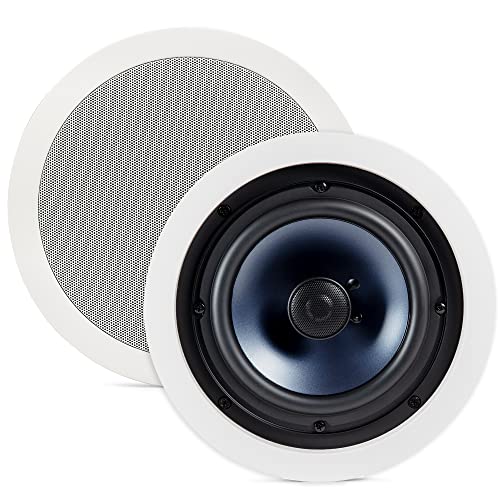
The best in-ceiling speakers are the ones that match the job: an 8-inch two-way model with a pivoting tweeter such as the Klipsch CDT-5800-C II or Polk RC80i for whole-room music, a 6.5-inch model such as the Yamaha NS-IC600 for smaller rooms, a moisture-rated pair for a bathroom, and angled-baffle models for Dolby Atmos height channels. Before you pick a brand, confirm three things: the ceiling cavity depth, the amplifier you will use, and whether you want stereo pairs or a ceiling-based surround layout. This guide uses published specifications and manufacturer documentation only, and it covers music, home theater, Atmos and bathroom use in that order.
Our top picks


As an Amazon Associate we earn from qualifying purchases at no extra cost to you.
Short answer by use
| Use | Speaker class | Typical woofer | Example models | Price tier |
|---|---|---|---|---|
| Whole-room background music | Two-way, pivoting tweeter | 6.5 to 8 in | Polk RC80i, Klipsch CDT-5800-C II | Mid |
| Small room or hallway | Two-way, compact | 5.25 to 6.5 in | Yamaha NS-IC600, Polk RC60i | Entry |
| Dolby Atmos height | Angled baffle two-way | 6.5 to 8 in | Klipsch CDT series, angled in-ceiling models from Polk and Q Acoustics | Mid |
| Bathroom or kitchen | Moisture-resistant, sealed back | 5.25 to 6.5 in | Polk moisture-resistant series, Q Acoustics install line | Entry to mid |
| Streaming without a receiver | Passive speakers plus an amp | Any | Sonos Architectural by Sonance in-ceiling pair with the Sonos Amp | Premium |
Ceiling speaker lines are refreshed more slowly than consumer electronics, but model numbers still change. Confirm the exact variant on the manufacturer’s page, and read the cutout diameter and mounting depth before you buy.
Best for music in main rooms: Klipsch CDT-5800-C II
Spec line: 8-inch fibre-composite woofer, 1-inch titanium tweeter on a pivoting mount with a horn, paintable grille, per Klipsch’s product page.
Best for: open-plan living spaces where you want clear dynamics and strong sensitivity from modest amplifier power. Skip if: your ceiling cavity is shallow or you dislike a forward tweeter.
- Pro: The pivoting horn tweeter can be aimed toward the listening area, which improves clarity.
- Pro: High efficiency, so it plays loudly from an ordinary receiver or compact amplifier.
- Pro: Large 8-inch woofer gives better midbass than smaller in-ceiling models.
- Con: Needs a deep cavity and a sizeable cutout.
- Con: Horn character may feel bright over very long listening sessions.
Best value for music and movies: Polk Audio RC80i
Spec line: 8-inch dynamic balance woofer, 0.75-inch pivoting dome tweeter, 2-way design, paintable grille, according to Polk’s published information.
Best for: families who want one speaker model for several rooms without paying hi-fi installer prices. Skip if: you want the cleanest possible midrange for critical listening.
- Pro: Widely available and straightforward to install, with a clamp-style bracket that tightens from the front.
- Pro: Pivoting tweeter lets you point sound toward seating.
- Pro: Sound is balanced, with easy bass for a ceiling speaker.
- Con: Plastic frame is fine for most rooms but not as stiff as premium designs.
- Con: Not meant for wet areas unless you choose a moisture-rated model.
Best compact option: Yamaha NS-IC600
Spec line: 6.5-inch woofer, 1-inch tweeter, 2-way, designed for easy installation, per Yamaha’s catalogue.
Best for: smaller rooms, bedrooms, kitchens and hallways where 8-inch speakers would be overkill. Skip if: you want deep bass without a subwoofer.
- Pro: Smaller cutout, so it works in ceilings with joists in awkward places.
- Pro: Matches with Yamaha receivers and streaming amplifiers for a single-brand ecosystem.
- Pro: Low-profile grille is easy to paint to match the ceiling.
- Con: Bass is limited by woofer size.
- Con: Fewer pivot and tuning options than larger designs.
Best for Atmos and height channels: angled-baffle in-ceiling speakers
For best ceiling speakers for atmos, the key feature is an angled baffle or tilting driver assembly, usually around 15 degrees, so the sound is aimed toward the listening seats rather than straight down. Dolby’s published layouts for home use specify height speakers placed above and slightly forward of the main listening position, and typically suggest 2 or 4 overhead speakers for a 5.1.2 or 5.1.4 layout. Klipsch, Polk, Q Acoustics and several installation-focused brands sell angled ceiling models, so choose by the same questions as any ceiling speaker: cutout size, cavity depth and tonal match with your main speakers.
- Pro: Direct sound toward seats improves height effects compared with straight-down speakers.
- Pro: Concealed in the ceiling, so no stands or tall cabinets are needed.
- Pro: Many models match the voicing of the brand’s in-wall and floorstanding speakers.
- Con: Poor spacing ruins the effect, so measure carefully before cutting.
- Con: Ceiling material and insulation can change sound, so treat the cavity if it is hollow.
Best for bathrooms and kitchens: moisture-resistant models
For best bathroom ceiling speakers, you need three things: a sealed or coated woofer, a water-resistant grille and a tweeter that tolerates humidity. Polk and Q Acoustics offer moisture-resistant ceiling lines, and several installation brands use polypropylene cones and treated surrounds for the same reason. A 5.25 to 6.5-inch two-way speaker is usually enough in a bathroom, since the small room and hard surfaces add reflected volume. Avoid placing a speaker directly above a shower head. Check the manufacturer’s rating, because a moisture-resistant label does not mean fully waterproof.
- Pro: Handles steam and humidity better than ordinary ceiling speakers.
- Pro: Small footprint suits bathrooms and kitchens.
- Pro: Pairs well with a small amplifier or Bluetooth amp behind the wall.
- Con: Sound quality is tuned for background listening rather than critical music.
- Con: Wet-area ratings differ, so read the specification.
Best for streaming-first homes: Sonos Architectural by Sonance with the Sonos Amp
Sonos Architectural by Sonance is a co-developed in-ceiling line that is designed to pair with the Sonos Amp. It suits households already using the Sonos app because it adds whole-home streaming and AirPlay 2 without a separate receiver. The trade-off is that the speakers are passive, so you still need the amplifier, and the platform is a closed ecosystem. If you only want one or two rooms, this is premium compared with standard ceiling speakers plus a basic amplifier.
- Pro: Clean integration with multi-room control and app-based EQ.
- Pro: Paintable grille and thin bezel for a tidy ceiling.
- Pro: Amp is small and can sit in a closet.
- Con: Premium tier pricing once the amp is included.
- Con: Locked to the Sonos ecosystem.
Bluetooth ceiling speakers: how they actually work
The phrase best bluetooth ceiling speakers covers two different products. The first is a self-contained ceiling speaker with a built-in amplifier and Bluetooth receiver, common in bathroom and kitchen models. The second, usually better, approach is a standard pair of passive ceiling speakers connected to a small Bluetooth or Wi-Fi amplifier. The second approach lets you upgrade the amplifier later, and the connection to your phone is less likely to be limited by a single cheap speaker module. If you want a quick install in a bathroom, self-powered units are acceptable. For a living room, passive speakers plus a streaming amplifier produce better sound.
Cutout, depth and installation numbers
| Speaker size | Typical cutout | Minimum depth | Room size it suits |
|---|---|---|---|
| 5.25 in | About 7 to 7.5 in | About 3 in | Bathroom, hallway, small bedroom |
| 6.5 in | About 8.5 to 9 in | About 3.5 to 4 in | Bedroom, kitchen, office |
| 8 in | About 10 to 11 in | About 4 to 5 in | Living room, open plan |
These numbers vary by model, so take the exact cutout from the template or manual. Typical joist spacing is 16 inches on center, which leaves enough room for a 6.5-inch speaker between joists but may block an 8-inch speaker. Locate joists before choosing a size.
How to choose: a step-by-step plan
- Count the zones. One stereo pair per room, or a sound field using four to six speakers for an open-plan space.
- Measure the cavity. Use a stud finder and a small inspection hole to check depth, insulation and obstructions.
- Pick the size by room. 5.25 inches for tiny rooms, 6.5 inches for most, 8 inches for large rooms.
- Match the amplifier. A 50 to 100 W per channel amplifier is a sensible range for most 8-ohm ceiling speakers. Check the impedance to make sure it matches.
- Plan wiring. Use in-wall rated cable, generally CL2 or CL3, and 14 or 16 AWG for typical runs.
- Add a subwoofer. In-ceiling speakers rarely have deep bass, so a small subwoofer improves music and movies.
Ownership and common mistakes
Ceiling speakers are a quiet, low-maintenance product, but a few errors cause most complaints. Mounting them in a single line down the middle of a room leaves a narrow stereo image, so place left and right speakers about 6 to 8 feet apart where possible. Cutting without checking for HVAC ducts, wiring and fire blocking wastes the installation. Painting grilles with thick paint clogs the holes and dulls the treble, so use thin coats and take the grille off the speaker first. Back boxes or enclosures reduce sound leakage into the room above and improve bass, and they are worth adding in multi-storey houses.
Wiring, amplifiers and zones: a worked example
Take a typical open-plan room of about 400 square feet with a kitchen, dining area and sofa. A sensible layout is four 6.5-inch or 8-inch speakers arranged as two stereo pairs: one pair over the sofa about 7 feet apart and one pair over the kitchen and dining space. Each pair is wired back to the amplifier on its own run of 14 AWG in-wall rated cable, so you can set volume per zone. A four-channel amplifier rated at 50 W per channel into 8 ohms is enough, because ceiling speakers in a normal 8-foot-ceiling room rarely need more than 10 to 20 W for ordinary listening. If you wire two speakers per channel in parallel, the load drops to 4 ohms, so check that the amplifier is rated for it; otherwise use a volume-control box or a multi-zone amplifier instead.
Cable length also matters. For runs under 50 feet, 16 AWG is acceptable; between 50 and 100 feet, use 14 AWG; beyond that, use 12 AWG to avoid loss. Always use cable marked CL2 or CL3, since it is rated for in-wall use. Label both ends before you pull it through, because an unlabelled bundle of identical wires is the single most common cause of reversed polarity, which makes bass thin and imaging vague.
In-ceiling versus in-wall versus bookshelf
People searching for best in ceiling speakers for music often ask whether they should choose in-wall speakers instead. In-wall speakers sit at a more natural height, which improves imaging for critical listening, but ceiling speakers are easier to place evenly across a room and keep the walls clear. A good rule is to use ceiling speakers where you want even coverage and background sound, in-wall where you want a main stereo or home-theater front stage, and freestanding bookshelf speakers where sound quality is the top priority. Ceiling speakers are also the practical option for rooms where furniture changes often, because they do not depend on the sofa position.
Back boxes, insulation and sound leakage
An open ceiling cavity acts as a large and unpredictable enclosure. Bass can sound boomy in one room and thin in another because of different joist spacing and insulation. A sealed back box, sold by most brands as an accessory, gives the woofer a consistent enclosure and reduces sound leaking upstairs. If a back box is not an option, loose fibreglass or mineral wool around the speaker can damp the cavity, but follow the manufacturer’s fire-safety guidance, because some insulation must not touch hot parts such as recessed lights. Where building codes require fire-rated enclosures, use rated back boxes.
Common buying mistakes
- Buying by wattage: maximum power ratings tell you what a speaker survives, not how loud it plays. Sensitivity and woofer size matter more.
- Mixing brands in one room: different voicing between pairs makes sound move unevenly as you walk around. Use one model per zone.
- Ignoring tweeter aim: pivoting tweeters are only useful if you actually rotate them toward the seating area after installation.
- Skipping the subwoofer: ceiling speakers with 6.5-inch woofers roll off below roughly 60 Hz, so a subwoofer fills in effects and bass notes.
Frequently Asked Questions
Are in-ceiling speakers good for music?
Yes, for background and casual listening. Larger two-way models with pivoting tweeters sound clear and balanced, but they rarely match a good bookshelf pair for imaging and bass. Many people use them for secondary rooms.
Do ceiling speakers need an amplifier?
Passive ceiling speakers need a receiver or amplifier. Some Bluetooth models include a built-in amplifier, which is simpler but less upgradable.
Which ceiling speakers are best for Dolby Atmos?
Choose angled-baffle models from a brand that matches your main speakers, and place them above and slightly ahead of the listening position. A 5.1.2 layout uses two overhead speakers, while 5.1.4 uses four.
Can I install ceiling speakers in a bathroom?
Yes, if the model is rated for humidity and steam. Keep them away from direct water spray, and use a small amplifier outside the wet area.
How many ceiling speakers do I need for a room?
A small room needs one stereo pair. A large open room may need four to six speakers on a zone so that sound is even, with a subwoofer for bass.
Do in-ceiling speakers sound as good as bookshelf speakers?
Generally no, because the ceiling is not an ideal baffle and bass response is limited. They win on convenience and appearance, so they are best where hiding the speakers matters more than the last bit of sound quality.
More from Amazon
Programs that pair well with the guide above. Offers and eligibility are set by Amazon and may change.
Free shipping on eligible items, Prime Video and more. Eligible new members can start with a free trial.
Start a Prime free trialAd-free music streaming. Eligible new subscribers can start with a free trial.
Try Music Unlimited freeA Prime membership for ages 18-24 with a trial period. Eligibility is set by Amazon.
See Prime for Young AdultsAudiobooks and podcasts to listen to on the go. Eligible new members can start with a free trial.
Try Audible freeAs an Amazon Associate we earn from qualifying purchases.