Key takeaways
- Pro: Cabinet bracing and a curved cone design are engineered to keep resonance low for the price class.
- Pro: Easy to place; the tuned port is designed to work reasonably close to a wall.
- Pro: Handles modest amplifiers well because sensitivity is decent.
- Con: Larger than genuinely compact bookshelf models, so it needs a proper stand or shelf.
- Con: Treble is smooth rather than exciting, which some listeners find polite.
The best bookshelf speakers for most listeners in 2026 are a passive pair such as the Q Acoustics 3020c or ELAC Debut Reference DBR62 if you already own an amplifier, and a powered wireless pair such as the Edifier R1280DB, Audioengine A2+ Wireless or KEF LSX II LT if you want a one-box system. Your decision really comes down to three things: whether you want to buy an amplifier, how close to a wall the speakers will sit, and whether the budget is closer to “best bookshelf speakers under $500” or a true hi-fi budget. This guide is based on published specifications, manufacturer documentation and professional reviews, and it sorts eight real models by those three questions.
Our top picks


As an Amazon Associate we earn from qualifying purchases at no extra cost to you.
Quick comparison of the eight picks
| Model | Type | Driver size | Connectivity | Price tier | Best for |
|---|---|---|---|---|---|
| Q Acoustics 3020c | Passive | 6.5 in woofer, 0.9 in tweeter | Speaker terminals | Mid | Warm, forgiving music listening |
| ELAC Debut Reference DBR62 | Passive | 6.5 in woofer, 1 in tweeter | Speaker terminals | Mid | Detail and imaging |
| Klipsch RP-600M II | Passive | 6.5 in woofer, 1 in horn tweeter | Speaker terminals | Mid | Dynamic, lively sound |
| Wharfedale Diamond series (current compact model) | Passive | Compact two-way | Speaker terminals | Entry to mid | Small rooms on a tight budget |
| Edifier R1280DB | Powered | 4 in woofer, 13 mm tweeter | Bluetooth, optical, coaxial, RCA | Entry | Desks and TV setups |
| Audioengine A2+ Wireless | Powered | 2.75 in woofer, 0.75 in tweeter | Bluetooth, USB, RCA, 3.5 mm | Entry to mid | Tight desks, computer audio |
| KEF LSX II LT | Powered wireless | 4.5 in Uni-Q coincident driver | Wi-Fi, Bluetooth, HDMI ARC, optical | Premium | Streaming, apartments |
| Klipsch The Fives / similar powered HDMI model class | Powered | Mid-size two-way | HDMI ARC, Bluetooth, phono | Premium | TV plus turntable |
The table mixes spec numbers that manufacturers publish with price tiers, because street prices move several times a year. “Entry” here means the cheapest sensible pair in the category, “mid” means the range where passive hi-fi speakers become genuinely refined, and “premium” means you are paying for built-in streaming, amplification and cabinet engineering together.
Passive or powered: the choice that decides everything else
A passive bookshelf speaker has no amplifier inside. It needs a stereo receiver, an integrated amplifier or a compact amp with speaker wire running from each channel. A powered (also called active) bookshelf speaker has the amplifier built into one or both cabinets, so you connect a source with a cable or Bluetooth and plug into the wall.
Passive pairs give you the widest upgrade path. You can swap the amplifier later, add a subwoofer, or move to a better DAC without changing speakers. The trade-off is the cost and space of the amplifier, and the need to match impedance and sensitivity sensibly. Powered pairs are simpler and often cheaper as a whole system, and the in-box amplifier is tuned to the drivers, but you cannot upgrade the amp, and one cabinet usually carries a power cable to the other.
If you want best wireless bookshelf speakers or best bluetooth bookshelf speakers, you are shopping in the powered column. Bluetooth is convenient, but it compresses audio. Wi-Fi streaming systems and wired USB, optical or analog inputs preserve more detail, so look for at least one wired or Wi-Fi input even if you mostly stream from a phone.
Best for warm, forgiving music: Q Acoustics 3020c
Spec line: two-way passive, 6.5-inch bass/mid driver, 0.9-inch tweeter, around 90 dB sensitivity, 6 ohm nominal, according to the manufacturer’s published specifications.
Best for: listeners who play acoustic, vocal-driven or jazz-leaning music and want a relaxed top end that does not tire the ears on long sessions. Skip if: you want the last bit of treble air or a very small footprint.
- Pro: Cabinet bracing and a curved cone design are engineered to keep resonance low for the price class.
- Pro: Easy to place; the tuned port is designed to work reasonably close to a wall.
- Pro: Handles modest amplifiers well because sensitivity is decent.
- Con: Larger than genuinely compact bookshelf models, so it needs a proper stand or shelf.
- Con: Treble is smooth rather than exciting, which some listeners find polite.
Best for detail and soundstage: ELAC Debut Reference DBR62
Spec line: two-way passive, 6.5-inch aramid-fibre woofer, 1-inch soft-dome tweeter, 6 ohm nominal, according to the manufacturer.
Best for: people who value imaging and instrument separation, and who plan to put the speakers on stands a few feet from the wall. Skip if: your amplifier is very low powered or you sit very close to the speakers.
- Pro: The Reference tier was designed by Andrew Jones, whose budget speaker designs are widely discussed in the hi-fi press.
- Pro: Good tonal balance with a clear midrange, so vocals sound present.
- Pro: Pairs well with a subwoofer later because the bass roll-off is predictable.
- Con: Sensitivity is lower than horn-loaded rivals, so it likes a capable amplifier.
- Con: Sits at the upper end of what people mean by “affordable”.
Best for dynamics and volume: Klipsch RP-600M II
Spec line: two-way passive, 6.5-inch copper-spun woofer, 1-inch titanium tweeter on a Tractrix horn, about 96 dB sensitivity, 8 ohm nominal, according to Klipsch.
Best for: rock, electronic and film listening where punch matters, and for smaller amplifiers that do not have much power in reserve. Skip if: you are sensitive to bright treble or listen quietly at close range.
- Pro: High sensitivity means loud, clean playback with modest amplifier power.
- Pro: Big dynamic range and strong center-image for movie dialogue.
- Pro: Optional matching center and floorstanders let the system grow.
- Con: The horn tweeter can sound forward, and long sessions on a bright source may tire you.
- Con: Not the most refined at low volume.
Best affordable passive pair for small rooms: Wharfedale Diamond series
Spec line: compact two-way passive in the Diamond family; check the current model’s sheet for exact driver size and sensitivity, as Wharfedale has refreshed the line several times.
Best for: a bedroom, study or small living room where space and budget are both tight. Skip if: you want deep bass without a subwoofer.
- Pro: Long-standing British brand with a reputation for friendly tonal balance at low prices.
- Pro: Cabinets are small enough for a shelf or desk stand.
- Pro: Easy to drive from budget amplifiers.
- Con: Bass extension is limited by cabinet size.
- Con: Model numbering changes, so confirm the exact version before buying.
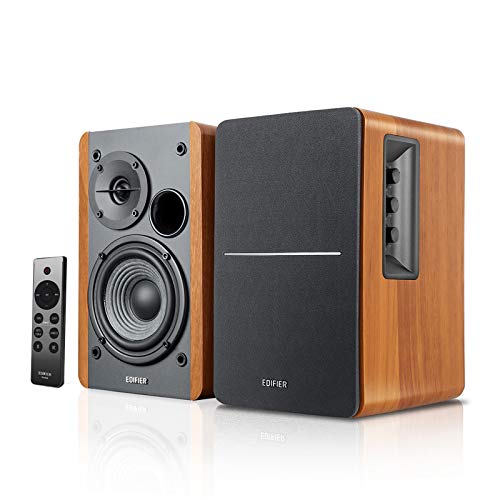
Best affordable powered pair for desks and TVs: Edifier R1280DB
Spec line: powered two-way, 4-inch bass driver, 13 mm silk-dome tweeter, roughly 42 W RMS total, Bluetooth plus optical, coaxial and two RCA inputs, with a remote, per Edifier’s specification sheet.
Best for: the cheapest practical entry to the best affordable bookshelf speakers category when you also want to plug a TV in by optical cable. Skip if: you want a refined, audiophile presentation or very low bass.
- Pro: Many inputs and a remote at a low price, so it works as a TV and music system together.
- Pro: Bass and treble knobs on the side let you tune a poor room.
- Pro: Wood-effect finish looks acceptable in a living room.
- Con: Wired connection between the two speakers is a fixed-length cable.
- Con: Limited resolution compared with spending three times as much.
Best compact powered pair for computers: Audioengine A2+ Wireless
Spec line: powered two-way, 2.75-inch Kevlar woofer, 0.75-inch silk tweeter, about 60 W peak total power, Bluetooth with aptX, USB, RCA and 3.5 mm inputs, according to Audioengine.
Best for: a tight desk or small room where size matters more than output. This is a leading example when people search for best small bookshelf speakers or best compact bookshelf speakers. Skip if: you want to fill a large room or play very loud.
- Pro: One of the smallest cabinets that still sounds balanced and clear.
- Pro: Built-in USB DAC makes a direct computer connection simple.
- Pro: Stylish finish options and solid build quality.
- Con: Cannot match larger bookshelf pairs for bass or volume without a subwoofer.
- Con: Stand-alone price is higher than the Edifier despite fewer inputs.
Best for streaming apartments: KEF LSX II LT
Spec line: powered wireless pair with KEF’s Uni-Q coincident driver design, Wi-Fi and Bluetooth, HDMI ARC for a TV, and a built-in digital amplifier, per KEF’s product page. The full LSX II sits above it with more finish options.
Best for: listeners who stream from Spotify, Tidal or AirPlay 2 and want hi-fi imaging without buying separate components. Skip if: you need to stay under a hard budget limit or want a passive pair you can upgrade.
- Pro: Coincident driver gives a wide sweet spot, so you can sit slightly off-center and still hear good imaging.
- Pro: Includes streaming, DAC and amplification, which saves buying and wiring three boxes.
- Pro: Pair-linking cable keeps wiring tidy between the speakers.
- Con: Premium price tier for the size of the speaker.
- Con: The digital amplifier cannot be swapped later.
Best for TV plus turntable: powered HDMI and phono models
Several brands, including Klipsch with its Heritage-styled powered models, make premium powered bookshelf speakers with HDMI ARC and a phono input. Because specific model availability shifts, treat this entry as a spec class. Look for HDMI ARC, a phono stage with a switch for moving magnet cartridges, a subwoofer output and Bluetooth. This class suits people who want records and a television on one pair of speakers.
- Pro: Replaces a receiver, phono stage and amplifier in one pair.
- Pro: HDMI ARC lets you control volume with the TV remote.
- Pro: Usually includes a subwoofer output for later expansion.
- Con: Premium tier pricing and large cabinets.
- Con: Fixed amplification again limits long-term upgrades.
How to choose bookshelf speakers: numbers that matter
Room size
Small rooms up to about 120 square feet suit two-way speakers with woofers of 4 to 5 inches. Rooms around 150 to 250 square feet suit 6.5-inch woofers. Beyond about 300 square feet, a bookshelf pair alone starts to struggle with bass unless you add a subwoofer.
Amplifier power and sensitivity
Sensitivity tells you how loud a speaker plays for a given power. A speaker rated at 96 dB gets roughly 3 dB louder than a 93 dB speaker with the same power, which equals doubling the amplifier wattage. A 20 W to 50 W per channel amplifier is enough for most 88 to 90 dB speakers in a medium room. If your amplifier is under 30 W and you listen loudly, favour 90 dB or higher.
Placement
Put the speakers on stands so the tweeters sit near ear height, about 36 to 40 inches from the floor for most seated positions. Aim for 6 to 12 inches from the rear wall for ported models unless the manual says otherwise. Toe them in slightly so the tweeters aim at your listening position, and form an equilateral triangle with your seat if possible.
Bluetooth and wireless limits
Bluetooth codecs like SBC, AAC and aptX compress audio. For critical listening, use a wired input or Wi-Fi streaming. Wireless bookshelf pairs typically still run a cable between the left and right speakers, so truly cable-free wiring is rare.
Best bookshelf speakers under $500: what to expect
Under $500 you can realistically choose a powered pair with inputs or a passive pair plus an inexpensive amplifier. The first approach is simpler, the second gives better long-term growth. As a rough split: a powered pair such as the Edifier R1280DB or Audioengine A2+ Wireless covers the whole budget in one purchase, while a passive pair such as the Wharfedale Diamond series or Q Acoustics entry models leaves little room for amplification unless you buy used or choose a compact amplifier. Keep budget for stands and cables too.
Decision matrix
| Your situation | Choose | Why |
|---|---|---|
| Desk, 2 to 4 feet listening distance | Audioengine A2+ Wireless or Edifier R1280DB | Small drivers and nearfield balance |
| Living room with a TV and music | Edifier R1280DB or KEF LSX II LT | Optical or HDMI ARC input |
| Already own a receiver | Klipsch RP-600M II or ELAC DBR62 | Upgrade path and passive value |
| Relaxed jazz and vocals | Q Acoustics 3020c | Smooth treble |
| Small bedroom, low budget | Wharfedale Diamond series | Compact and easy to drive |
Ownership realities
Passive speakers last for decades because the parts are simple, but foam surrounds on older designs can degrade, and magnets and cones rarely fail. Powered speakers depend on the amplifier electronics, which are less repairable, so warranty length matters more. Clean grilles with a soft brush, avoid placing speakers on top of heat sources, and keep ported speakers away from curtains that block the port. Always power down before disconnecting speaker wire to avoid short circuits.
Frequently Asked Questions
Do bookshelf speakers need a subwoofer?
Not always. In a small room, a good 6.5-inch pair provides enough bass for music. For movies or electronic music, a subwoofer adds the lowest octave and takes load off the amplifier, so it is a useful later upgrade rather than a requirement.
What is the difference between powered and passive bookshelf speakers?
Powered speakers contain their own amplifier, so you connect a source directly. Passive speakers need a separate amplifier or receiver. Powered pairs are simpler, passive pairs are easier to upgrade.
Are Bluetooth bookshelf speakers good enough for music?
For casual listening, yes. For critical listening, wired or Wi-Fi connections keep more detail because Bluetooth compresses the signal. Many powered pairs offer both, so you can use Bluetooth for convenience and a wired input for quality.
How far should bookshelf speakers be from the wall?
Front-ported or sealed designs tolerate walls well. Rear-ported speakers usually sound cleaner with 6 to 12 inches of space behind them. Check the manual, because some models include port plugs that let you place them closer.
Do I need speaker stands?
Stands raise the tweeters to ear height and isolate the speakers from furniture, which improves clarity and imaging. If you must use a shelf, a stable one at ear height with isolation pads is a fair compromise.
What size room suits bookshelf speakers?
Most bookshelf speakers fill rooms from small bedrooms up to about 250 square feet comfortably. Larger spaces call for floorstanding speakers or a subwoofer.
More from Amazon
Programs that pair well with the guide above. Offers and eligibility are set by Amazon and may change.
Free shipping on eligible items, Prime Video and more. Eligible new members can start with a free trial.
Start a Prime free trialAd-free music streaming. Eligible new subscribers can start with a free trial.
Try Music Unlimited freeA Prime membership for ages 18-24 with a trial period. Eligibility is set by Amazon.
See Prime for Young AdultsAudiobooks and podcasts to listen to on the go. Eligible new members can start with a free trial.
Try Audible freeAs an Amazon Associate we earn from qualifying purchases.