Key takeaways
- Pro: very strong sound per unit of cost, with warm, clear voices.
- Pro: several digital and analogue inputs let you connect a TV, console and phone.
- Pro: wooden cabinets look neat on a stand.
- Con: no HDMI, so volume is managed by the supplied remote.
- Con: bass is modest without a subwoofer.
The best speakers for a TV in 2026 depend on how much space you have: powered bookshelf speakers such as the Edifier R1280DBs or Klipsch The Fives give the best music and stereo clarity, the Bose TV Speaker is the simplest dialogue upgrade, and the Sonos Arc Ultra is the premium single-bar answer when you want Dolby Atmos without running wires. The right choice also depends on one practical check: which input your TV offers, because HDMI ARC or eARC, optical and analogue outputs each limit what you can connect. This guide is based on manufacturer spec sheets and published reviews, not on our own listening.
Flat TVs have thin cabinets and tiny drivers, so their built-in speakers point downward or backward and struggle with voices once the volume rises. External speakers fix this in three ways: larger drivers, a better position (facing you instead of the wall), and a wider space between left and right channels. The sections below cover eight real options, a connection guide, a worked placement example and a decision table.
Our top picks


As an Amazon Associate we earn from qualifying purchases at no extra cost to you.
Quick comparison of eight speakers for TV
| Pick | Best for | Type and connections | Price tier |
|---|---|---|---|
| Edifier R1280DBs | Best value pair | Powered bookshelf, about 42 W RMS total, optical, coaxial, RCA, Bluetooth | Entry |
| Fluance Ai41 | Mid-range music and TV | Powered bookshelf pair with digital and Bluetooth inputs | Entry to mid |
| Kanto YU6 | Several devices, desktop or stand | Powered pair, 5.25-inch-class woofers, Bluetooth, optical, phono | Mid |
| Klipsch The Fives | Best HDMI ARC speakers | Powered pair, HDMI ARC, Bluetooth, phono, optical | Mid to upper-mid |
| Audioengine A5+ | Premium analogue sound | Powered pair, about 50 W RMS per channel, analogue input | Upper-mid |
| Bose TV Speaker | Dialogue clarity | Compact 2.0 bar, HDMI ARC, optical, Bluetooth | Entry to mid |
| Polk Audio Signa S4 | Atmos on a budget | Soundbar plus wireless subwoofer, HDMI eARC | Mid |
| Sonos Arc Ultra | Premium Atmos bar | Single bar, HDMI eARC, Wi-Fi streaming | Premium |
Price tier is a relative position, not a quote. Entry means a basic upgrade over TV speakers, mid means a clear step up, premium means several times the entry tier.
First check your TV: ports decide which speakers work
Look at the back or side of the TV before buying anything. The ports you find decide what you can connect without extra adapters.
| TV output | What it carries | Best for | Limit |
|---|---|---|---|
| HDMI eARC | Up to 37 Mbps audio, uncompressed multichannel and Atmos | Atmos soundbars, receivers | Needs the eARC-labelled HDMI port |
| HDMI ARC | Compressed Dolby Digital and DTS, stereo PCM | Most soundbars and ARC-ready powered speakers | No lossless audio |
| Optical (TOSLINK) | Stereo PCM or compressed 5.1 | Powered speakers without HDMI | No Atmos, no volume pass-through on some TVs |
| 3.5 mm or RCA analogue | Stereo analogue | Powered speakers like the Audioengine A5+ | TV volume is often fixed, so use the speaker’s knob |
| Bluetooth | Compressed wireless audio | Convenience listening | Delay is possible, which affects lip-sync |
HDMI ARC and eARC bring the best experience because the TV remote can control the volume of the speakers through HDMI-CEC. Optical is a dependable fallback. Bluetooth is convenient, but delays between 100 and 250 milliseconds are common, and anything above roughly 80 to 100 milliseconds becomes noticeable on speech unless the TV offers an audio-delay setting.
Edifier R1280DBs: best value external speakers for TV
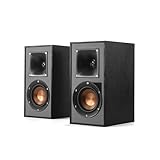
Spec line: powered bookshelf pair, about 42 watts RMS combined, with optical, coaxial, dual RCA and Bluetooth inputs, plus a remote. Price tier: entry.
Best for: bedrooms, desks and small living rooms where the TV is within about 3 metres. Skip if: you need HDMI ARC control or Atmos.
- Pro: very strong sound per unit of cost, with warm, clear voices.
- Pro: several digital and analogue inputs let you connect a TV, console and phone.
- Pro: wooden cabinets look neat on a stand.
- Con: no HDMI, so volume is managed by the supplied remote.
- Con: bass is modest without a subwoofer.
Fluance Ai41: best mid-range option for music plus TV
Spec line: powered two-way bookshelf pair with digital and wireless inputs, positioned as a step up from small desktop pairs. Price tier: entry to mid.
Best for: people who want a bigger sound than the entry class and also play music from a phone. Skip if: your TV only has HDMI outputs and you want one-remote control.
- Pro: larger cabinets give fuller mid-bass than compact desktop pairs.
- Pro: simple, hi-fi style presentation.
- Pro: easy to expand with a subwoofer output.
- Con: fewer control features than the HDMI ARC models.
- Con: wall placement is more limited.
Kanto YU6: best for connecting several devices
Spec line: powered pair with 5.25-inch-class woofers and silk-dome tweeters, with Bluetooth, optical and a phono stage, per the maker’s specs. Price tier: mid.
Best for: a living room that also hosts a turntable, game console or streamer. Skip if: you want the smallest possible footprint.
- Pro: phono input means a turntable plugs in directly.
- Pro: balanced, smooth presentation for music and voices.
- Pro: wide range of cabinet finishes.
- Con: needs stands or a deep shelf.
- Con: no HDMI ARC.
Klipsch The Fives: best HDMI ARC speakers for TV
Spec line: powered bookshelf pair with HDMI ARC, Bluetooth, phono and optical inputs, with a Tractrix horn-loaded tweeter. Price tier: mid to upper-mid.
Best for: people who want a compact, stylish pair that responds to the TV remote through HDMI. Skip if: you want Dolby Atmos or a wider room-filling sound without a subwoofer.
- Pro: HDMI ARC allows one-remote control.
- Pro: lively, detailed sound with strong voices.
- Pro: retro wood-and-fabric design looks like furniture.
- Con: price is high next to the entry pairs.
- Con: bass depth is limited, so add a subwoofer for movies.
Audioengine A5+: best premium analogue pair
Spec line: powered pair with about 50 watts RMS per channel and 5-inch Kevlar woofers, analogue inputs, from the A5+ family. Price tier: upper-mid.
Best for: a desk or small room where sound quality counts and the TV or streamer has an analogue output. Skip if: you need HDMI ARC.
- Pro: clean, detailed sound with strong bass for the size.
- Pro: solid build quality.
- Pro: works well for both TV and music.
- Con: analogue-only connections make some modern TVs awkward.
- Con: needs desk space for the speakers.
Bose TV Speaker: best for dialogue clarity
Spec line: compact 2.0 bar with HDMI ARC, optical and Bluetooth inputs, and a dialogue mode on the remote. Price tier: entry to mid.
Best for: people who mostly want voices easier to follow and an uncluttered stand. Skip if: you want deep bass or surround effects.
- Pro: very small and quick to set up.
- Pro: dedicated dialogue setting suits speech-heavy shows.
- Pro: Bluetooth lets you stream music.
- Con: no subwoofer, so low-end is limited.
- Con: no Atmos or surround.
Polk Audio Signa S4: best budget Atmos solution
Spec line: Dolby Atmos soundbar with wireless subwoofer and HDMI eARC. Price tier: mid.
Best for: a movie setup that needs deeper bass and height effects without separate speakers. Skip if: you mostly stream music and want separate stereo drivers.
- Pro: includes a subwoofer, which most small pairs lack.
- Pro: Atmos decoding gives overhead effects.
- Pro: simple one-bar installation.
- Con: virtual Atmos is less convincing than real height speakers.
- Con: a subwoofer needs mains power and floor space.
Sonos Arc Ultra: best premium soundbar for a TV
Spec line: single Dolby Atmos soundbar with HDMI eARC and Wi-Fi streaming; can add a Sonos subwoofer and rear speakers later. Price tier: premium.
Best for: a large living room, apartment dwellers who want a clean look, and people already in the Sonos ecosystem. Skip if: you want a lower-cost speaker pair.
- Pro: wide, convincing Atmos for a single bar.
- Pro: easy expansion and multi-room music features.
- Pro: a speech enhancement mode helps dialogue.
- Con: premium price tier.
- Con: no separate stereo drivers for left and right channel separation.
For Samsung owners, check whether you prefer a Samsung soundbar, because the Q-Symphony feature lets certain Samsung TVs play through their own speakers and a compatible Samsung bar together. If you stay with other brands, you simply switch off the TV speakers.
Best TV speakers for dialogue and for people who struggle to hear speech
If speech is the problem, the first fix is cheap: open your TV’s sound menu and try a “clear voice”, “dialogue enhancer” or “speech” mode, and set the audio output to PCM or stereo if the TV defaults to surround passthrough. Then, choose speakers with a dedicated centre-style driver or a voice mode. The Bose TV Speaker and Sonos speech modes are common examples. External speakers that sit nearer to you also increase the ratio of direct voice to room echo, which helps in any room.
For anyone with hearing difficulties, this article offers general product information only. A hearing professional can give personal advice, and some TV streaming devices and hearing-friendly accessories may suit better than speakers.
Best wireless TV speakers and what “wireless” really means
Most “wireless” TV speakers still need power cables. The wireless part is usually the audio link: Bluetooth, Wi-Fi or a proprietary transmitter. Bluetooth is easy but adds delay; Wi-Fi systems and proprietary dongles add less delay and are better for movies. Where a pair of speakers are truly wireless to each other, such as Roku’s Wireless Speakers set, one of them pairs to the TV and the second receives sound from the first. Check the maker’s compatibility list because some options work only with a particular TV platform.
Worked example: placing a pair for a 65-inch TV
A 65-inch TV is about 57 inches (1.45 metres) wide. If your sofa is 3 metres from the screen, the ideal stereo triangle puts the speakers about 3 metres apart, which is far wider than the TV itself. A practical compromise is to place each speaker 10 to 20 centimetres outside the TV edge, giving a total spacing of about 1.7 to 1.9 metres. Raise the speakers on stands so tweeters reach ear height at roughly 1 metre above the floor, and toe them in slightly toward the sofa. If the pair has to sit on a low TV stand, use stands or isolation pads to angle them up by 5 to 10 degrees.
Decision table: which type of TV speaker suits you
| Your situation | Choose | Why |
|---|---|---|
| Small room, tight budget, plus music | Edifier R1280DBs | Best value and many inputs |
| One remote, HDMI ARC TV | Klipsch The Fives | HDMI ARC control |
| Turntable, console, TV in one setup | Kanto YU6 | Phono and optical inputs |
| Hard-to-follow speech, minimum clutter | Bose TV Speaker | Dialogue mode and compact size |
| Movies with extra bass | Polk Signa S4 | Bar plus subwoofer |
| Large living room, Atmos, no wires | Sonos Arc Ultra | Premium single-bar Atmos |
Speakers for TV used for music
If music matters as much as TV, stereo speaker pairs beat most soundbars. Separate left and right drivers give a wider stage and a more natural image. The Klipsch, Kanto and Audioengine pairs also double as desk or turntable speakers. Soundbars such as the Arc Ultra bring convenience and wireless streaming, but a stereo pair with a subwoofer is usually more musical at a similar price tier.
Setup mistakes that make TV speakers sound worse
- Leaving the TV speakers on. Some TVs play through both the internal and external speakers, which creates an echo. Set the output to “external”, “ARC” or “audio system” in the sound menu.
- Using the wrong HDMI port. ARC and eARC work only on the port labelled for them. A normal HDMI input will not return audio.
- Leaving the audio format on bitstream. If the speakers only handle stereo, switch the TV output to PCM so it downmixes properly rather than sending a signal the speakers cannot decode.
- Hiding speakers in a cabinet. Front-ported or rear-ported designs need at least a few inches of clearance. Closed shelves muddy the bass and voices.
- Forgetting CEC. If the remote does not change volume, enable HDMI-CEC (it may be named Anynet+, Bravia Sync or Simplink depending on the TV brand).
Frequently Asked Questions
What are the best speakers for a TV?
For value, the Edifier R1280DBs is hard to beat. For HDMI ARC convenience, Klipsch The Fives is the common pick. For simple dialogue improvement, the Bose TV Speaker is popular, and for premium Atmos, the Sonos Arc Ultra leads. The best one depends on your TV’s ports and room size.
Can I connect any speakers to my TV?
Not directly. Passive speakers need an amplifier or receiver. Powered speakers can connect through optical, analogue or HDMI ARC depending on their inputs and your TV outputs. Check the TV’s audio output settings and set them to match.
What are the best external speakers for a Samsung TV?
Any HDMI ARC or optical speaker works. For the most integrated experience, a Samsung soundbar supports Q-Symphony, which uses the TV and bar together. If you prefer other brands, disable TV speakers in the sound menu and choose the external output.
Do I need a subwoofer for TV speakers?
For speech and casual viewing, no. For action films and music with strong bass, a subwoofer helps because small bookshelf speakers roll off below around 60 Hz. Soundbar kits like the Polk Signa S4 include one, while pairs usually need a separate model.
Why does the sound lag behind the picture?
Bluetooth and some TV processing add delay. Switch to optical, HDMI ARC or a wired connection, and look for an audio delay or lip-sync adjustment in the TV menu. A change of 20 to 50 milliseconds can bring speech back in line.
Are soundbars better than bookshelf speakers for a TV?
Soundbars are simpler and fit under the screen, which suits small spaces and wall mounts. A bookshelf pair usually gives better stereo imaging and music quality, but requires more space and wiring. If you want Atmos or surround without wires, a bar is the easier route.
More from Amazon
Programs that pair well with the guide above. Offers and eligibility are set by Amazon and may change.
Free shipping on eligible items, Prime Video and more. Eligible new members can start with a free trial.
Start a Prime free trialAd-free music streaming. Eligible new subscribers can start with a free trial.
Try Music Unlimited freeA Prime membership for ages 18-24 with a trial period. Eligibility is set by Amazon.
See Prime for Young AdultsAudiobooks and podcasts to listen to on the go. Eligible new members can start with a free trial.
Try Audible freeAs an Amazon Associate we earn from qualifying purchases.