Key takeaways
- Pro: Matching timbre with Klipsch fronts and surrounds.
- Pro: Efficient design that works well with mid-priced receivers.
- Pro: Large enough drivers to carry dialogue-adjacent height effects.
- Con: Bigger than many rivals, so it looks bulky on a small bookshelf speaker.
- Con: Premium price tier for a module.
The best Dolby Atmos speaker setup for most living rooms is a pair of compact up-firing height modules added to the front speakers you already own, driven by an AV receiver with at least nine amplified channels. If you do not want a receiver at all, a flagship Atmos soundbar such as the Sonos Arc Ultra is the simplest route. In-ceiling speakers give the most precise overhead effects but need cutting and wiring. The right answer depends on your ceiling, your receiver and how much hardware you are willing to place in the room.
This guide is based on published specifications, manufacturer documentation and the way Dolby describes Atmos layouts, not on personal listening claims. Prices are described as entry, mid or premium tiers because street prices shift weekly.
Our top picks


As an Amazon Associate we earn from qualifying purchases at no extra cost to you.
Quick Answer: Which Type of Atmos Speaker Fits You
| Your situation | Best route | Why |
|---|---|---|
| You own a 5.1 receiver with spare amp channels | Up-firing add-on modules | No ceiling work, ships as a pair, sits on top of your existing front speakers |
| Ceiling is flat, white and 2.4 to 3.7 m high | Up-firing modules or in-ceiling speakers | Both work; modules bounce sound off the ceiling at about 14 to 20 degrees |
| Cathedral, vaulted or textured ceiling | In-ceiling or wall-mounted height speakers | Reflected sound scatters on irregular surfaces |
| Renting or no receiver | Atmos soundbar plus sub | Everything in one chassis, one HDMI eARC cable |
| Want Atmos music over Wi-Fi | Sonos Era 300 or similar | Built-in up-firing drivers for spatial music |
| Building a dedicated theater | Discrete 7.1.4 with in-ceiling speakers | Most accurate overhead object placement |
How Dolby Atmos Speaker Layouts Actually Work
Dolby Atmos describes a layout with three numbers. A 5.1.2 system has five ear-level speakers, one subwoofer and two overhead channels. A 7.1.4 system has seven ear-level speakers, a subwoofer and four overhead channels. The third digit is the part that makes a system “Atmos” in the sense most people mean, because it lets sound objects such as rain, helicopters or a voice-over-head cue move above you.
There are three physical ways to deliver the overhead channels. Up-firing drivers point at the ceiling and rely on reflection. In-ceiling or on-ceiling speakers point straight down. High wall-mounted speakers sit above the screen and surrounds and angle down. Each approach has trade-offs in cost, accuracy and installation effort, which is why the picks below are grouped by type rather than ranked as a single list.
One practical point catches many buyers out: a receiver must be Atmos-capable, and it needs enough amplified channels. A 7.2-channel receiver can run 5.1.2 or 7.1.2 but not 7.1.4, because height channels share amplification with surrounds. Nine channels covers 5.1.4 or 7.1.2, and eleven covers 7.1.4. Check the speaker-assignment menu in the manual before buying speakers.
Best Up-Firing Atmos Add-On Speakers
Add-on modules are the most popular solution because they cost less than a second set of speakers and require only a speaker cable. They are designed to sit on top of an existing bookshelf or tower and share the same footprint.
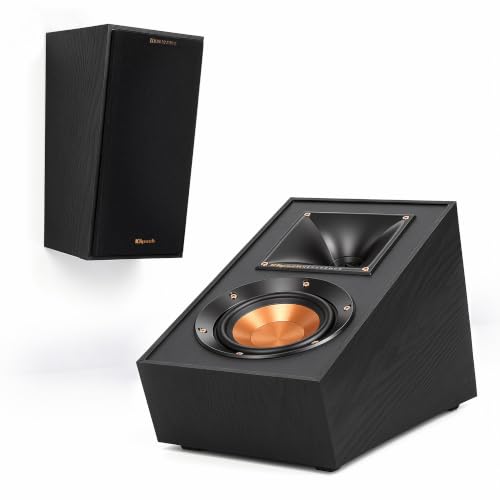
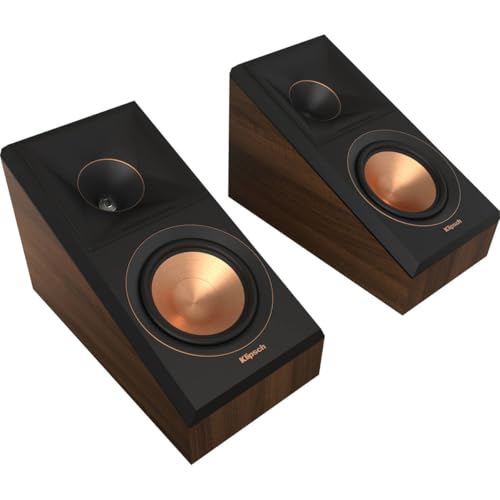
Klipsch RP-500SA II: Best Overall Add-On Module
Spec line: Atmos-enabled elevation speaker, 1-inch titanium tweeter on a Tractrix horn, 5.25-inch woofer, angled up-firing baffle, high sensitivity design.
Best for: Owners of Klipsch Reference Premiere towers or bookshelves who want matching tonality and the clearest overhead detail. Klipsch builds these modules to share the horn-loaded voice of its main speakers, so height effects blend with the front stage rather than sounding like a separate device.
Skip if: You dislike horn-loaded brightness, or you prefer a warmer, smoother sound.
- Pro: Matching timbre with Klipsch fronts and surrounds.
- Pro: Efficient design that works well with mid-priced receivers.
- Pro: Large enough drivers to carry dialogue-adjacent height effects.
- Con: Bigger than many rivals, so it looks bulky on a small bookshelf speaker.
- Con: Premium price tier for a module.
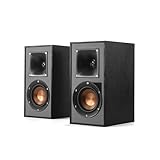
Klipsch R-41SA: Best Value Add-On Module
Spec line: Compact Atmos module from Klipsch’s Reference line, 1-inch aluminum tweeter on a horn, roughly 4-inch fiber-composite woofer, designed to sit on top of R-series speakers.
Best for: Budget-conscious home theater builders who want Atmos height without spending as much as on a second pair of speakers.
Skip if: You plan a high-end build or have towers where a bigger module would balance better.
- Pro: Entry price tier within a respected speaker family.
- Pro: Small footprint suitable for shelves and furniture.
- Pro: Horn tweeter keeps effects clear at moderate volume.
- Con: Smaller woofer means less low-mid body in overhead effects.
- Con: Best matched to other Klipsch speakers.
Polk Audio Atmos Elevation Modules: Best for Polk Owners
Spec line: Up-firing height modules from Polk’s Signature Elite and Monitor XT lines, with a dedicated tweeter and midwoofer angled toward the ceiling, designed to sit on top of Polk towers or bookshelf speakers.
Best for: Listeners with a Polk Signature Elite or Monitor XT system who want certified Atmos height from the same company. Polk positions these as a low-cost way into Atmos, which makes them one of the cheapest sensible paths.
Skip if: You want a module that stays neutral with non-Polk speakers or you need a very compact shape.
- Pro: Entry to mid price tier.
- Pro: Designed to pair with Polk speakers that many buyers already own.
- Pro: Dolby Atmos enabled certification is part of the product line.
- Con: Model names and availability change between product generations, so confirm the current match for your speakers.
- Con: Sound signature is more relaxed than Klipsch, which means slightly less sparkle in effects.
SVS Prime Elevation: Best Sound Quality in a Compact Cabinet
Spec line: Compact two-way height speaker from SVS that can either up-fire from the top of a speaker or mount on a wall or ceiling, using a dedicated tweeter and midrange driver.
Best for: Listeners who want a flexible height speaker that works as a reflective module today and a wall-mounted height speaker later if the room changes. SVS is known for subwoofers and the Prime line is tuned to blend with its own towers and bookshelves.
Skip if: You are on a tight budget or want an all-in-one product.
- Pro: Two mounting modes in one cabinet.
- Pro: Clean midrange and low distortion for overhead effects.
- Pro: Pairs naturally with SVS subwoofers for a coherent bass-to-height blend.
- Con: Mid price tier for a small speaker.
- Con: Less common in stores, so it is usually bought online.
Best Atmos Ceiling Speakers (In-Ceiling and On-Ceiling)
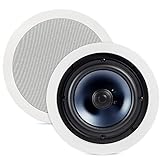
Because model lines change often, the practical way to pick in-ceiling speakers is by specification class rather than a single model number. Reputable manufacturers such as Klipsch, Polk, Sonance, Episode, Definitive Technology and Yamaha each sell in-ceiling Atmos-capable speakers. Look for these traits:
- A 6.5- to 8-inch woofer with a pivoting tweeter, so you can aim the high frequencies at the listening position.
- A pre-construction or retrofit flange that matches your ceiling type.
- Sensitivity of roughly 88 to 92 dB, so a mid-priced receiver can drive them.
- A paintable grille so the speaker disappears into the ceiling.
- A sealed back box or included enclosure to control resonance in the cavity above.
In-ceiling speakers are the best choice for a dedicated theater with a standard flat ceiling, because they point sound straight down and do not depend on surface reflection. The trade-off is installation: you need to cut holes, run speaker wire through a cavity and sometimes fire-rated enclosures where building code requires them. Hire an installer if you are unsure about fire codes or insulation.
Best Atmos Wireless and Streaming Speakers
Sonos Era 300: Best Spatial Music Speaker
Spec line: Six-driver wireless speaker with up-firing and side-firing tweeters, Dolby Atmos Music support, Wi-Fi 6, Bluetooth, AirPlay 2, Trueplay tuning and a line-in via an optional adapter.
Best for: Streaming Atmos music from supported services and as rear surround speakers in a Sonos soundbar system. The drivers fire in several directions to bounce sound off walls and ceiling, giving a wider soundstage than a conventional single-box speaker.
Skip if: Your priority is film height effects at high volume, or you want a pair for stereo at a lower cost than premium bookshelf speakers.
- Pro: True spatial audio from a single box.
- Pro: Works as a rear surround pair for Sonos Arc, Arc Ultra and Beam.
- Pro: Easy setup through the app.
- Con: Premium price tier for one speaker.
- Con: Spatial effect depends heavily on room shape and nearby walls.
Best Dolby Atmos Soundbars
Sonos Arc Ultra: Best All-Round Atmos Soundbar
Spec line: 7.1.4-channel virtualization, 14 drivers according to Sonos, HDMI eARC, Wi-Fi, AirPlay 2, optional Sub and Era 300 rear speakers.
Best for: Households that want the simplest upgrade path from TV speakers to full Atmos. The soundbar can start alone and grow into a 5.1 or 7.1 system by adding a subwoofer and two rear speakers.
Skip if: You want the lowest price for Atmos or prefer a bar with included wireless rears from the start.
- Pro: Strong dialogue clarity and wide front soundstage.
- Pro: Sound Motion driver design improves bass from the bar itself.
- Pro: Expandable and multi-room friendly.
- Con: Premium price tier; rear speakers and sub cost extra.
- Con: Not as tall in height effects as discrete overhead speakers.
Samsung HW-Q990F: Best Bar With Included Rears
Spec line: 11.1.4-channel system with a soundbar, wireless subwoofer and wireless rear speakers, Dolby Atmos and DTS:X, Q-Symphony pairing with compatible Samsung TVs.
Best for: Buyers who want a boxed surround-sound experience and own a recent Samsung TV. The included rears and sub reduce the number of purchases and cables.
Skip if: You do not own a Samsung TV or dislike remote-control menus for tuning.
- Pro: Complete system in the box.
- Pro: Many HDMI and format options for gaming and movies.
- Pro: Wide height-channel coverage for a bar system.
- Con: Premium price tier.
- Con: The best features depend on a Samsung TV.
Sony BRAVIA Theater Bar 9: Best for Sony TV Owners
Spec line: 13-speaker soundbar, 7.1.2-channel, Dolby Atmos and DTS:X, HDMI eARC, Sony 360 Spatial Sound Mapping, and optional BRAVIA Theater Sub and rear speakers according to Sony’s documentation.
Best for: Sony TV owners who want matched setup and optimized sound modes. Sony’s room-calibration tools aim to adapt the bar to your space automatically.
Skip if: You want deep expandability to a full discrete layout.
- Pro: Solid dialogue focus with separate center-channel drivers.
- Pro: Easy integration with Sony TVs.
- Pro: Upgrade path with matched rear speakers and sub.
- Con: Mid to premium price tier.
- Con: Less app-based multi-room flexibility than Sonos.
Comparison Table: Atmos Speaker Picks at a Glance
| Pick | Type | Key spec | Price tier | Needs receiver? |
|---|---|---|---|---|
| Klipsch RP-500SA II | Up-firing module | 1-inch titanium tweeter, 5.25-inch woofer | Premium | Yes |
| Klipsch R-41SA | Up-firing module | 1-inch tweeter, roughly 4-inch woofer | Entry | Yes |
| Polk Atmos modules | Up-firing module | Tweeter plus midwoofer, Atmos-enabled | Entry to mid | Yes |
| SVS Prime Elevation | Module or wall height | Two-way design, flexible mount | Mid | Yes |
| In-ceiling class | Ceiling | 6.5 to 8 inch woofer, pivot tweeter | Mid to premium | Yes |
| Sonos Era 300 | Wireless speaker | 6 drivers, Atmos Music | Premium | No |
| Sonos Arc Ultra | Soundbar | 14 drivers, 7.1.4 virtual | Premium | No |
| Samsung HW-Q990F | Soundbar system | 11.1.4 with sub and rears | Premium | No |
| Sony BRAVIA Theater Bar 9 | Soundbar | 13 speakers, 7.1.2 | Mid to premium | No |
How to Choose Atmos Speakers: The Numbers That Matter
Check Your Ceiling Height First
Up-firing speakers work best between about 2.4 and 3.7 metres (8 to 12 feet). Below 2.4 metres the reflection is too short and can sound sharp. Above 3.7 metres the reflected sound loses energy before it reaches you. Ceilings that are acoustic tile, heavily textured or sloped will scatter the beam, so favor in-ceiling or wall-mounted height speakers in those rooms.
Match the Receiver Channel Count
Count the amplified channels. A 5.1.2 system needs seven channels, a 5.1.4 or 7.1.2 system needs nine, and a 7.1.4 system needs eleven. If you buy a 7.2-channel receiver and later want four height speakers, you will need an external amplifier or a larger receiver. Our companion guide on amplifiers and receivers explains the sizing in more detail.
Think in Angles, Not Just Locations
Dolby recommends height speakers be positioned so that the angle from the listening position to the speaker is roughly 30 to 55 degrees above the horizontal for front and rear heights in a 5.1.4 layout. For a 5.1.2 layout, a position above the front left and right speakers, or overhead at the listening position, both work. In practice, aim for a spot where the overhead speakers are about as far apart as your front left and right speakers and sit slightly forward of the main seat.
Worked Example: Budget for a 5.1.2 Upgrade
Imagine a living room with a 5.1 receiver that has seven amplified channels and an existing front pair, a center, a pair of surrounds and a subwoofer. To go to 5.1.2, you add two height modules. The receiver already has two spare channels (7 minus 5 equals 2), so you spend only on the two modules and some speaker wire. The same room moving to 5.1.4 would need nine channels, so the receiver would have to be replaced or paired with a two-channel external amp.
Subwoofer Pairing
Overhead speakers rarely play below 80 Hz, so crossover settings matter. Set height speakers to small in the receiver and use a crossover near 80 to 120 Hz, depending on the module size. Smaller modules such as the 4-inch class need a higher crossover than 5.25-inch modules.
Common Mistakes With Atmos Speakers
- Placing modules on a shelf that is too low, so the ceiling bounce lands behind the listener instead of overhead.
- Leaving the receiver on stereo or 5.1 decoding, so height channels never receive signal.
- Buying a 7.2-channel receiver and expecting 7.1.4 playback.
- Ignoring ceiling material and finding that the reflection is weak.
- Skipping room calibration. Run the receiver’s microphone calibration with all speakers connected.
- Using Atmos with a source that is not Atmos. Streaming apps need the right audio setting and the TV must pass bitstream audio through eARC.
Frequently Asked Questions
Do Dolby Atmos speakers need an AV receiver?
Discrete height speakers such as add-on modules and in-ceiling units need a receiver or an amplifier with Atmos decoding. Soundbars and wireless speakers such as the Sonos Era 300 decode Atmos internally, so they work with only a TV and an HDMI eARC connection.
Are up-firing Atmos speakers as good as in-ceiling speakers?
In-ceiling speakers generally deliver more precise overhead placement because they point straight down, while up-firing modules depend on ceiling reflection. A flat, smooth ceiling of normal height makes the gap smaller. Many listeners find modules acceptable and far easier to install.
How many height speakers do I need?
Two is enough to hear a clear Atmos effect in a 5.1.2 layout. Four overhead channels, as in 5.1.4 or 7.1.4, give smoother movement front to back and are worth adding when the room and budget allow it.
Can I use any speaker as an Atmos height speaker?
Technically yes if it is mounted overhead and connected to a height channel, but purpose-built modules and ceiling speakers are voiced for reflections or downward firing. A regular bookshelf speaker on the ceiling is possible but often sounds directional and may require careful angling.
Is a Dolby Atmos soundbar worth it compared with discrete speakers?
A soundbar is worth it when simplicity, space or rental restrictions matter more than precision. Discrete speakers win on overhead accuracy, power and long-term upgradeability, but they require more hardware and set-up time.
Do I need Atmos content to benefit?
Yes, to hear true Atmos objects you need Atmos-encoded content such as Blu-ray discs or streaming titles marked with the Dolby Atmos logo. Many receivers also include an upmixer that spreads regular stereo or 5.1 sound to the height channels, which can be pleasant but is not the same as native Atmos.
More from Amazon
Programs that pair well with the guide above. Offers and eligibility are set by Amazon and may change.
Free shipping on eligible items, Prime Video and more. Eligible new members can start with a free trial.
Start a Prime free trialAd-free music streaming. Eligible new subscribers can start with a free trial.
Try Music Unlimited freeA Prime membership for ages 18-24 with a trial period. Eligibility is set by Amazon.
See Prime for Young AdultsAudiobooks and podcasts to listen to on the go. Eligible new members can start with a free trial.
Try Audible freeAs an Amazon Associate we earn from qualifying purchases.