Key takeaways
- Compare the best smart air purifiers for pet odors: five app-controlled picks with heavy carbon filters, auto modes, and coverage for busy pet homes.
Pet odors are a gas problem, not a dust problem. The smells that linger around litter boxes, dog beds, and feeding corners come from volatile organic compounds that drift straight through an ordinary HEPA filter. Clearing them takes a purifier with a serious activated carbon stage, and a smart model adds the tools that make odor control practical day to day: sensors that react when smells spike, auto modes that raise fan speed by themselves, and app alerts that tell you when the carbon filter is spent.
The five picks below all connect to an app or voice assistant, and each attacks odors with a dedicated carbon, catalytic, or PECO filter stage rather than a token carbon sheet. They span compact medium-room units through to large open-plan models, suiting everything from a studio apartment with one cat to a busy multi-dog household.
As an Amazon Associate, we earn from qualifying purchases.
Quick Answer
For most pet homes, the Coway Airmega 250S is the best smart air purifier for pet odors, pairing a deep activated carbon filter with app control and coverage for large rooms. The Winix 5520 is the strongest value pick, while the Molekule Air Pro suits owners who want pollutant-destroying PECO filtration and detailed air quality tracking.
Table of Contents
- Quick Answer
-
- Coway Airmega 250S
-
- Winix 5520
-
- Blueair Blue Pure 311i+ Max
-
- Molekule Air Pro
-
- Dyson Purifier Cool Formaldehyde TP09
- How to Choose
- Who Should Skip
- FAQ
- Final Verdict
- Product and ASIN Reference
1. Coway Airmega 250S
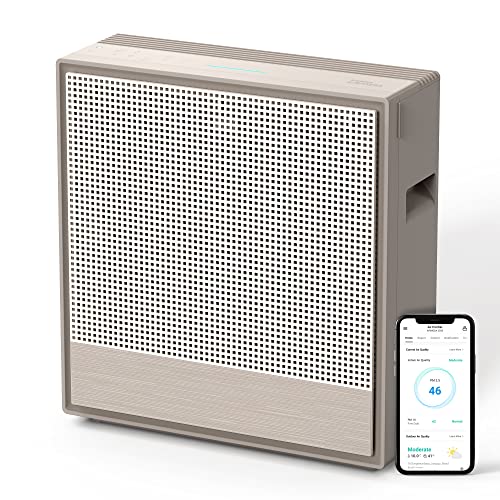
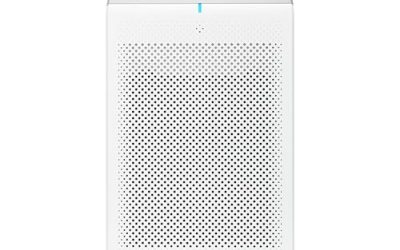
The Airmega 250S is the most complete all-rounder here for homes where pet odor is a daily issue. Its HyperCaptive filtration system stacks a washable pre-filter for hair and dander, an activated carbon filter for gases and smells, and a Green True HEPA filter for fine particles. Coway rates the system for large spaces, covering up to 930 square feet in 30 minutes and 1,860 square feet in an hour, which suits open living areas where pets spend their days.
Smart control runs through the IoCare app, with Alexa and Google Assistant voice support, filter tracking, and scheduling. A real-time air quality indicator changes with conditions, and auto mode raises fan speed as pollutant levels climb, so the machine works harder right after a litter box visit and settles down afterwards.
Specs
- Filtration: HyperCaptive system with washable pre-filter, activated carbon filter, and Green True HEPA filter
- Coverage: Up to 930 sq ft in 30 minutes and 1,860 sq ft in 60 minutes (manufacturer figures)
- Connectivity: IoCare app, Amazon Alexa, Google Assistant
- Odor performance: Manufacturer cites up to 99 percent reduction of VOCs and household odors
- Modes: Auto, sleep, and manual speeds with a real-time air quality indicator
- Warranty: 3-year limited manufacturer warranty
2. Winix 5520
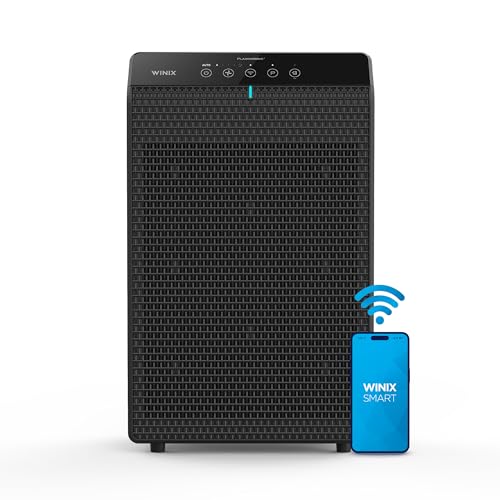
The Winix 5520 is the mid-range pick that still treats odor as a priority. Its four-stage system runs a washable pre-filter, an AOC (Advanced Odor Control) carbon filter formulated for household smells such as pet, cooking, and smoke odors, a True HEPA filter, and Winix PlasmaWave technology, which can be switched off if you prefer filtration only.
It is AHAM verified for rooms up to 392 square feet, and Winix rates it for spaces up to 1,882 square feet at one air change per hour. Wi-Fi connects it to the Winix Smart app and Alexa, and an onboard sensor drives auto mode across its five fan speeds.
Specs
- Filtration: 4-stage with washable pre-filter, AOC carbon filter, True HEPA filter, and switchable PlasmaWave
- Coverage: AHAM verified for 392 sq ft; up to 1,882 sq ft at one air change per hour (manufacturer figure)
- CADR: 253 cfm smoke, 252 cfm dust, 247 cfm pollen
- Connectivity: Wi-Fi, Winix Smart app, Amazon Alexa
- Fan speeds: 5, including sleep and turbo
- Sensor: Air quality sensor with color indicator and auto mode
3. Blueair Blue Pure 311i+ Max
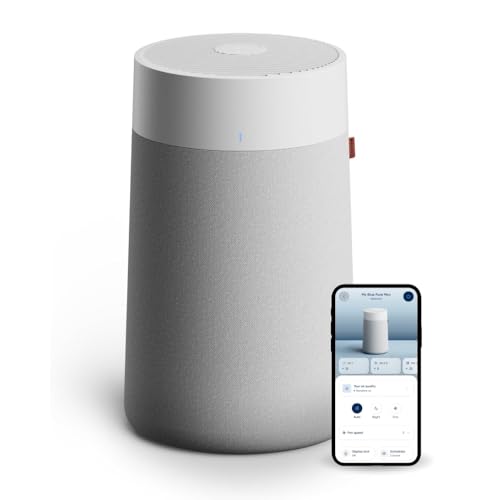
Blueair’s Blue Pure 311i+ Max is the strongest choice for a single medium room, such as a bedroom shared with a cat or a home office where the dog sleeps. HEPASilent technology combines electrostatic and mechanical filtration, and the standard Particle and Carbon filter traps light pet and cooking odors. For heavier smells, Blueair sells a SmokeBlock replacement filter with twice the activated carbon of the standard filter, which is the upgrade pet owners should plan on.
Published performance is strong for the size, with a quiet 23 to 50 dB sound range on just 38 watts. A washable fabric pre-filter catches hair before it reaches the main filter, and Wi-Fi with the Blueair app brings auto mode, a night mode, and filter reminders.
Specs
- Filtration: HEPASilent with Particle and Carbon filter; optional SmokeBlock filter with double activated carbon
- Coverage: Recommended for 525 sq ft; cleans 525 sq ft in 12.5 minutes (manufacturer figures)
- CADR: 339 cfm smoke, 370 cfm dust, 446 cfm pollen
- Noise and power: 23 to 50 dB; 38 W
- Connectivity: Wi-Fi, Blueair app, auto and night modes
- Dimensions and weight: 21 x 12.5 x 12.5 in; 7.9 lb
4. Molekule Air Pro

The Molekule Air Pro takes a different approach to odors. Instead of relying on carbon alone, its PECO-HEPA Tri-Power filter uses a light-activated catalyst that the manufacturer says breaks down VOCs, mold, bacteria, and viruses at a molecular level while the HEPA layer captures particles. Molekule markets the Air Pro with FDA-cleared Class II device claims for destroying airborne viruses and bacteria, which sets it apart from every other pick here.
It is rated for rooms up to 1,000 square feet, and its sensor suite tracks particles, VOCs, carbon dioxide, and humidity, feeding a detailed air quality history in the app. The trade-offs are a premium position in the range and a 123 W draw at full speed, so it suits owners who want the deepest data and pollutant destruction.
Specs
- Filtration: PECO-HEPA Tri-Power filter with light-activated PECO catalyst
- Coverage: Up to 1,000 sq ft (manufacturer figure)
- Sensors: Particles, VOCs, carbon dioxide, and humidity with app history
- Connectivity: Molekule app, Amazon Alexa
- Power: 123 W
- Regulatory note: Marketed with FDA-cleared Class II device claims for destroying viruses and bacteria
5. Dyson Purifier Cool Formaldehyde TP09

The Dyson TP09 is the pick for chemical smells rather than everyday pet musk. Alongside a HEPA H13 filter and an activated carbon layer for gases and odors, it carries a separate catalytic filter that Dyson says continuously destroys formaldehyde, a common VOC released by new furniture, flooring, and pressed-wood pet furniture. A solid-state sensor measures formaldehyde specifically, alongside separate sensing for PM2.5, PM10, VOCs, and nitrogen dioxide, with results shown on the LCD screen and in the MyDyson app.
Because it is also an Air Multiplier fan with oscillation up to 350 degrees, it doubles as a cooling fan for the room, and it works with Alexa, Google Assistant, and Siri Shortcuts. Note that Dyson does not publish a CADR rating, instead testing whole-room purification with its own POLAR method, so compare it on features rather than headline airflow numbers.
Specs
- Filtration: HEPA H13 filter, activated carbon filter, and catalytic filter that destroys formaldehyde
- Sensors: Solid-state formaldehyde sensor plus PM2.5, PM10, VOC, and nitrogen dioxide sensing
- Connectivity: Wi-Fi, MyDyson app, Amazon Alexa, Google Assistant, Siri Shortcuts
- Airflow: Air Multiplier fan with oscillation up to 350 degrees
- Display: LCD screen with live air quality readouts
- Rating note: No published CADR; manufacturer uses whole-room POLAR test method
How to Choose
Start with the carbon stage, because that is what removes odor. A thin carbon sheet behind a HEPA filter will not keep up with a litter box; look for a dedicated carbon filter with real depth, an odor-specific carbon blend such as the Winix AOC filter, an upgrade path like Blueair’s SmokeBlock, or an alternative technology such as Molekule’s PECO catalyst or Dyson’s formaldehyde catalyst.
Next, match coverage to the room where the pet actually spends time. Use the AHAM-verified or recommended room size where one is published, and size up for open-plan layouts, since odor control needs frequent air changes at moderate speeds rather than short bursts on turbo. A washable pre-filter matters more in pet homes than almost anywhere else, because hair loads a filter fast and a rinseable screen keeps the main filter working on gases instead of clogging with fur.
Finally, judge the smart features by whether they help with smell specifically. An air quality sensor with auto mode reacts to odor events without you touching anything, app filter alerts prevent the common failure of running on a saturated carbon filter, and scheduling lets the unit run hard while you are out and quiet down before you return. Voice control is a convenience; sensor-driven automation earns its keep.
Who Should Skip
Skip a smart purifier if your only concern is dust and dander. Odor-focused models spend their filter budget on carbon, and a simpler particle-focused unit will serve an allergy-driven purchase better. Skip the app-connected route entirely if you do not want another account and another device on your Wi-Fi; every pick here works best with its app, and a manual purifier with a good carbon filter is a reasonable alternative.
Also skip the upgrade if the odor source is unmanaged: no purifier compensates for a litter box that is not scooped or bedding that is never washed. Fix the source first, then let the purifier handle the background level. Households with birds or other sensitive species should check the manufacturer’s guidance on features such as PlasmaWave before buying, and can leave that stage switched off on the Winix.
FAQ
Do smart air purifiers really remove pet odors?
They remove the airborne part of the problem. Pet smells are mostly gases, so they are captured by activated carbon or broken down by catalyst technologies such as PECO, while the HEPA stage handles dander and dust. A purifier will steadily lower background odor in a closed room, but it will not erase a strong source smell instantly.
How often does the carbon filter need replacing in a pet home?
Follow the manufacturer’s interval for your model, commonly somewhere between six and twelve months, and watch for odor breakthrough: when smells start lingering again despite the unit running, the carbon is saturated. App-connected models help by tracking filter life and sending replacement alerts before performance falls off.
Where should I place a purifier for litter box odors?
Place it in the same room, a short distance from the litter box rather than directly against it, with space around the intake so air can circulate freely. Keep doors to the room closed where possible so the unit recycles the same air repeatedly, and let auto mode handle the spikes after the box is used.
Can I run a smart air purifier on auto mode all the time?
Yes, that is what auto mode is designed for. The sensor raises fan speed when particle or gas levels climb and drops it back when the air clears, which keeps noise and energy use down between odor events. Night or sleep modes cap the fan at its quietest settings for bedrooms.
Final Verdict
For most pet households, the Coway Airmega 250S is the safest buy: deep carbon filtration, generous coverage, and mature app control in one unit. The Winix 5520 covers medium rooms with a purpose-built odor filter at a mid-range position, and the Blueair Blue Pure 311i+ Max is the quiet, efficient single-room choice, especially with the SmokeBlock filter fitted. Choose the Molekule Air Pro for pollutant destruction and the richest sensor data, and the Dyson TP09 if chemical odors such as formaldehyde matter as much as pet smells.
Product and ASIN Reference
| Product | ASIN |
|---|---|
| Coway Airmega 250S | B08H4JLMYX |
| Molekule Air Pro | B0BV8PDZ2K |
| Winix 5520 | B0DT4F8T4L |
| Blueair Blue Pure 311i+ Max | B0BN2LCF5H |
| Dyson Purifier Cool Formaldehyde TP09 | B0BV59P8YY |
More from Amazon
Programs that pair well with the guide above. Offers and eligibility are set by Amazon and may change.
Free shipping on eligible items, Prime Video and more. Eligible new members can start with a free trial.
Start a Prime free trialAd-free music streaming. Eligible new subscribers can start with a free trial.
Try Music Unlimited freeA Prime membership for ages 18-24 with a trial period. Eligibility is set by Amazon.
See Prime for Young AdultsAudiobooks and podcasts to listen to on the go. Eligible new members can start with a free trial.
Try Audible freeAs an Amazon Associate we earn from qualifying purchases.