Key takeaways
- An AV equipment rack turns a tangle of receivers, amplifiers, streamers, switches, and power strips into one organized column.
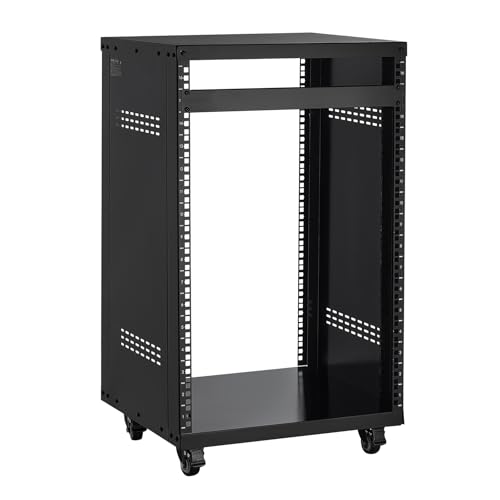
An AV equipment rack turns a tangle of receivers, amplifiers, streamers, switches, and power strips into one organized column. The catch is that “rack” covers products as different as an open-frame stand on casters, an enclosed cabinet with glass doors, and a small wall-mounted box. The best choice depends on what is going in it, how much cable work is involved, and whether the rack lives in a visible living space, a closet, or a recording studio.
This guide is for home theater builders, small studios, and network hobbyists choosing a 19-inch rack for audio-video gear. Every detail comes from the listed product titles, which state rack-unit heights of 6U to 22U, open-frame or cabinet styles, caster and wall-mount options, depth ranges, and in one case a 300-pound listed capacity. Weight ratings, rail hole spacing, and finish details are not in most titles and should be confirmed on the listing. In 2026 the useful sequence is to count the gear first, add spare space, and only then pick the style.
A rack unit, abbreviated U, is 1.75 inches of vertical mounting space, so a 12U rack offers 21 inches of equipment height. Most AV components are 2U to 4U tall, which means a modest stack can fill a small rack faster than expected.
Cabling is the quiet deciding factor in rack choice. Power cords, HDMI runs, speaker wire, and network cables all need to enter and leave the rack somewhere, and a frame that offers easy access to the back panel saves hours at install time and every time a component is swapped. Sketch the cable path before ordering, and plan on cable ties, labels, and a power strip rated for the total load of the equipment.
Quick Picks
Our top picks



As an Amazon Associate we earn from qualifying purchases at no extra cost to you.
| Product | Best for | Key spec from the title |
|---|---|---|
| Tecmojo Open Frame Network Rack (12U to 20U) | Budget open-frame setups | Floor or wall mount, 2 shelves, hardware included |
| VEVOR 12U Open Frame Server Rack | Deep equipment | 23 to 40 in adjustable depth, 4 casters, heavy duty |
| VEVOR 12U and 16U AV Rack on Wheels | Studios and mobile setups | 18-inch depth, wheels, removable side panels |
| VEVOR 22U Wall Mount Cabinet | Tall wall-mounted builds | 22U, 23.6 in depth, 300 lbs max capacity |
| Ktaxon 12U AV Rack | Enclosed look with side panels | 12U, removable side panels, lockable case |
| Tecmojo 6U Wall Mount Cabinet | Small gear in a closet | 6U, lockable door, cooling fan, 450mm depth |
How to Choose
Count rack units with room to spare
Add up the height of every component, then add at least 20 percent for shelves, vents, patch panels, and future gear. A receiver is often 3U to 4U, a streamer or switch 1U, and a power conditioner 1U to 2U. A 12U rack suits a typical home stack, while 16U to 22U leaves space for growth. Check the listing for usable rail height, since some frames reserve space for the base or top.
Depth and weight capacity
Many receivers and amplifiers are 15 to 20 inches deep, and heavier amps are deeper still. The VEVOR open-frame listing names an adjustable depth of 23 to 40 inches, while other listings name an 18-inch depth or 450 millimeters. Measure the deepest piece of equipment and add room for cable bends. Check the listing for a weight rating before loading amplifiers, and distribute heavy items low in the frame. Budget-tier racks sometimes cut corners on frame thickness.
Open frame versus enclosed cabinet
Open-frame racks keep air moving and make cabling easy, which suits gear that runs warm. Enclosed cabinets with doors or side panels hide clutter and allow locking but need ventilation, such as fans or vented panels. Rack gear should never be sealed in without airflow. A glass door looks good, but make sure there is a way to exhaust heat, and follow the listed ventilation instructions for the fan or vent design.
Mounting, mobility, and shelves
Casters help when the rack moves for service, but locking wheels are advisable on any rack that must stay still. Wall-mount cabinets save floor space but need studs or rated anchors, so confirm the wall type and the load before purchase. Many AV components are not rack-mount, so shelves matter, and the Tecmojo listing includes two 1U shelves. Check the listing for hardware, cage nuts, and cable management accessories.
What to ignore: broad labels like “server rack,” “network rack,” and “AV rack” are used almost interchangeably, and the real difference is in depth, rail spacing, and ventilation. Marketing words such as “heavy duty” are only meaningful when paired with a stated capacity. A listing that gives dimensions, a load figure, and a hardware list is more useful than one with a long adjective list. Also look at the finish and edge quality in listing photos, since sharp edges on budget racks can nick cables and hands.
The 6 Best Options
Tecmojo Open Frame Network Rack
Tecmojo lists open-frame racks for IT and AV gear in 12U, 16U, and 20U heights, with floor-standing or wall-mounted use, two 1U shelves, and mounting hardware. The 16U version also appears with casters. A hobbyist building a first rack for a receiver, a streamer, and a small switch can start in the 12U size and still have room for a patch panel, while a bigger system can use the 20U. Because shelves and hardware are named in the title, the order can be unpacked and loaded without a separate trip for parts.
- Strength: multiple heights let a buyer match the rack to the gear.
- Strength: two shelves and hardware are in the title, which helps with non-rackmount components.
- Trade-off: open frames expose equipment and cables, so tidy cable management is needed.
Skip it if the rack will sit in a living room and needs a closed look.
VEVOR 12U Open Frame Server Rack
This heavy-duty four-post open frame has a 23 to 40 inch adjustable depth, four casters, and free-standing or wall-mount use. It is the pick for deep amplifiers and unusual gear. Home theater builders with a long power amplifier, or a studio with an oversized processor, will value the freedom to set the depth rather than hunting for a fixed-depth rack that fits. Lock the casters before loading heavy equipment, and move the rack only when it is lightly loaded.
- Strength: an adjustable depth range up to 40 inches suits long equipment.
- Strength: four casters make moving the rack easier.
- Trade-off: the open design leaves gear visible and dusty, so a cover or room placement matters.
Skip it if a short, compact rack is all that is needed.
VEVOR 12U and 16U AV Rack on Wheels
VEVOR also lists 12U and 16U AV racks with wheels, an 18-inch depth, removable side panels, and an open-frame design with special vents. The 12U is described for homelab and recording studio use. A podcaster or musician who moves gear between rooms will like the rolling base, and the vents mentioned in the title are aimed at keeping equipment from heating up in a tight space. Check how the side panels attach and whether they can be left off.
- Strength: removable side panels allow either an open or semi-enclosed look.
- Strength: wheels make it flexible in a studio.
- Trade-off: an 18-inch depth may not fit deep amplifiers.
Skip it if equipment is deeper than 18 inches.
VEVOR 22U Wall Mount Cabinet
This 22U network cabinet is wall-mounted, with a 23.6-inch depth, an 18-inch installation depth for 19-inch IT and AV equipment, and a 300-pound maximum capacity. It is the tallest option here. A mounted cabinet of this height suits a utility room or garage where floor space is limited, and a lot of network and AV equipment can live in one place. Weigh the load of the finished rack, not just the listed capacity, and plan the wall anchoring before the cabinet is lifted into place.
- Strength: 22U offers the most vertical space in the group.
- Strength: a listed 300-pound capacity gives a clear load figure to check against the gear.
- Trade-off: wall mounting a tall cabinet needs strong anchors and a suitable wall.
Skip it if the wall cannot be reinforced.
Ktaxon 12U AV Rack
The Ktaxon is a 12U, 19-inch audio and server equipment rack with removable side panels and a lockable case. It comes with tools for assembly. A user who wants a tidy, semi-enclosed look in a spare room, with the option to lock the case, can use it as a basic home studio or media rack. Test fit the heaviest component first, and use the removable panels to route cables before closing the case.
- Strength: a lockable case gives some control over access.
- Strength: removable side panels make cabling easier.
- Trade-off: the title gives no depth or weight rating, so check the listing.
Skip it if an open frame is preferred for airflow.
Tecmojo 6U Wall Mount Cabinet
This 6U wall-mount server cabinet has a lockable door, side panels, a cooling fan, a glass door, and a 450-millimeter depth. It is the small, enclosed pick. A router, a switch, a streamer, and a compact amplifier can live behind the glass door in a hallway closet or garage, with the fan helping to move air. Check the fan’s power needs and noise on the listing, since a fan near a living space can be audible.
- Strength: a cooling fan is part of the listing.
- Strength: a lockable glass door allows viewing while limiting access.
- Trade-off: 6U is limited, and 450 millimeters of depth rules out deeper amplifiers.
Skip it if more than a few components must fit.
Which One Fits Your Situation
A home theater closet
VEVOR 22U Wall Mount Cabinet or Tecmojo 6U Wall Mount Cabinet keep floor space free, with the larger one for more gear.
A recording studio or mobile rig
VEVOR 12U and 16U AV Rack on Wheels moves around and has removable side panels.
A bench with deep amplifiers
VEVOR 12U Open Frame Server Rack offers a depth up to 40 inches.
A budget build that needs shelves
Tecmojo Open Frame Network Rack includes two shelves and hardware in the listing. Start with a size one step larger than today’s stack, since new components almost always arrive after the first rack is full.
Common Mistakes
- Buying a rack sized to current gear with no room to grow.
- Ignoring equipment depth, so the rear connectors and cables do not fit.
- Sealing warm amplifiers in a closed cabinet without airflow.
- Wall-mounting a loaded cabinet without checking studs and anchors.
- Forgetting power strips, cable ties, and shelves.
Related guides
- Electrical Testing Tools For Diy Projects
- Wireless Chargers For Iphone And Airpods
- Bookshelf Speakers Under 300 Dollars
Frequently Asked Questions
What does 12U mean?
One rack unit is 1.75 inches. A 12U rack offers 21 inches of mounting height. Check the listing for usable height.
Do racks need cooling?
Warm equipment needs airflow. Open frames help, and cabinets need fans or vents. Follow the gear’s own ventilation guidance.
Can a rack hold non-rackmount gear?
Yes, with shelves. Several listings include or mention shelves, so confirm the shelf weight rating.
Floor or wall mount?
Floor racks suit heavier gear. Wall mounts save space but need solid anchoring and a load check.
More from Amazon
Programs that pair well with the guide above. Offers and eligibility are set by Amazon and may change.
Free shipping on eligible items, Prime Video and more. Eligible new members can start with a free trial.
Start a Prime free trialAd-free music streaming. Eligible new subscribers can start with a free trial.
Try Music Unlimited freeA Prime membership for ages 18-24 with a trial period. Eligibility is set by Amazon.
See Prime for Young AdultsAudiobooks and podcasts to listen to on the go. Eligible new members can start with a free trial.
Try Audible freeAs an Amazon Associate we earn from qualifying purchases.