Key takeaways
- Compare the best bookshelf speakers for music, movies, and desktop listening, from premium passive pairs to powered budget picks, with key specs for each.
The best bookshelf speakers for most people are the KEF Q150 if you already own a receiver or amplifier, and the Kanto YU6 if you want a powered pair that connects to a TV, turntable, and phone with nothing else to buy. Below those two premium picks sit a mid-range passive pair from Sony and two budget options, one powered and one passive, so every common setup is covered. This is a general roundup across music, movie, and desktop use, with both powered and passive pairs, and every pick is sold as a stereo pair.
As an Amazon Associate, we earn from qualifying purchases.
Table of Contents
- Quick Picks at a Glance
- KEF Q150
- Kanto YU6
- Sony SSCS5
- Edifier R1280T
- Polk Audio T15
- How to Choose Bookshelf Speakers
- Frequently Asked Questions
- Conclusion
- Product and ASIN Reference
Quick Picks at a Glance
- Best passive overall: KEF Q150, a premium passive pair with a coincident Uni-Q driver that images evenly anywhere in the room.
- Best powered overall: Kanto YU6, a premium powered pair with Bluetooth, an optical input for a TV, and a built-in phono stage.
- Best mid-range passive: Sony SSCS5, a three-way design with a super tweeter for extended high frequencies.
- Best budget powered: Edifier R1280T, an active pair with dual RCA inputs that needs no receiver at all.
- Best budget passive: Polk Audio T15, an easy-to-drive passive pair that also wall-mounts for surround duty.
KEF Q150
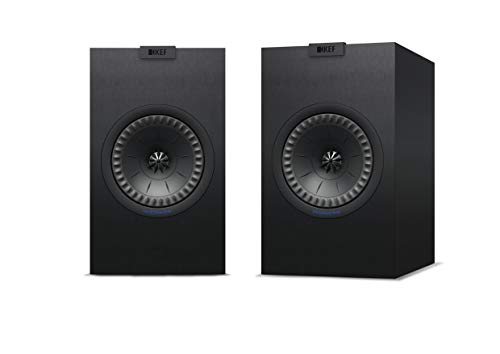
The Q150 is the passive pick for listeners who care most about imaging. KEF mounts the 1 inch vented aluminium dome tweeter inside the center of the 5.25 inch aluminium woofer, a coincident arrangement called Uni-Q. Because high and low frequencies leave the speaker from the same point, the sound stays coherent when you move around the room, which makes the Q150 forgiving of imperfect seating positions and a strong fit for a shared living room. The cabinet is rear ported, so it wants a little space from the wall behind it.
As a passive speaker it needs a separate amplifier or AV receiver, and its 86 dB sensitivity is on the lower side, so very small amplifiers will run out of headroom in large rooms. Within a normal room, though, the Q150 covers music and movies with a single pair and can anchor a system that grows into a full surround setup later, since matching KEF center and surround models exist in the same Q series.
Specs
- Type: Passive, 2-way bass reflex
- Driver: 5.25 inch Uni-Q with 1 inch vented aluminium dome tweeter
- Frequency response: 51 Hz to 28 kHz
- Sensitivity: 86 dB
- Impedance: 8 ohms
- Recommended amplifier power: 10 to 100 watts
- Dimensions: 11.9 x 7.1 x 10.9 inches
- Weight: 12.3 pounds each
Kanto YU6

The YU6 is the powered pick for a mixed-use room. Its built-in Class D amplifier delivers 200 watts of peak power, and the input panel covers nearly every source a general roundup needs to serve: Bluetooth with aptX for a phone, an optical input for a TV, RCA with a switchable phono preamp for a turntable, and a 3.5 mm auxiliary input for a computer. A subwoofer output lets you add a sub later, and a USB charge port on the back can top up a phone or a streaming stick.
The 5.25 inch Kevlar woofer and 1 inch silk dome tweeter reach down to 50 Hz, which is enough low end for movie dialogue and most music without a sub in a small or medium room. Because the amplifier is built in, placement only needs a power outlet near the primary speaker, and the included remote handles volume, input, and tone from the couch. For a desk or a TV stand where a separate receiver would crowd the space, the YU6 is the simplest premium route.
Specs
- Type: Powered, Class D amplification
- Total power: 200 watts peak, 100 watts RMS
- Drivers: 5.25 inch Kevlar woofer, 1 inch silk dome tweeter
- Inputs: Bluetooth with aptX, optical, RCA with phono preamp, 3.5 mm AUX
- Frequency response: 50 Hz to 20 kHz
- Subwoofer output: Yes
- Extras: Remote control, USB charge port, auto standby
Sony SSCS5

The SSCS5 is the mid-range passive option, and it takes a different route from the two-driver designs around it. It is a 3-way speaker with three drivers: a 5.12 inch woofer with a foamed mica cellular diaphragm, a 1 inch polyester soft dome tweeter, and a smaller super tweeter that extends the response out to 50 kHz for high-resolution audio formats. The wide dispersion super tweeter also spreads high frequencies across a broader area, which helps when listeners sit off to the side.
The SSCS5 is rated at 6 ohms with a maximum input power of 100 watts, and almost any current AV receiver or stereo amplifier will drive it comfortably. It works as a front pair for movies, a stereo pair for music, or a surround pair in a larger Sony CS series system, since matching center, tower, and subwoofer models share the same voicing. Listeners building a first receiver-based system get the most from this pair.
Specs
- Type: Passive, 3-way, 3-driver
- Woofer: 5.12 inch foamed mica cellular diaphragm
- Tweeters: 1 inch soft dome plus wide dispersion super tweeter
- Frequency response: 53 Hz to 50 kHz
- Sensitivity: 87 dB
- Impedance: 6 ohms
- Maximum input power: 100 watts
Edifier R1280T
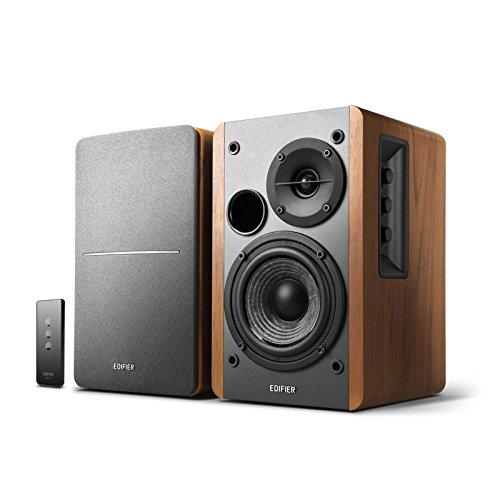
The R1280T is the budget powered pick and one of the simplest ways to upgrade from monitor or TV speakers. Each cabinet holds a 4 inch woofer and a 13 mm silk dome tweeter, powered by 42 watts RMS of built-in amplification, so the pair connects straight to a source with no receiver in between. Dual RCA inputs let two devices stay plugged in at once, for example a computer and a turntable with its own preamp, or a TV and a game console through adapters.
Bass and treble dials sit on the side of the active speaker alongside the volume control, and a small remote handles volume and mute. The wooden enclosure keeps the design at home on a bookshelf or desk. The trade-offs for the tier are clear: there is no Bluetooth and no subwoofer output on this version, and the 75 Hz low end will not fill a large room. For a desktop, bedroom, or small apartment, the R1280T covers the job with the least extra hardware of any pick here.
Specs
- Type: Powered, 2.0 active pair
- Total power: 42 watts RMS
- Drivers: 4 inch woofer, 13 mm silk dome tweeter
- Inputs: Dual RCA
- Frequency response: 75 Hz to 18 kHz
- Signal-to-noise ratio: 85 dB or higher
- Controls: Side panel bass, treble, and volume dials, remote included
Polk Audio T15

The T15 is the budget passive pick, built for listeners who already own a receiver or plan to build a home theater piece by piece. Each speaker pairs a 5.25 inch Dynamic Balance composite woofer with a 0.75 inch silk dome tweeter in a front-ported cabinet. The front port matters for placement: unlike rear-ported designs, the T15 can sit close to a wall without choking its bass, and a keyhole slot on the back allows direct wall mounting, which makes it a natural surround speaker as well.
With 89 dB sensitivity and an 8 ohm impedance, the T15 is easy to drive and pairs well with entry-level receivers, handling between 20 and 100 watts per channel. The response runs from 60 Hz to 24 kHz, so deep movie effects will still want a subwoofer, but dialogue and music come through clearly at this tier. Matching T series center and tower models make it easy to expand the pair into a full surround system over time.
Specs
- Type: Passive, 2-way, front ported
- Woofer: 5.25 inch Dynamic Balance composite driver
- Tweeter: 0.75 inch silk dome
- Frequency response: 60 Hz to 24 kHz
- Sensitivity: 89 dB
- Impedance: 8 ohms
- Power handling: 20 to 100 watts per channel
- Dimensions: 10.7 x 6.5 x 7.3 inches
- Mounting: Integrated keyhole slot for wall mounting
How to Choose Bookshelf Speakers
Powered or passive. Powered speakers like the Kanto YU6 and Edifier R1280T carry their own amplifiers, so they connect directly to a TV, computer, or turntable and keep a setup small. Passive speakers like the KEF Q150, Sony SSCS5, and Polk T15 need a receiver or stereo amplifier, which costs more and takes more space but lets you upgrade each part separately and build toward surround sound.
Woofer size and room size. A 5.25 inch woofer is the sweet spot for most rooms, reaching low enough for satisfying music and movie playback without a subwoofer in small and medium spaces. The 4 inch drivers in the R1280T suit near-field desktop listening, where you sit close and volume demands are low. Large rooms, or listeners who want full movie impact, should plan on adding a subwoofer regardless of which pair they choose.
Sensitivity and impedance. Sensitivity tells you how loud a passive speaker plays with a given amount of power. The 89 dB T15 gets more volume from a modest receiver than the 86 dB Q150, which rewards stronger amplification. Impedance between 6 and 8 ohms, as on every passive pick here, is safe with essentially any modern receiver.
Inputs for powered pairs. Match the input list to your sources before choosing. Optical is the cleanest connection for a TV, Bluetooth covers phones, and a phono input matters only for turntables without their own preamp. A subwoofer output, like the one on the YU6, leaves room to grow.
Placement and ports. Rear-ported speakers such as the Q150 sound best pulled a short distance from the wall, while front-ported designs like the T15 tolerate shelves and wall mounting. Tweeters at ear height, on stands or isolation pads, give the clearest imaging from any pair in this roundup.
Frequently Asked Questions
Do bookshelf speakers need an amplifier?
Passive bookshelf speakers such as the KEF Q150, Sony SSCS5, and Polk Audio T15 always need a separate amplifier or AV receiver. Powered models such as the Kanto YU6 and Edifier R1280T have amplifiers built in and connect straight to a TV, computer, or other source with no extra box.
Are bookshelf speakers good for movies and TV?
Yes, a bookshelf pair is a large step up from built-in TV speakers for dialogue clarity and overall fullness. An optical input, like the one on the Kanto YU6, is the simplest TV connection for a powered pair, while passive pairs run through an AV receiver, which also lets you add a center channel and subwoofer later.
Do I need a subwoofer with bookshelf speakers?
Not for most music or desktop listening, since the pairs here reach between 50 and 75 Hz on their own. A subwoofer helps in large rooms and with action movies, where effects extend below what a compact woofer can reproduce. If you expect to add one, a powered pair with a subwoofer output or a receiver-based passive setup makes the upgrade easy.
How far should bookshelf speakers sit from the wall?
Rear-ported speakers such as the KEF Q150 generally sound best with some space between the cabinet and the wall so the port can breathe. Front-ported speakers such as the Polk Audio T15 are more flexible and can sit close to a wall or mount directly on it, which suits shelves and surround positions.
Conclusion
For a general bookshelf speaker setup, start with the source you already own. Listeners with a receiver get the most from the KEF Q150, while the Sony SSCS5 and Polk Audio T15 cover mid-range and budget receiver systems. Listeners who want the fewest boxes should choose the Kanto YU6 for a full input set and premium power, or the Edifier R1280T for a compact desktop or bedroom pair. Any of the five will outperform TV and monitor speakers by a wide margin, and each leaves a clear path to add a subwoofer later.
Product and ASIN Reference
| Product | ASIN |
|---|---|
| KEF Q150 Bookshelf Speakers (Pair, Black) | B071P6KQZX |
| Kanto YU6 Powered Bookshelf Speakers (Matte Black) | B01N0YCWUY |
| Sony SSCS5 3-Way Bookshelf Speaker System (Pair) | B00O8YLMVA |
| Edifier R1280T Powered Bookshelf Speakers | B016P9HJIA |
| Polk Audio T15 Bookshelf Speakers (Pair, Black) | B002RJLHB8 |
More from Amazon
Programs that pair well with the guide above. Offers and eligibility are set by Amazon and may change.
Free shipping on eligible items, Prime Video and more. Eligible new members can start with a free trial.
Start a Prime free trialAd-free music streaming. Eligible new subscribers can start with a free trial.
Try Music Unlimited freeA Prime membership for ages 18-24 with a trial period. Eligibility is set by Amazon.
See Prime for Young AdultsAudiobooks and podcasts to listen to on the go. Eligible new members can start with a free trial.
Try Audible freeAs an Amazon Associate we earn from qualifying purchases.