Key takeaways
- Quick Charge 3.0 is an older fast-charging standard, and that is exactly why shoppers still search for it.
Quick Charge 3.0 is an older fast-charging standard, and that is exactly why shoppers still search for it. A lot of phones, power banks, earbuds cases, and older tablets were built around Qualcomm’s 18W protocol, and a charger that speaks it will pull noticeably more current out of those devices than the plain 5W cube that shipped in the box. If your accessory drawer is full of USB-A cables and your device lists “QC 3.0” on its spec sheet, a dedicated Quick Charge 3.0 block is a cheaper and simpler fix than replacing every cable with USB-C.
This guide is for people who want that specific protocol, not a generic “fast charger” label. It matters because many listings in this category mix QC 3.0 with USB Power Delivery wording, and the two are not interchangeable. Below, the seven wall chargers are compared strictly on what their listing titles state: wattage, port count, pack size, and the standards they name. Use it as a checklist for a 2026 purchase, then match the block to the phone, bank, or accessory you are actually trying to speed up.
Quick Picks
Our top picks




As an Amazon Associate we earn from qualifying purchases at no extra cost to you.
| Product | Best for | Key spec taken from the product title |
|---|---|---|
| 18W 3A QC 3.0 wall plug (Galaxy S and Z Flip listing) | Single-device bedside charging | 18W, 3A, Quick Charge 3.0 |
| OKRAY 2-pack 18W | Home plus office or travel bag | 2-pack, 18W, Type A, QC 3.0 |
| QC 3.0 18W wall charger (Galaxy A listing) | Mid-range Android phones | 18W 3A USB-A, QC 3.0 adapter |
| QC 3.0 wall charger block (USB cube) | Simple replacement block | Quick Charge 3.0 cube adapter |
| QC 3.0 18W charger (iPhone and Galaxy listing) | Mixed Android and iPhone households | 18W, QC 3.0, 3A |
| 4-port QC.3 multiport charger | Charging several devices at one outlet | 4 ports, QC.3 quick charge |
| 40W 4-port USB-C 2-pack | Mixed USB-C and USB-A gear | 2-pack, 40W, dual PD plus QC |
How to Choose
Confirm the standard, not just the wattage
Quick Charge 3.0 negotiates voltage in small steps up to 12V and tops out around 18W. A charger that says “18W” without naming QC 3.0 may be a USB Power Delivery brick that behaves differently with your device. Look for the words “Quick Charge 3.0” or “QC 3.0” in the title, and check that your phone or bank lists the same standard. Backward compatibility is built in, so a QC 3.0 block still charges non-QC gear at standard speed, but you only get the fast rate when both ends support it.
Match the port type to your cables
USB-A ports pair with the cables most people already own. If your phone charges over USB-C, you need a USB-A to USB-C cable, and thin cables can throttle current. Choose cables rated for at least 3A. A block with a USB-C port, such as the 40W model here, is the better pick when you are moving toward USB-C everything but still own a few older accessories.
Think about port count and shared wattage
Multiport chargers split their total output. A four-port block does not deliver 18W to every port at once; the wattage on the label is a shared budget, and a single port often falls back to a slower rate when several devices are plugged in. If you charge one phone overnight, a single-port block is enough. If you charge a phone, a tablet, and earbuds together, accept that each will get less than its maximum.
What to ignore and where budget blocks cut corners
Ignore the long lists of phone models in the titles; they are keyword padding, and compatibility depends on the protocol, not the model name. Budget blocks usually skimp on safety documentation, heat management, and plug fit, so favor listings that mention certifications and overcurrent protection in the product details, and avoid anything that feels loose in the outlet. Note also that many titles name phones released years apart, which tells you nothing about the internal circuitry.
One more practical check: look at how the title describes the output side. Phrases such as “3A” and “18W” describe the maximum a single port can supply, while “multiport” and “4-port” describe the housing. When a title mentions a wireless charger, it is hinting that the block can feed a pad that accepts higher input voltage. If a listing leaves out the wattage entirely, treat that as a gap to close in the product details before you buy, because a block that cannot confirm its rating is hard to match to a hungry device such as a tablet or a power bank.
The 7 Best Options
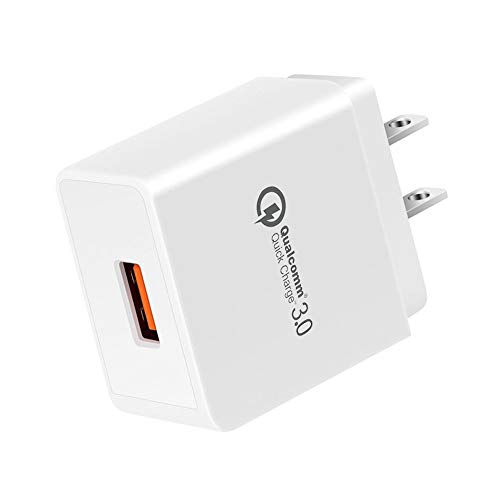
18W 3A Quick Charge 3.0 Wall Plug
This listing names the exact formula buyers search for: 18W, 3A, and Quick Charge 3.0 on a USB-A wall plug. It is aimed at Samsung Galaxy S and Z Flip owners who want a straightforward single-port replacement for a lost stock brick. It suits a nightstand outlet where only one phone needs a quick top-up.
- Strength: states the QC 3.0 standard and 3A rating directly in the title.
- Strength: single-port design keeps the full 18W budget available to one device.
- Trade-off: only one port, so a second device needs another outlet.
Skip it if you travel with several gadgets or need a USB-C port.
OKRAY 2-Pack 18W Quick Charge Adapter
OKRAY sells this as a two-pack of 18W Type A blocks, which makes it a practical pick for households that want one charger at the desk and one in a bag. The title mentions use with wireless chargers, which is relevant because some wireless pads accept QC input to unlock faster pad speeds.
- Strength: two blocks in one purchase means a spare for travel or the car-side outlet.
- Strength: the Type A format works with cables you likely already own.
- Trade-off: the title does not describe port count beyond Type A, so it is a single-output design per block.
Skip it if you only need one charger and would rather spend on a sturdier single unit.
Galaxy A-Series 18W QC 3.0 Wall Charger
This one targets owners of the Galaxy A line, listing a long run of A-series models alongside 18W, 3A, and QC 3.0 on a USB-A port. Mid-range Android phones often ship with a modest charger, so an upgrade block is a logical swap.
- Strength: 18W and 3A are both stated, so the headline numbers are clear.
- Strength: described as a fast charger and QC 3.0 adapter, covering the standard by name.
- Trade-off: the title is crowded with phone names, so the listing gives little concrete detail on build or safety features.
Skip it if your phone charges over USB-C Power Delivery only.
QC 3.0 Wall Charger Block Plug (USB Cube)
The title leads with Quick Charge 3.0 and calls it a USB cube power adapter for Galaxy phones. It is the plainest option here, which can be a virtue: a compact single-purpose block for people who just want the standard met and nothing else.
- Strength: Quick Charge 3.0 is the headline feature, not an afterthought.
- Strength: cube format is easy to pack and replace.
- Trade-off: the visible title gives no wattage figure, so confirm the output rating on the listing before buying.
Skip it if you want a clearly stated 18W number up front.
QC 3.0 18W USB Wall Charger (iPhone and Galaxy Listing)
This listing names both iPhone and Galaxy models, with 18W, 3A, and QC 3.0 in the title. Be realistic about the iPhone side: iPhones charge fast through USB-C Power Delivery, so a QC-only USB-A block will charge them at the standard rate. Its real value is for the Android phones and QC accessories in the same household.
- Strength: 18W and QC 3.0 stated plainly for the Android devices in the house.
- Strength: USB-A output works with older cables and accessories.
- Trade-off: iPhone owners should not expect QC speeds from this block.
Skip it if your main device is a recent iPhone and you want its fastest rate.
4-Port QC.3 Multiport Wall Charger
The title advertises four ports and Quick Charge on a cube-style block meant for all mobile devices. It is the right shape for a family charging station, a hotel-style nightstand, or a desk where a phone, tablet, earbuds, and a power bank all need power.
- Strength: four ports consolidate several chargers into one outlet.
- Strength: Quick Charge support is stated alongside the multiport design.
- Trade-off: the total output is shared, so expect slower rates when every port is busy.
Skip it if one fast phone charge matters more than convenience.
40W 4-Port USB-C 2-Pack (Dual PD and QC)
This is the most modern block of the group: two chargers, 40W each, four ports, with dual Power Delivery and a Quick Charge plug named in the title. It covers both USB-C and legacy USB-A gear, which makes it a bridge option for people mid-transition between connector types.
- Strength: combines PD and QC support, so newer and older devices can share a block.
- Strength: two units in the pack cover home and travel.
- Trade-off: larger and more complex than a single-port 18W cube, and the 40W budget is shared across ports.
Skip it if you only own one QC phone and want the smallest possible block.
Which One Fits Your Situation
You own one QC 3.0 phone and want a clean replacement
The 18W 3A Quick Charge 3.0 wall plug is the direct answer. One port, a stated standard, and nothing to learn.
You split time between a desk and a travel bag
The OKRAY 2-pack gives you two identical 18W blocks, so nothing gets forgotten at the office outlet.
You charge a whole family’s devices in one place
The 4-port QC.3 multiport charger consolidates cables on a kitchen counter. Accept that shared output means not every port runs at its peak.
You are switching to USB-C but keep old accessories
The 40W 4-port USB-C 2-pack covers PD and QC, so a new phone and an older power bank can live on the same block.
Common Mistakes
- Buying on wattage alone and assuming an 18W label means Quick Charge 3.0 compatibility.
- Pairing a fast block with a thin, low-current cable that caps the charging rate.
- Expecting every port on a multiport charger to deliver the full headline wattage at once.
- Trusting a long phone-model list as proof of compatibility instead of checking the protocol your device supports.
- Assuming an iPhone will use QC 3.0, when it relies on USB Power Delivery for fast charging.
Related guides
- Wireless Chargers For Iphone And Airpods
- Black Friday And Cyber Monday Deals
- Noise Cancelling Earbuds Under $100
Frequently Asked Questions
Will a Quick Charge 3.0 charger work with a phone that does not support it?
Yes. The standard is backward compatible, so the phone simply charges at its normal rate. You only see the faster speed when both the charger and the device support Quick Charge.
Is Quick Charge 3.0 the same as USB Power Delivery?
No. They are separate protocols that negotiate voltage differently. Some blocks include both, like the 40W model above, while others offer only one, so read the title carefully.
Does the cable matter?
It does. A cable rated for 3A or more is a safer match for an 18W charger, and a very thin cable can limit the current regardless of the block you buy.
Is a multiport charger slower than a single-port block?
Often, when several ports are in use, because the total wattage is shared. With only one device plugged in, a multiport block can still deliver its full rated speed on that port.