Key takeaways
- Compare the best home weather stations with wireless outdoor sensors, color displays, and app-connected forecasts for accurate readings at home.
- Top Pick: Ambient Weather WS-2902 WiFi Smart Weather Station
- Runner-up: Ecowitt Wittboy Weather Station GW2001
- Also consider: Ecowitt Wittboy Pro HP2564
A home weather station puts hyperlocal conditions on your counter instead of a forecast built for the nearest airport. A wireless sensor array outside measures temperature, humidity, wind, and rain where you actually live, then sends the readings to an indoor display and, on connected models, to a phone app. That matters for gardeners deciding when to water, homeowners watching for freeze risk, and anyone who wants to know whether the wind is safe for patio furniture or a weekend bike ride.
The five stations below cover the main buying paths: full-featured Wi-Fi systems that publish data to weather networks, a sensor design with no moving parts to wear out, a screen-focused console for a larger display, and a simple atomic-clock station for people who want readings without an app or account. Each one uses a wireless outdoor sensor, so installation usually means mounting one unit outside and placing the display wherever it is easiest to read.
As an Amazon Associate, we earn from qualifying purchases.
Quick Answer
The Ambient Weather WS-2902 is the best all-around home weather station for most households, pairing a complete outdoor sensor array with Wi-Fi app data and network sharing. The Ecowitt Wittboy suits buyers who want no moving parts, while the La Crosse 308-1425B-INT keeps things simple without any app or account.
How to Choose
Start with the measurements you actually need. Basic stations report indoor and outdoor temperature and humidity plus a simple forecast icon. Fuller arrays add wind speed and direction, rainfall totals, barometric pressure, UV index, and solar radiation, which are the numbers gardeners, weather hobbyists, and homeowners near the coast tend to use most. If a station lacks a rain gauge or anemometer, adding one later is rarely possible, so buy the sensor set that matches your interests from the start.
Display size is the second decision. A compact console suits a nightstand, while a larger color display is easier to read across a kitchen and can show graphs, highs and lows, and multiple data fields at once. Some stations skip a big screen and lean on a phone app instead, which works well if the display will live in a hallway or utility room.
Connectivity separates the field. Wi-Fi stations upload data to services such as Weather Underground and AmbientWeather.net, so readings are visible away from home and can feed smart home routines and alerts. Non-connected stations use a direct radio link between sensor and display, which is simpler and keeps working during an internet outage, but the data stays inside the house.
Finally, check transmission range and power. Manufacturers quote line-of-sight range, and walls, metal siding, and distance reduce it in practice, so place the display within a comfortable margin of the outdoor sensor. Most arrays run on solar charging with backup batteries, and a south-facing mounting spot keeps the panel productive. A mounting pole or bracket is sometimes sold separately, so confirm what the box includes before ordering.
Ambient Weather WS-2902 WiFi Smart Weather Station
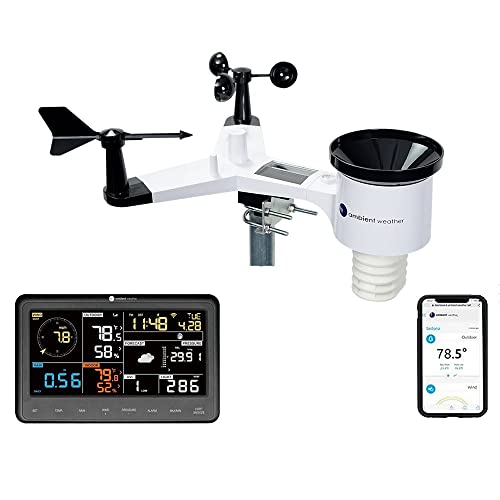
The WS-2902 is the default recommendation in this category because it balances a complete sensor array, a readable color console, and mature app support. The Osprey sensor suite measures wind speed and direction, temperature, humidity, rainfall, dew point, UV, and solar radiation, then reports to the console over a wireless link. Wi-Fi connectivity sends the same data to AmbientWeather.net, Weather Underground, and other networks, so readings are available on a phone and can trigger alerts for frost, heat, or heavy rain.
The console display is a color LCD that organizes the main readings on one screen without menu diving, and the system supports additional Ambient Weather sensors for soil, lightning, and indoor rooms. Setup involves mounting the array, connecting the console to Wi-Fi, and optionally creating network accounts. For households that want one station that does nearly everything, this is the most complete package of the five.
Specs
| Specification | Detail |
|---|---|
| Sensor measurements | Wind speed and direction, temperature, humidity, rainfall, UV, solar radiation, pressure |
| Display | Color LCD console |
| Connectivity | Wi-Fi, AmbientWeather.net, Weather Underground |
| Wireless range | Up to 330 ft line of sight |
| Power | Solar panel with battery backup |
Ecowitt Wittboy Weather Station GW2001

The Wittboy takes a different mechanical approach: its sensor head has no moving parts at all. Wind is measured with ultrasonic sensors, and rain is measured with a haptic sensing surface instead of a tipping bucket, so there are no cups to spin, no funnel to clog with leaves, and less wear over the years. The GW2001 kit pairs the Wittboy sensor with a gateway hub that connects to home Wi-Fi and publishes data to Ecowitt.net, Weather Underground, and Weathercloud.
Because the kit is gateway-based, the main viewing experience is the Ecowitt app and web dashboard rather than a large countertop screen, although compatible Ecowitt consoles can be added. The sensor runs on solar power with backup batteries. Buyers who have had anemometer cups break or rain funnels jam will appreciate the sealed design, and the Ecowitt ecosystem offers a wide range of add-on sensors for soil moisture, lightning, and air quality.
Specs
| Specification | Detail |
|---|---|
| Sensor measurements | Ultrasonic wind, haptic rainfall, temperature, humidity, pressure, UV, solar radiation |
| Display | App and web dashboard via gateway hub |
| Connectivity | Wi-Fi gateway, Ecowitt.net, Weather Underground |
| Moving parts | None |
| Power | Solar panel with battery backup |
Ecowitt Wittboy Pro HP2564

The Wittboy Pro HP2564 combines the same sealed Wittboy sensor with a dedicated 7-inch color display console, which fixes the main compromise of the gateway-only kit. The console shows wind, rain, temperature, humidity, pressure, and light readings on a large screen at home, while built-in Wi-Fi uploads data to Ecowitt.net and partner networks for phone access and history graphs.
The haptic rain sensor and ultrasonic wind measurement keep maintenance low, and the console doubles as the system hub, receiving the outdoor sensor directly and supporting additional Ecowitt sensors around the house and garden. This is the pick for buyers who like the no-moving-parts design but still want a proper display on the counter rather than reaching for a phone every time they want the temperature. It costs more than the gateway kit, and the difference is essentially the console.
Specs
| Specification | Detail |
|---|---|
| Sensor measurements | Ultrasonic wind, haptic rainfall, temperature, humidity, pressure, UV, solar radiation |
| Display | 7-inch color console |
| Connectivity | Wi-Fi, Ecowitt.net, Weather Underground |
| Moving parts | None |
| Power | Solar panel with battery backup |
La Crosse Technology 308-1425B-INT Wireless Color Weather Station

The La Crosse 308-1425B-INT is the straightforward option for people who want outdoor readings on a clear display without accounts, apps, or Wi-Fi setup. The wireless outdoor sensor sends temperature and humidity to a color console that also shows indoor conditions, a forecast icon based on pressure changes, and an atomic clock that sets itself from the WWVB signal.
There is no wind or rain measurement here, and no data leaves the house, which is either a limitation or a relief depending on the buyer. In exchange, setup takes minutes: insert batteries, place the sensor in a shaded spot outside, and the console does the rest. The display uses large digits and simple animated forecast graphics, making it a good fit for kitchens, workshops, and anyone who finds app-based stations more complicated than the problem they solve.
Specs
| Specification | Detail |
|---|---|
| Sensor measurements | Outdoor temperature and humidity, indoor temperature and humidity, pressure trend |
| Display | Color console with atomic clock |
| Connectivity | Direct wireless sensor link, no Wi-Fi |
| Wireless range | Up to 330 ft line of sight |
| Power | Batteries, optional AC adapter for console |
AcuRite Iris (5-in-1) Weather Station 01540M
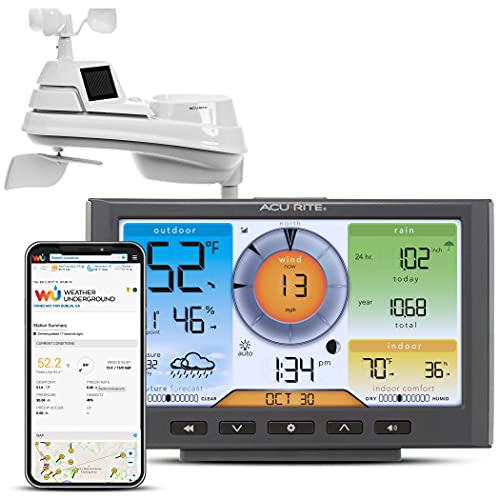
The AcuRite Iris pairs a 5-in-1 outdoor sensor with a color display and Wi-Fi streaming to Weather Underground through the My AcuRite platform. The integrated sensor measures temperature, humidity, wind speed, wind direction, and rainfall, and the console presents current conditions with a future forecast readout, plus records for highs, lows, and rain totals.
AcuRite’s strength is availability and simplicity: the Iris line is widely stocked, replacement sensors and parts are easy to find, and the display is designed to be read at a glance rather than studied. The 5-in-1 sensor uses a solar panel to power an aspirating fan on sunny days, which helps keep temperature readings accurate when the sun hits the housing. For buyers who want connected data without entering the hobbyist end of the market, the Iris is a sensible middle path between the La Crosse and the Ambient Weather.
Specs
| Specification | Detail |
|---|---|
| Sensor measurements | Temperature, humidity, wind speed and direction, rainfall |
| Display | Color console |
| Connectivity | Wi-Fi to Weather Underground via My AcuRite |
| Wireless range | Up to 330 ft line of sight |
| Power | Solar panel with battery backup |
Who Should Skip It
Skip a home weather station if a phone weather app already answers your questions, because a station only pays off when readings from your own yard change a decision. Skip the Wi-Fi models if the display will sit somewhere without reliable router coverage, and skip the full sensor arrays if you only care about outdoor temperature, since a simple sensor-and-display station covers that for far less effort. Renters who cannot mount anything outside should also pause, because every station here needs an outdoor sensor placement with reasonable sky and wind exposure to produce useful data.
FAQ
How accurate are home weather stations?
Accuracy depends more on placement than on the brand. A temperature sensor in direct sun or beside a dryer vent will read wrong on any station, while a shaded, ventilated spot several feet above grass gives readings close to official stations. Wind and rain numbers improve when the sensor sits away from walls, fences, and roof edges that block or deflect airflow.
Where should the outdoor sensor be mounted?
Mount the sensor where air moves freely, ideally on a pole in an open part of the yard, away from heat sources, sprinklers, and overhanging branches. Keep it within the stated wireless range of the display, remembering that walls reduce real-world range. Solar-powered arrays also need a panel orientation that receives direct sun for part of the day.
Do I need Wi-Fi for a home weather station?
No. Stations such as the La Crosse 308-1425B-INT work entirely on a direct radio link between the sensor and the display. Wi-Fi adds phone access, cloud history, alerts, and sharing to public weather networks, which many owners enjoy, but the core job of showing current conditions at home does not require an internet connection.
How long do the outdoor sensors last?
The sensors are built for continuous outdoor use and typically run for years. Solar charging with backup batteries means most owners only change batteries occasionally. Designs without moving parts, such as the Wittboy, remove the most common wear items, while traditional cups and rain funnels may need an occasional cleaning to stay accurate.
Final Verdict
For most homes, the Ambient Weather WS-2902 remains the safest single purchase, with a complete sensor set, a clear console, and dependable app and network support. Choose the Ecowitt Wittboy GW2001 for a sealed, low-maintenance sensor with app-based viewing, or step up to the Wittboy Pro HP2564 to add its large console. The La Crosse 308-1425B-INT is the right call when simple and offline beats connected, and the AcuRite Iris 01540M splits the difference with Wi-Fi sharing and an easy-reading display.
More from Amazon
Programs that pair well with the guide above. Offers and eligibility are set by Amazon and may change.
Free shipping on eligible items, Prime Video and more. Eligible new members can start with a free trial.
Start a Prime free trialAd-free music streaming. Eligible new subscribers can start with a free trial.
Try Music Unlimited freeA Prime membership for ages 18-24 with a trial period. Eligibility is set by Amazon.
See Prime for Young AdultsAudiobooks and podcasts to listen to on the go. Eligible new members can start with a free trial.
Try Audible freeAs an Amazon Associate we earn from qualifying purchases.