Key takeaways
- Compare the best driveway alarms for early arrival alerts, from a one-mile vehicle probe to solar motion kits, with range, detection and power specs.
The best driveway alarm for most homes is a wireless motion kit like the Chamberlain CWA2000, which pairs a weatherproof sensor with a base that chimes and flashes when a car or visitor approaches. Homes with long rural drives need a different tool: a buried vehicle probe such as the Dakota Alert DCPA-4000, rated by its maker for up to a mile of wireless range. Between those poles sit solar motion kits, vehicle-only electromagnetic wands, and one announcer with a relay output that can feed a wider security setup.
None of these five kits needs Wi-Fi, an app, or a subscription. Each is a self-contained radio link between an outdoor sensor and an indoor receiver, which is why the category still exists alongside smart cameras: the alert arrives in the room where you actually are.
As an Amazon Associate, we earn from qualifying purchases.
Table of Contents
- Quick Answer
- How to Choose
- Dakota Alert DCPA-4000
- Chamberlain CWA2000
- Optex RCTD-20U
- Wuloo Solar Driveway Alarm
- Mighty Mule FM231
- Who Should Skip
- FAQ
- Conclusion
Quick Answer
For most homes, the Chamberlain CWA2000 is the easiest driveway alarm to live with: a weatherproof motion sensor, a half-mile maker-rated link and simple sound and light alerts. Long rural drives need the Dakota Alert DCPA-4000 probe system, while the Wuloo solar kit covers two approach points without battery swaps.
How to Choose a Driveway Alarm
Start with the detection method, because it decides what wakes you up. Passive infrared sensors, used by the Chamberlain, Optex, and Wuloo kits here, react to moving heat signatures, so they catch cars, people, and larger animals. That breadth is useful at a gate, but deer and stray dogs trigger alerts too. Probe and wand systems, like the Dakota and Mighty Mule, read the magnetic disturbance of a large metal vehicle instead, ignoring pedestrians and wildlife almost entirely.
Next, measure your driveway honestly and compare it with the wireless range. Every range figure in this category is a maker rating for open, unobstructed conditions. Trees, hills, and house walls all shorten it, so buy headroom: a kit rated for half a mile suits a 600-foot drive, while a 400-foot kit belongs on short suburban approaches.
Power is the third filter. Solar sensors, like the Wuloo units, suit sunny mounting points and remove battery changes, but a shaded post may never charge them well. Battery sensors trade that freedom for placement flexibility, with maker estimates up to roughly two years per set.
Finally, decide what the alert needs to do. A hallway chime is enough for most households. If the alarm should trigger something else, such as a strobe or an input on a larger security panel, you need a receiver with relay outputs, where the Dakota and Optex systems separate themselves from the chime-only kits.
Dakota Alert DCPA-4000 Wireless Driveway Alarm System

The DCPA-4000 is the premium pick for properties where the drive runs far past the reach of ordinary motion kits. Instead of watching for heat, it buries a magnetic probe beside the driveway on a direct burial cable, sensing vehicles that pass within roughly 10 to 12 feet of it and ignoring everything else. Dakota rates the wireless link to the DCR-4000 receiver at up to one mile, the longest rating here.
The receiver is where this system earns its keep. It plays a tune on arrival, and its relay outputs and 12-volt output let it trigger external devices, from a workshop strobe to an alarm panel input. Extra probes and motion sensors from the maker’s 4000 Series can report to the same receiver over time. Installation is the most involved here: the probe and cable need a shallow trench.
Specs
- Detection: buried magnetic probe, vehicles only, within about 10 to 12 feet of the probe
- Wireless range: up to 1 mile (maker rating)
- Probe connection: direct burial cable to the transmitter
- Transmitter power: three CR123A batteries
- Receiver: AC transformer powered, selectable alert tune
- Receiver outputs: form C relays and a 12-volt output (maker specification)
- App or Wi-Fi: none
- Tier: premium
Chamberlain CWA2000 Wireless Motion Alert System

The CWA2000 is the straightforward mid-range answer for a typical suburban driveway. Its weatherproof passive infrared sensor detects motion up to 30 feet away, and a sensitivity adjustment lets you tune out smaller animals. The base receiver hears sensors from up to half a mile away in ideal conditions and answers with sound and light, using a unique flash pattern per sensor.
Expansion is built in: the base supports up to four sensors in total, with additional CWPIR sensors sold separately. The sensor runs on four AA batteries the maker says can last up to two years depending on use, and the base runs on AA batteries or the included AC adapter, so the receiver can move between rooms. There is no app, and that simplicity is the point.
Specs
- Detection: passive infrared motion, up to 30 feet, adjustable sensitivity
- Wireless range: up to half a mile in ideal conditions (maker rating)
- Expansion: up to 4 sensors per base receiver
- Sensor power: 4 AA batteries, up to two years per maker estimate
- Receiver power: AA batteries or included AC adapter
- Alerts: sound plus a unique light pattern per sensor
- App or Wi-Fi: none
- Tier: mid-range
Optex RCTD-20U Wireless Driveway Announcer

The RCTD-20U comes from a maker better known for commercial detection gear, and it shows in the adjustment options. The weatherproof sensor offers multiple detection patterns, including a long-range pattern for a drive lane and a fan pattern for a wider apron, plus five sensitivity levels and three alert tones. Optex rates transmission at up to 2,000 feet, and one receiver can pair with up to 12 transmitters, suiting properties with several entrances.
The detail that matters most for smart home readers is on the receiver: a form C relay output can trigger an external device when the sensor trips, so the announcer can flash a light, start a recorder, or feed a dry-contact input on a larger system instead of only chiming. The sensor runs on a single 9V alkaline battery the maker says lasts about two years on average.
Specs
- Detection: passive infrared motion, multiple patterns including long-range and fan
- Transmission range: up to 2,000 feet (maker rating)
- Sensitivity: five levels; three selectable alert tones
- Expansion: up to 12 transmitters per receiver
- Sensor power: one 9V alkaline battery, about two years per maker estimate
- Receiver output: form C relay for external devices
- Mounting: wall mount, weatherproof sensor housing
- App or Wi-Fi: none
- Tier: premium
Wuloo Solar Driveway Alarm, 1 Receiver and 2 Sensors
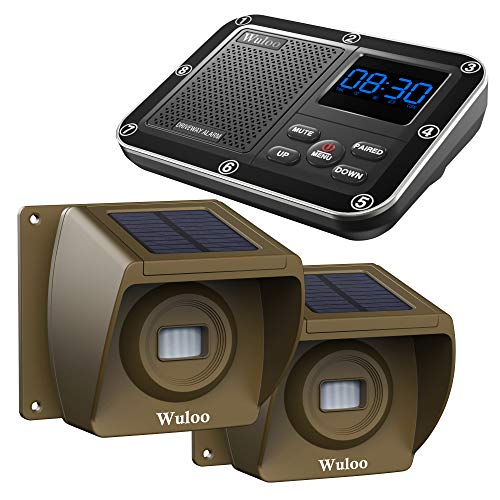
The Wuloo kit is the mid-range solar option, and this configuration pairs one indoor receiver with two brown solar sensors, so a driveway entrance and a side path report to the same base from day one. Wuloo rates the wireless link at up to 1,800 feet. Each sensor carries its own solar panel and rechargeable battery, removing routine battery swaps where the mounting point gets reasonable daylight.
The receiver offers a mute mode for quiet hours, a feature chime-only rivals often skip, and the system expands with additional sensors if a third approach needs coverage. Heavily shaded mounting spots are this kit’s one real weakness; the panels need a few hours of direct sun.
Specs
- Kit contents: 1 receiver and 2 solar motion sensors (Brown)
- Detection: passive infrared motion; distance not stated in listing data
- Wireless range: up to 1,800 feet (maker rating)
- Sensor power: solar panel with rechargeable battery
- Alerts: chime with mute mode; additional sensors supported
- Weatherproofing: outdoor-rated sensor housing
- App or Wi-Fi: none
- Tier: mid-range
Mighty Mule FM231 Wireless Driveway Alarm

The FM231 is the budget vehicle-only option. Its electromagnetic wand buries beside the driveway and responds to large metal objects, so it announces cars and trucks while ignoring people and animals entirely. Mighty Mule rates the wireless link to the indoor receiver at up to 400 feet, the shortest rating here, which fits compact lots and short lanes where the house sits near the road.
Setup is simple: bury the wand, fit two AA batteries, and let the sensor learn its surroundings at the installation site before you walk away. The system accepts additional receivers so a second room can listen in, and low battery indicators cover both sensor and receiver. It is a single-purpose arrival chime at the lowest commitment in the group.
Specs
- Detection: electromagnetic wand, vehicles only
- Wireless range: up to 400 feet (maker rating)
- Installation: wand buried beside the driveway, stake included
- Power: 2 AA batteries (not included); low battery indicators
- Expansion: additional indoor receivers supported
- Alerts: audible chime at the indoor receiver
- App or Wi-Fi: none
- Tier: budget
Who Should Skip a Driveway Alarm
Skip this category if what you actually want is evidence. A driveway alarm tells you something arrived; it records nothing and shows no video. If identification matters, put the money toward a camera covering the drive instead.
Renters may also find the category hard to justify. Probe and wand systems ask you to bury hardware beside the drive, which many landlords will not allow, and a short approach within sight of the front windows gains little from a chime. Skip the long-range probe systems if your drive is short: a one-mile link over 80 feet buys installation work you did not need.
FAQ
Do driveway alarms work through trees and hills?
They work, but over shorter distances than the box suggests. Every range figure here is a maker rating for open conditions, and trees, terrain, and building materials all absorb signal. Buy headroom: choose a kit rated well beyond your actual driveway length, and mount the receiver on the side of the house facing the sensor.
Will a driveway alarm alert my phone?
None of the five kits here sends phone alerts. They are self-contained radio systems that chime at an indoor receiver, with no Wi-Fi, no app, and no subscription. That is a deliberate trade: they keep working during internet outages. If phone alerts are essential, look at a Wi-Fi camera or a hub-based sensor system instead.
Which detection type gives the fewest false alerts?
Vehicle-only detection, by a wide margin. Probe and wand systems such as the Dakota DCPA-4000 and Mighty Mule FM231 respond to large metal objects, so deer, dogs, and pedestrians pass silently. Passive infrared sensors catch people as well as cars, which some households want at a gate, but they also announce wildlife. Choose based on whether an alert should mean a vehicle or any movement at all.
How much installation work is involved?
Motion kits are the lightest lift: mount the sensor on a post or tree, fit batteries, and power the receiver. Probe and wand systems take the most effort because the sensor buries beside the driveway and, on the Dakota, a cable runs to the transmitter. None of the five requires wiring back to the house.
Conclusion
A driveway alarm is one of the oldest ideas in home alerts, and these five kits show how far the concept stretches. The Chamberlain CWA2000 covers the typical suburban case with the least fuss, the Wuloo solar kit watches two approaches without battery chores, and the Mighty Mule FM231 keeps a short drive under vehicle-only watch on a budget. For long rural drives, and for readers who want an alarm that can trigger other hardware, the Dakota Alert DCPA-4000 and Optex RCTD-20U justify their premium tier. Measure your drive, pick the detection type that matches what you want to hear about, and buy more range than the tape measure says you need.
Product and ASIN Reference
| Product | ASIN |
|---|---|
| Dakota Alert DCPA-4000 Wireless Driveway Alarm System | B07PDZPF31 |
| Chamberlain CWA2000 Wireless Motion Alert System | B002ISVJL6 |
| Optex RCTD-20U Wireless Driveway Announcer | B003XKQ6W0 |
| Wuloo Solar Driveway Alarm, 1 Receiver and 2 Sensors (Brown) | B07VLXGWVX |
| Mighty Mule FM231 Wireless Driveway Alarm | B003765W0W |
More from Amazon
Programs that pair well with the guide above. Offers and eligibility are set by Amazon and may change.
Free shipping on eligible items, Prime Video and more. Eligible new members can start with a free trial.
Start a Prime free trialAd-free music streaming. Eligible new subscribers can start with a free trial.
Try Music Unlimited freeA Prime membership for ages 18-24 with a trial period. Eligibility is set by Amazon.
See Prime for Young AdultsAudiobooks and podcasts to listen to on the go. Eligible new members can start with a free trial.
Try Audible freeAs an Amazon Associate we earn from qualifying purchases.