Key takeaways
- Worked example: a 4,500mAh phone battery and a 10,000mAh bank: 10,000 x 0.65 = 6,500mAh usable, or about 1.4 full charges.
- Laptop example: a 55Wh laptop battery and a 20,000mAh bank (74Wh): 74 x 0.85 = about 63Wh usable, or roughly one full charge.
The best portable charger for most people in 2026 is a 10,000mAh power bank with a built-in USB-C cable and 30W output, such as the Anker Nano Power Bank. If you also charge a laptop, step up to a 20,000-25,000mAh bank with at least 100W output, such as the Baseus Blade HD or the UGREEN Nexode 25,000mAh. The right size depends on how many full charges you need and whether your bank must pass airline limits.
Our top picks


As an Amazon Associate we earn from qualifying purchases at no extra cost to you.
Quick Comparison of the Top Portable Chargers
| Pick | Best for | Capacity | Max output | Price range |
|---|---|---|---|---|
| Anker Nano Power Bank (30W) | Everyday carry, built-in cable | 10,000mAh | 30W | Budget to mid |
| Cuktech 10 | Fast recharge, phone plus small tablet | 10,000mAh | about 96W | Mid |
| Anker MagGo Qi2 power bank | iPhone wireless top-ups | about 6,600mAh | Qi2 wireless plus USB-C | Mid |
| Baseus Blade HD | Thin laptop charging | 20,000mAh | 100W | Mid |
| UGREEN Nexode 25,000mAh | Laptop plus phone at once | 25,000mAh | up to 200W total | Mid to upper |
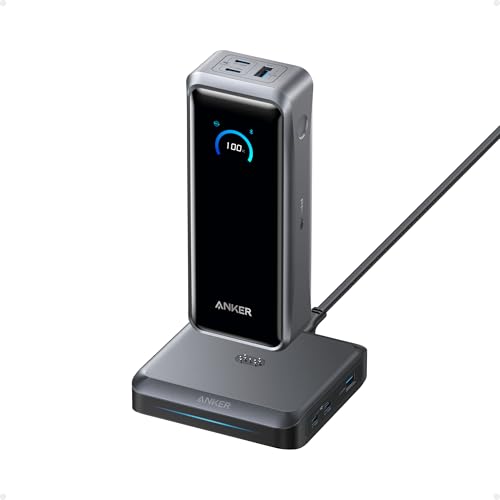
| Anker Prime 27,650mAh | Power users, multiple devices | 27,650mAh | up to 250W total | Premium |
Figures come from the manufacturers’ spec sheets and can differ slightly between revisions of the same product, so confirm the exact model on the label before you buy.
Best Overall: Anker Nano Power Bank (30W, 10,000mAh)
This is the one to buy if you want a charger you will actually carry every day. The USB-C cable is built into the body, so there is one less thing to forget, and 30W is enough to fast-charge most phones and run a small tablet. The trade-off is the modest output: it will not meaningfully charge a laptop under load.
Best for Fast Recharging: Cuktech 10
Cuktech’s 10,000mAh model pushes far higher output than most banks of this size, with a figure near 96W in listings, and it refills faster than a typical 30W-class competitor. It suits people who forget to charge their bank overnight. The trade-off is brand familiarity: Cuktech has a shorter track record in Western markets, so check the warranty terms for your region.
Best for iPhone: Anker MagGo Qi2 Power Bank
A Qi2 magnetic bank snaps onto the back of recent iPhones and charges without a cable, which is handy on a train or at a desk. Capacity is smaller, roughly 6,600mAh, so expect about one and a half phone charges. Wireless charging is also less efficient than a cable, so use the USB-C port when speed matters.
Best Thin Laptop Option: Baseus Blade HD (20,000mAh, 100W)
The Blade HD is a flat slab that slides into a laptop sleeve rather than a bulky brick. At 100W it can charge a typical 14-inch ultrabook at close to full speed, and 20,000mAh is roughly 74Wh, enough for about one full laptop charge on a 50-60Wh battery after losses. The trade-off is that a flat shape means a larger footprint in a jacket pocket.
Best for Laptop Plus Phone: UGREEN Nexode 25,000mAh
With a higher total output and several ports, this class of bank powers a laptop and a phone at the same time. It is a strong value for students and remote workers who work away from outlets. The trade-off is weight and bulk, which you will notice in a small bag.
Best for Power Users: Anker Prime 27,650mAh
Anker’s Prime bank targets people who charge a laptop, phone and earbuds together and want the highest sustained output. It sits close to the 100Wh airline line, so read the printed watt-hour rating before flying. The trade-off is price and size; it is overkill for phone-only users.
How Much Capacity Do You Actually Need?
Capacity printed on a bank is measured at the cell voltage (about 3.7V), not at the 5V your phone receives, so real output is lower. As a rule of thumb, expect to use about 60-70% of the printed number.
- Worked example: a 4,500mAh phone battery and a 10,000mAh bank: 10,000 x 0.65 = 6,500mAh usable, or about 1.4 full charges.
- Laptop example: a 55Wh laptop battery and a 20,000mAh bank (74Wh): 74 x 0.85 = about 63Wh usable, or roughly one full charge.
| Your situation | Capacity to buy | Minimum output |
|---|---|---|
| One phone, daily commute | 5,000-10,000mAh | 20-30W |
| Phone and earbuds, weekend trip | 10,000-20,000mAh | 30-45W |
| Phone plus tablet | 20,000mAh | 45-65W |
| Laptop and phone | 20,000-27,000mAh | 100W or more |
Flying With a Power Bank
Power banks must go in carry-on baggage, never checked bags, under FAA and most airline rules. Banks up to 100Wh are generally allowed; between 100Wh and 160Wh usually needs airline approval. To convert: mAh x 3.7 / 1000 = Wh, so 20,000mAh is 74Wh and 27,650mAh is about 102Wh by that formula, which is why makers print their own rated figure on the label. Airline policies on in-flight use have been tightening, so check your carrier.
Features That Matter More Than the Headline Number
- Power Delivery (PD) support: needed for fast charging iPhones and laptops. Look for PD 3.0 and PPS for Samsung phones.
- Pass-through charging: lets you charge the bank and your phone at the same time, useful at a hotel outlet with one plug.
- Cell quality and safety certifications: look for UL, CE or similar marks and overheat protection.
- Cable situation: built-in cables are convenient but a single point of failure; removable cables are easier to replace.
Frequently Asked Questions
Is a 10,000mAh power bank enough?
For one phone, yes. It delivers about 1.3-1.5 full charges of a typical modern phone after conversion losses. If you carry a tablet or earbuds too, step up to 20,000mAh.
Can a power bank charge a laptop?
Yes, if it supports USB-C Power Delivery at a wattage close to your laptop’s charger. Most ultrabooks need 45-65W; performance laptops can need 100W or more. A 30W bank will charge slowly or only maintain battery level.
Do power banks wear out?
Yes. Lithium cells typically keep most of their capacity for several hundred charge cycles and then fade gradually. Heat and leaving a bank fully drained for months speed up wear.
Can I bring a power bank on a plane?
Yes, in your carry-on. Banks under 100Wh are generally allowed without approval, and 100-160Wh usually need airline permission. Never pack one in checked luggage.
Is wireless or wired charging better on a power bank?
Wired is faster and more efficient. Wireless Qi2 is convenient for light top-ups but wastes more energy as heat, so expect fewer total charges per bank.