Key takeaways
- Operating system: Android tablets with Google Play offer the widest app selection. Amazon Fire tablets run Fire OS, which uses Amazon’s app store and services. Confirm which store your apps require before you buy.
- Physical versus expanded RAM: Listings such as “8GB (3+5GB expand)” combine physical memory with a portion of storage used as virtual memory. The performance gain is real but smaller than the headline figure suggests.
- Storage expansion: A “1TB expandable” claim only holds if the tablet recognises a card of that size. Check the maximum supported capacity in the product description and choose a reputable microSD card.
- Display resolution and brightness: A 1024 x 600 or 1280 x 800 IPS panel is adequate for video and reading at small sizes. Lower brightness makes outdoor reading difficult, so look for brightness information where it is published.
- Battery and bundled extras: A battery rated around 6000mAh generally supports a full day of light use. Bundled cases, styluses, and screen protectors reduce the cost of protecting a low-priced device.
Budget tablets have become a practical option for reading, video streaming, light browsing, and children’s use. The 2026 market is crowded with 7-inch and 10-inch models that look almost identical on a product page, yet they differ in software ecosystem, real memory, storage expansion, and screen quality. This guide narrows the field to a set of affordable tablets and explains which trade-offs matter most at a low price point.
Cheap tablets usually compromise on processor speed, panel brightness, and how long the manufacturer keeps issuing updates. Knowing which compromises you can accept will do more for your satisfaction than any single headline number on a spec sheet.
Our top picks




As an Amazon Associate we earn from qualifying purchases at no extra cost to you.
How to Choose
- Operating system: Android tablets with Google Play offer the widest app selection. Amazon Fire tablets run Fire OS, which uses Amazon’s app store and services. Confirm which store your apps require before you buy.
- Physical versus expanded RAM: Listings such as “8GB (3+5GB expand)” combine physical memory with a portion of storage used as virtual memory. The performance gain is real but smaller than the headline figure suggests.
- Storage expansion: A “1TB expandable” claim only holds if the tablet recognises a card of that size. Check the maximum supported capacity in the product description and choose a reputable microSD card.
- Display resolution and brightness: A 1024 x 600 or 1280 x 800 IPS panel is adequate for video and reading at small sizes. Lower brightness makes outdoor reading difficult, so look for brightness information where it is published.
- Battery and bundled extras: A battery rated around 6000mAh generally supports a full day of light use. Bundled cases, styluses, and screen protectors reduce the cost of protecting a low-priced device.
The Best Picks Reviewed
Amazon Fire HD 10 Tablet (10.1-inch, 32 GB)
The Fire HD 10 is the most conventional choice in this group. It pairs a 10.1-inch Full HD screen with an octa-core processor and 4 GB of RAM, a sensible balance for streaming and e-book reading. The trade-off is software. Fire OS is built around Amazon’s ecosystem, so Google Play apps are not available by default. For people who mainly use Prime Video, Kindle, and Alexa, that exchange is reasonable. Anyone who depends on Google accounts or Android-only apps should look elsewhere.
ECOPAD 10.1-Inch Tablet with Android 15
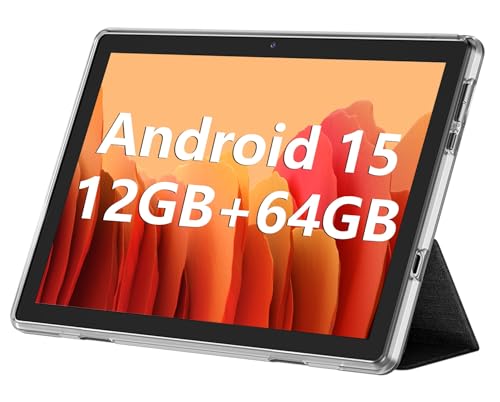
The ECOPAD lists the largest memory configuration in this set, with 4 GB physical RAM plus 8 GB expanded, 64 GB storage, and support for microSD cards up to 1TB. Its 1280 x 800 IPS display gives text more clarity than the 7-inch models. Because part of the RAM figure is expanded memory, multitasking will not match a true 12 GB device. The listing references GMS, which points to Google Mobile Services, so confirm that before purchase. The 6000mAh battery and dual-band Wi-Fi suit everyday streaming.
Android 15 10-Inch Tablet with Stylus and Case
This 10-inch model sits between the budget 7-inch units and the Fire tablet. It offers 8 GB RAM including expansion, 32 GB base storage extendable by microSD, a 6000mAh battery, and a 2MP plus 8MP camera pair. The included stylus is useful for quick notes, although the responsiveness of inexpensive styluses varies. Wi-Fi 6 and Bluetooth 5.0 cover typical needs. Its main limitation is the 32 GB base storage, which fills quickly once apps and offline media are added, so the expansion slot becomes important.
HOTTABLET 7-Inch Android 14 Tablet with Case
The HOTTABLET is one of the most portable options here. Its 7-inch IPS screen, 8 GB RAM including expansion, 32 GB ROM, dual cameras, and Bluetooth 5.0 make it a compact reading and video device. At this size it is comfortable in one hand and fits easily in a small bag. Its processor and screen limit it to lighter tasks, so treat it as a media and reading tablet rather than a work machine. The included protective case is a practical addition for a device in this price range.
IWEGGO 7-Inch Android 14 Tablet with Case
The IWEGGO shares the 7-inch format and the 8 GB RAM and 32 GB storage profile of the HOTTABLET, and its listing names a 1.6 GHz quad-core processor and a 3000mAh battery. That battery is modest for a tablet, so expect shorter runtime during extended video playback. It suits a child’s device or a secondary tablet used for games and short video sessions. Check the storage slot compatibility before relying on the 1TB expansion claim.
Frequently Asked Questions
Are cheap Android tablets good enough for streaming?
Yes, for standard and HD video from major apps, provided the screen and storage meet your needs. Streaming quality depends more on Wi-Fi strength and the app’s quality settings than on the processor. Download content over Wi-Fi when possible and keep several gigabytes of free storage so apps run smoothly.
Does expanded RAM make a budget tablet faster?
It helps somewhat. The system can keep more background app data in memory, which reduces how often apps reload. Expanded memory does not replace physical RAM, so a device with 8 GB of expanded memory will still feel slower under heavy multitasking than one with 8 GB of physical memory.
Is a Fire tablet a good choice if I need Google apps?
Usually not. Fire tablets use Fire OS and Amazon’s app store by default. Installing Google Play through workarounds is possible but unsupported, and it can complicate updates and app compatibility. An Android tablet with Google Play support is the simpler option for people who rely on Google services.
How much storage do I need on a budget tablet?
For streaming and reading, 32 GB is workable if you rely on cloud apps and keep offline downloads limited. Large games and offline video libraries fill that space quickly. A microSD card with consistent write speeds, sized within the tablet’s officially supported maximum, is a more economical way to add room than buying a higher-tier model.
Final Thoughts
The Fire HD 10 suits buyers who want to stay within Amazon’s ecosystem. The ECOPAD and the Android 15 10-inch model are better fits for people who want Google services and a larger screen. The 7-inch HOTTABLET and IWEGGO work well for reading, bedtime video, and children’s use. Before buying, check the software ecosystem, the real storage expansion limit, and the battery expectations that match how you plan to use the tablet.