Key takeaways
- Compare the best mesh WiFi systems for large homes, with coverage, Wi-Fi 6E bands, Ethernet ports, and device capacity explained for every pick.
- Top Pick: Amazon eero Pro 6E (1-Pack)
- Runner-up: TP-Link Deco XE75 (3-Pack)
- Also consider: Google Nest Wifi Pro (3-Pack)
A mesh WiFi system replaces a single router with several cooperating nodes, so the far bedroom and the backyard office stop being dead zones. Modern systems add Wi-Fi 6 or 6E radios, dedicated backhaul links between nodes, and app-based setup that takes minutes instead of an afternoon. The differences that matter are coverage per kit, whether the system uses the 6 GHz band, how many wired ports each node carries, and what the advanced features cost after the first year.
This guide compares five systems spanning those trade-offs: a Wi-Fi 6E eero sold as a single expandable node, two TP-Link Deco kits at different speeds, Google’s Nest Wifi Pro three-pack, and a tri-band NETGEAR Orbi kit built for large homes.
As an Amazon Associate, we earn from qualifying purchases.
Quick Answer
The TP-Link Deco XE75 three-pack is the best Wi-Fi 6E value, covering up to 7,200 square feet. The Amazon eero Pro 6E is easiest to live with and doubles as a smart home hub. Google Nest Wifi Pro suits Google households, the Deco X55 keeps costs down, and the NETGEAR Orbi RBK753 is the large-home option with a dedicated backhaul band.
How to Choose
Start with coverage, and be honest about your home. Manufacturer square-footage figures assume open layouts; thick walls, brick, and metal ducting shrink real coverage, so multi-story or sprawling homes should size up a pack rather than down. Node count matters more than headline speed for most households.
Next, the Wi-Fi generation. Wi-Fi 6E systems add the 6 GHz band, which gives newer phones and laptops a cleaner, faster lane and can serve as a fast wireless backhaul between nodes. Wi-Fi 6 systems cost less and are plenty for gigabit-or-slower internet plans in most homes. Tri-band designs dedicate one band to node-to-node traffic, which protects your speeds when several people stream at once.
Check the wired details too: nodes with multiple Ethernet ports can wire a TV, console, or office, and a 2.5 gigabit port matters if your internet plan runs faster than gigabit. Finally, look at the subscription picture. Parental controls, security filtering, and detailed reports are free with some brands and paid add-ons with others, which changes the real cost over three years of ownership.
Amazon eero Pro 6E (1-Pack)

This listing is the single-node eero Pro 6E, the starting point for Amazon’s Wi-Fi 6E mesh line. One unit covers up to 2,000 square feet and supports more than 100 connected devices, and you expand coverage later by adding any compatible eero node. The tri-band AX5400 radio system supports network speeds up to 2.3 Gbps, and the 6 GHz band keeps newer devices off the crowded lower bands.
The Pro 6E also earns its place in a smart home: an 802.15.4 radio gives it Zigbee and Thread hub duties, so it can anchor compatible sensors and bulbs alongside Alexa. Wired connections are strong for the class, with one auto-sensing 2.5 gigabit Ethernet port and one gigabit port. Setup and management run through the eero app, with advanced security and content features offered under the optional eero Plus plan. Buy the single node for apartments and smaller homes, knowing the system can grow.
Specs
| Specification | Detail |
|---|---|
| Wi-Fi standard | Wi-Fi 6E, tri-band AX5400 |
| Coverage | Up to 2,000 sq. ft. per node |
| Device support | 100+ connected devices |
| Ethernet | 1 x 2.5 GbE, 1 x 1 GbE per node |
| Smart home | Zigbee and Thread hub built in |
| Processor | 1 GHz dual-core, 1 GB RAM |
TP-Link Deco XE75 (3-Pack)

The Deco XE75 is the Wi-Fi 6E value benchmark: an AXE5400 tri-band system whose three units cover up to 7,200 square feet, with the 6 GHz band available for devices and for the AI-driven mesh backhaul that steers traffic between nodes. TP-Link rates the system for busy households with many simultaneous streams, and each unit carries gigabit Ethernet ports for wired devices or an optional wired backhaul.
Setup runs through the Deco app, which also handles parental controls, device prioritization, and the HomeShield security features, with a paid tier for the advanced options. This listing is the standard XE75 three-pack; a Pro variant with a 2.5 gigabit port is sold separately. For a larger home on a gigabit plan that wants 6E without paying flagship prices, this is the kit to beat.
Specs
| Specification | Detail |
|---|---|
| Wi-Fi standard | Wi-Fi 6E, tri-band AXE5400 |
| Coverage | Up to 7,200 sq. ft. |
| Model | Deco XE75(3-pack) |
| Backhaul | 6 GHz band, AI-driven mesh |
| Ethernet | Gigabit ports on each unit |
| App | TP-Link Deco with HomeShield |
Google Nest Wifi Pro (3-Pack)
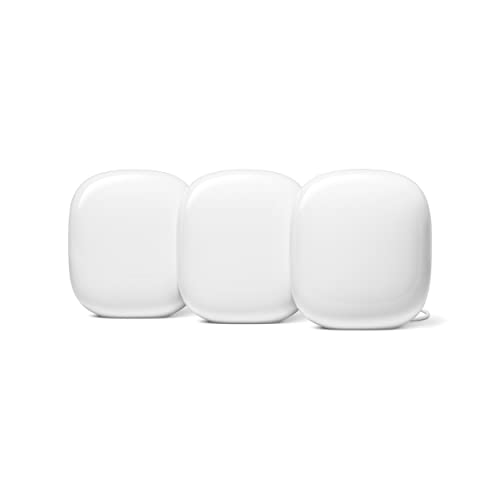
Nest Wifi Pro is Google’s Wi-Fi 6E system, and this three-pack in Snow covers large homes with up to 2,200 square feet per router. The design-first hardware hides antennas in a glossy pebble that can sit on a shelf without looking like network gear, and setup and management run through the Google Home app alongside Nest cameras and speakers.
The system is tri-band with the 6 GHz lane for capable devices, and each unit doubles as a Thread border router, which positions it well for Matter-based smart homes. Google keeps the software simple: automatic updates, a guest network, and basic parental controls are built in, with fewer manual knobs than TP-Link or NETGEAR offer. Households already invested in Google Home will find it the most natural fit, provided the streamlined settings cover what they need.
Specs
| Specification | Detail |
|---|---|
| Wi-Fi standard | Wi-Fi 6E, tri-band |
| Coverage | Up to 2,200 sq. ft. per router |
| Model | G6ZUC |
| Configuration | 3 routers |
| Smart home | Thread border router, Matter ready |
| App | Google Home |
TP-Link Deco X55 (2-Pack)

The Deco X55 is the budget workhorse of this list: a dual-band Wi-Fi 6 system in the AX3000 class whose two units cover up to 4,500 square feet. It skips the 6 GHz band, which keeps the price down, and for homes on internet plans at or below gigabit speeds that trade is usually invisible in daily use.
Each unit carries three gigabit Ethernet ports, more wired flexibility than most rivals at this level, and the system supports Ethernet backhaul if your home is wired for it. The Deco app provides setup, parental controls, and quality-of-service basics, and the X55 mixes with other Deco models if you expand later. This two-pack suits apartments and mid-size homes that want mesh coverage and plenty of ports without paying for 6E radios they cannot yet use.
Specs
| Specification | Detail |
|---|---|
| Wi-Fi standard | Wi-Fi 6, dual-band AX3000 |
| Coverage | Up to 4,500 sq. ft. |
| Model | Deco X55(2-pack) |
| Ethernet | 3 gigabit ports per unit |
| Backhaul | Wireless or Ethernet |
| App | TP-Link Deco |
NETGEAR Orbi RBK753

The Orbi RBK753 is a tri-band Wi-Fi 6 system built around a dedicated backhaul: its AX4200 radio layout reserves a 5 GHz band for traffic between the router and its two satellites, so client speeds hold up better under load. NETGEAR rates the three-piece kit for coverage up to 7,500 square feet and 40 or more devices, aimed at large and multi-story homes.
Orbi hardware is bigger than the pebble-style rivals and the app experience is more traditional, but wired ports are generous and the system supports the NETGEAR Armor security service as an add-on. This listing is the original RBK753 kit, distinct from the later RBK753P revision. If your home is large, your walls are stubborn, and a dedicated backhaul band sounds worth paying for, the Orbi remains a proven answer.
Specs
| Specification | Detail |
|---|---|
| Wi-Fi standard | Wi-Fi 6, tri-band AX4200 |
| Coverage | Up to 7,500 sq. ft. |
| Configuration | Router plus 2 satellites |
| Backhaul | Dedicated 5 GHz band |
| Model | RBK753-100NAS |
| Security | NETGEAR Armor available |
Who Should Skip It
Skip mesh entirely if you live in a small apartment where a single good router already covers everything; extra nodes add cost and complexity with no benefit. Gamers chasing the lowest possible latency on a single wired PC may prefer a high-end standalone router placed near the desk. Renters who cannot place nodes freely or run any cables should confirm the layout works before buying a big kit. And if your internet plan is slow, mesh will not make it faster; it only spreads the speed you already pay for more evenly around the home.
FAQ
How many mesh nodes do I actually need?
As a rough guide, one node per 1,500 to 2,000 square feet works in typical wood-frame homes, with an extra node for long or multi-story layouts. Place nodes within sight of the next room rather than in the dead zone itself, since a node can only repeat the signal it can hear.
Will a mesh system work with my existing modem?
Yes. One node plugs into your modem or gateway by Ethernet and becomes the router. If your internet provider supplied a combined modem-router, putting that device in bridge mode avoids double NAT issues, though most mesh systems also work fine in a simple plug-in setup.
Is Wi-Fi 6E worth it over Wi-Fi 6?
Only if you own or plan to buy 6 GHz capable phones, laptops, or tablets, or if your neighborhood airwaves are crowded. The 6 GHz band is faster and cleaner but shorter-ranged. For homes with older devices and gigabit-or-slower plans, Wi-Fi 6 systems like the Deco X55 and Orbi RBK753 remain strong value.
Can I mix nodes from different brands?
Generally no. Mesh nodes form a system within their own brand and product family, and some brands even restrict mixing between generations. Eero and Deco allow mixing within their own lines, which is worth checking before you expand an older kit.
Final Verdict
The Deco XE75 three-pack is the default recommendation for most larger homes, balancing Wi-Fi 6E, coverage, and price. The eero Pro 6E wins on simplicity and smart home duties, Nest Wifi Pro fits Google-centered homes, the Deco X55 keeps smaller homes covered for less, and the Orbi RBK753 serves big houses that benefit from a dedicated backhaul band. Match the kit to your floor plan first, and the speeds will follow.
More from Amazon
Programs that pair well with the guide above. Offers and eligibility are set by Amazon and may change.
Free shipping on eligible items, Prime Video and more. Eligible new members can start with a free trial.
Start a Prime free trialAd-free music streaming. Eligible new subscribers can start with a free trial.
Try Music Unlimited freeA Prime membership for ages 18-24 with a trial period. Eligibility is set by Amazon.
See Prime for Young AdultsAudiobooks and podcasts to listen to on the go. Eligible new members can start with a free trial.
Try Audible freeAs an Amazon Associate we earn from qualifying purchases.