Key takeaways
- Compare the best 4K projectors for movies and gaming, from triple laser Dolby Vision models to bright lamp designs, with the specs that actually matter.
The best 4K projectors solve three different problems, and the right pick depends on which one you have. For accurate color in a darkened theater room, the Epson Home Cinema 3800 and the Hisense C1 lead this list. For a smart projector that sets itself up on a coffee table, the XGIMI HORIZON S Pro is the easiest to live with. If you game or watch in a room that never gets fully dark, the Optoma UHD38x and ViewSonic PX701-4K bring brightness and low input lag.
One honesty note before the picks. Almost every projector in this price class reaches 4K by pixel shifting: a chip with fewer native pixels fires multiple offset images so fast that your eye sees a full 3840 x 2160 pixel count on screen. Shifted 4K looks genuinely sharp at normal seating distances, but it is not the same as a native 4K panel, and each section below states which method that model uses.
As an Amazon Associate, we earn from qualifying purchases.
Table of Contents
- How to Choose a 4K Projector
-
- Epson Home Cinema 3800
-
- Hisense C1
-
- XGIMI HORIZON S Pro
-
- Optoma UHD38x
-
- ViewSonic PX701-4K
- Frequently Asked Questions
- Conclusion
- Product and ASIN Reference
How to Choose a 4K Projector
Understand what 4K means on the box. Epson calls its approach 4K PRO-UHD: three 1080p LCD chips with pixel shifting and dedicated resolution processing. DLP models from Optoma, Hisense, XGIMI and ViewSonic use a smaller DMD chip with rapid XPR shifting to place 8.3 million pixels on screen. Both accept full 4K signals and look far sharper than 1080p, but neither is a native 3840 x 2160 imaging chip, and phrases like True 4K describe the on-screen pixel count, not the chip.
Match brightness to your room. Lumens decide whether a projector survives ambient light. Around 1,600 to 1,800 lumens is a dark-room specification: fine for movie nights with the lights off, washed out at midday. At 3,000 lumens and above, a projector holds a watchable picture with lamps on or curtains open. Check which standard the number uses: ANSI and ISO lumens are measured standards, while unlabelled LED lumen figures are not comparable.
Decide between lamp, LED and laser. Lamp models are the brightest for the money, but the lamp dims over a few thousand hours and eventually needs replacing. Laser and LED designs hold brightness far longer and never need a lamp swap, which is why every smart lifestyle model here uses one.
Check the throw distance before anything else. A standard throw projector needs roughly 13 feet to fill a 120 inch screen, which suits dedicated rooms and ceiling mounts. Lifestyle cubes sit closer and correct the picture electronically. Decide where the projector will live before comparing image quality, because the best projector on paper is worthless if it cannot fill your screen from the spot you have.
Look at HDR format support, not just the HDR label. HDR10 is universal in this group. Dolby Vision is rarer and appears only on the Hisense C1 and XGIMI HORIZON S Pro here, adjusting tone mapping scene by scene on supported streaming content. If most of your viewing is streaming movies, Dolby Vision is a real advantage; for discs and gaming, HDR10 with good brightness matters more.
Gamers should read the input lag line. Lag figures are quoted at specific resolutions: the gaming picks below reach 4.2 milliseconds at 1080p with high refresh rates, and around 16 to 17 milliseconds at 4K 60Hz.
1. Epson Home Cinema 3800: Best for a Dedicated Theater Room
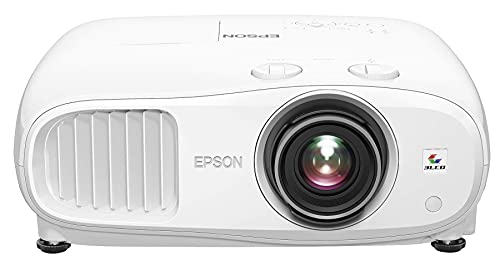
Tier: premium. The Home Cinema 3800 is the traditional home theater pick in this group: a 3LCD projector built for a fixed installation, with lens flexibility and color accuracy the portable cubes trade away.
Its 4K PRO-UHD system pixel shifts three 1080p LCD chips, so the on-screen image carries a full 4K pixel count without being a native 4K panel, and Epson is upfront about that design. The 3LCD layout shows 100 percent of the RGB color signal for every frame, which means no rainbow effect for viewers who are sensitive to it on single-chip DLP models. Brightness is rated at 3,000 lumens for both color and white, and the precision glass lens offers vertical and horizontal lens shift, so you can align the image optically instead of leaning on picture-softening keystone correction.
HDR handling is a strength: full 10-bit HDR10 and HLG processing with 12-bit digital video processing for smooth tonal transitions, plus 18 Gbps HDMI 2.0 inputs that carry 4K HDR at a full 60 frames per second. Dual 10 watt speakers and aptX Bluetooth cover casual audio.
Specs
- Display technology: 3LCD, 3-chip
- Resolution: 4K PRO-UHD pixel shifting, 3840 x 2160 on screen
- Brightness: 3,000 lumens color and 3,000 lumens white
- Contrast ratio: up to 100,000:1
- HDR: HDR10 and HLG, full 10-bit processing
- Inputs: HDMI 2.0 at 18 Gbps, 4K at 60 Hz
- Lens: precision glass with vertical and horizontal lens shift
- Audio: dual 10 watt speakers, aptX Bluetooth output
- Weight: 15.2 pounds
2. Hisense C1: Best Color With Triple Laser and Dolby Vision

Tier: premium. The C1 is a compact laser cube that behaves like a theater projector. Its TriChroma engine uses separate red, green and blue lasers instead of a color wheel, producing the widest color in this roundup: 110 percent of the BT.2020 gamut and 151 percent of DCI-P3 according to the product details, with a Delta-E of 0.9.
It is also one of only two picks here with Dolby Vision, alongside HDR10 and HLG, and the laser light source is rated for more than 25,000 hours, so brightness stays consistent for years. Rated brightness is 1,600 ANSI lumens, which makes this a lights-off projector: in a dark room the color saturation is superb, but it will not fight a bright living room like the lamp models below. The 4K image comes from a DLP chip with pixel shifting.
Setup is fully automatic. The AutoMagic system handles focus, keystone, screen alignment and obstacle avoidance, and the Vidda operating system carries licensed Netflix along with the other major streaming apps. Sound is a highlight: a 2 x 10 watt JBL system with Dolby Atmos support.
Specs
- Display technology: DLP with pixel-shifted 4K UHD
- Light source: triple RGB laser, over 25,000 hours
- Brightness: 1,600 ANSI lumens
- Color gamut: 110 percent of BT.2020, Delta-E 0.9
- HDR: Dolby Vision, HDR10 and HLG
- Audio: 2 x 10 watt JBL speakers, Dolby Atmos
- Smart platform: Vidda OS with licensed Netflix
- Setup: auto focus, auto keystone, obstacle avoidance, screen alignment
- Image size: up to 300 inches
3. XGIMI HORIZON S Pro: Best Smart Projector for Easy Setup

Tier: mid-range. The HORIZON S Pro is the lifestyle pick: a 4K projector on a built-in flexible stand that you point at a wall, let the automation square the picture, and start watching.
The Dual Light 2.0 system pairs laser and LED light sources and is rated at 1,800 ISO lumens, enough for dim and dark rooms. The listing states a 3840 x 2160 display resolution from its DLP design, with Dolby Vision, HDR10 and HLG support and 110 percent of the BT.2020 color gamut, a rare combination at this tier. Sound comes from dual 12 watt Harman Kardon speakers.
XGIMI’s ISA 5.0 setup suite runs uninterrupted auto keystone, auto focus, obstacle avoidance and screen alignment, so moving rooms takes seconds. The flexible built-in stand tilts the unit toward a wall or ceiling without a tripod. Image sizes run from 40 to 200 inches.
Specs
- Display technology: DLP, 3840 x 2160 display resolution
- Light source: Dual Light 2.0 laser and LED hybrid
- Brightness: 1,800 ISO lumens
- HDR: Dolby Vision, HDR10 and HLG
- Color gamut: 110 percent of BT.2020
- Audio: 2 x 12 watt Harman Kardon speakers
- Setup: ISA 5.0 auto keystone, auto focus, obstacle avoidance, screen alignment
- Stand: built-in flexible stand
- Image size: 40 to 200 inches
- Light source life: 20,000 hours
4. Optoma UHD38x: Best for Gaming and Bright Rooms

Tier: mid-range. The UHD38x is built around two numbers the lifestyle cubes cannot touch: 4,000 lumens of lamp brightness and input lag as low as 4.2 milliseconds. If your projector has to work in a lit living room with a console plugged in, this is the pick.
Optoma’s DLP design places 8.3 million addressable pixels on screen for a 3840 x 2160 image, with HDR10 and HLG support, Dynamic Black contrast enhancement and a rated contrast ratio of 1,000,000:1. The eight-segment color wheel favors brightness, so HDR color volume sits a step behind the laser models: the honest trade for this much light output. Lamp life runs up to 15,000 hours in Eco mode.
For gaming, Enhanced Gaming Mode delivers 4.2 milliseconds at 1080p 240Hz and about 16.7 milliseconds at 4K 60Hz, and it accepts 1080p at 120Hz from current consoles. A 120 inch image needs about 13.1 feet of throw, so plan on a ceiling mount or a rear shelf.
Specs
- Display technology: DLP, 3840 x 2160 with 8.3 million on-screen pixels
- Brightness: 4,000 lumens
- Contrast ratio: 1,000,000:1 with Dynamic Black
- HDR: HDR10 and HLG
- Input lag: 4.2 ms at 1080p 240Hz, about 16.7 ms at 4K 60Hz
- Light source: lamp, up to 15,000 hours in Eco mode
- Lens: 1.1x zoom, vertical keystone correction
- Inputs: 2 x HDMI 2.0, S/PDIF optical out, USB power
- Audio: 10 watt built-in speaker
- Image size: 33 to 300 inches
5. ViewSonic PX701-4K: Best Budget Route Into 4K
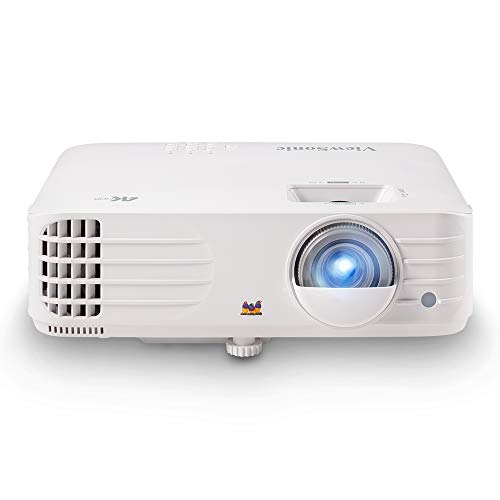
Tier: budget. The PX701-4K is the entry point in this group, without giving up the specifications that matter: a 4K UHD image, HDR support, 3,200 ANSI lumens and gaming figures that match the Optoma.
Its 0.47 inch DLP chip uses pixel shifting to produce the 3840 x 2160 image, like the other DLP models here. Brightness at 3,200 ANSI lumens is enough for lights-on viewing at moderate screen sizes, and the 240Hz refresh rate with 4.2 millisecond input lag at 1080p makes it a legitimate gaming projector. The 1.1x optical zoom is modest, so placement flexibility is limited.
Dual HDMI inputs handle a console and a streamer at once, and screens run up to 300 inches. What you give up against the premium picks is color refinement, HDR format support beyond the basics, and any built-in smart platform: plan on a streaming stick in one of those HDMI ports.
Specs
- Display technology: DLP, 0.47 inch chip with pixel-shifted 4K UHD
- Brightness: 3,200 ANSI lumens
- HDR: HDR support
- Refresh rate: up to 240Hz at 1080p
- Input lag: 4.2 ms at 1080p
- Lens: 1.1x optical zoom
- Keystone: auto vertical, horizontal and vertical correction
- Inputs: dual HDMI
- Image size: up to 300 inches
- Smart platform: none built in, use a streaming stick
Frequently Asked Questions
Is a pixel-shifted 4K projector really 4K?
On screen, yes: pixel shifting places the full 8.3 million pixels of a 3840 x 2160 image, and at normal seating distances it looks dramatically sharper than 1080p. The honest caveat is that the imaging chip itself has fewer native pixels, so shifted 4K is not identical to a native 4K panel. Every model in this roundup uses shifting.
How many lumens do I need for a living room?
For a darkened room, 1,600 to 1,800 ANSI or ISO lumens is enough and lets laser models like the Hisense C1 and XGIMI HORIZON S Pro shine on color. For a living room with lamps on or daylight coming in, look at 3,000 lumens or more, where the Epson Home Cinema 3800, Optoma UHD38x and ViewSonic PX701-4K sit.
Which of these projectors is best for gaming?
The Optoma UHD38x and ViewSonic PX701-4K are the gaming picks: both quote 4.2 millisecond input lag at 1080p with refresh rates up to 240Hz, and the Optoma adds about 16.7 milliseconds at 4K 60Hz. The Epson Home Cinema 3800 supports 4K gaming at 60 frames per second over its 18 Gbps HDMI inputs.
Do I still need a screen, or is a wall enough?
A smooth white wall works, but a fixed frame screen gives a flatter surface, better contrast and defined borders, and makes automatic screen alignment on the smart models more reliable. At the premium tier, a screen is the upgrade that most improves the picture.
Conclusion
Choose by room first and technology second. For a dedicated dark theater, the Epson Home Cinema 3800 brings the most complete traditional package, while the Hisense C1 counters with triple laser color and Dolby Vision in a smaller box. The XGIMI HORIZON S Pro is the pick if the projector will move between rooms and set itself up. For bright rooms and gaming, the Optoma UHD38x is the strongest all-rounder, and the ViewSonic PX701-4K delivers the same core experience on a budget.
Product and ASIN Reference
| Product | ASIN |
|---|---|
| Epson Home Cinema 3800 | B07XF2G9WT |
| Hisense C1 | B0C8WWS1DW |
| XGIMI HORIZON S Pro | B0DDQ57GTV |
| Optoma UHD38x | B0BGVGDB72 |
| ViewSonic PX701-4K | B08L9SM2DK |
More from Amazon
Programs that pair well with the guide above. Offers and eligibility are set by Amazon and may change.
Free shipping on eligible items, Prime Video and more. Eligible new members can start with a free trial.
Start a Prime free trialAd-free music streaming. Eligible new subscribers can start with a free trial.
Try Music Unlimited freeA Prime membership for ages 18-24 with a trial period. Eligibility is set by Amazon.
See Prime for Young AdultsAudiobooks and podcasts to listen to on the go. Eligible new members can start with a free trial.
Try Audible freeAs an Amazon Associate we earn from qualifying purchases.