Key takeaways
- Compare the best smart contact sensors for doors and windows, from Matter over Thread to Z-Wave and long-range LoRa, with hub and battery guidance.
- Top Pick: Ring Alarm Contact Sensor (2nd Gen)
- Runner-up: Specs
- Also consider: Aqara Door and Window Sensor
A smart contact sensor is the simplest security and automation device you can add to a home. Two small pieces, a sensor and a magnet, sit on a door or window frame and report the moment the two halves separate. That single open or closed signal can send a phone alert, announce a door through a smart speaker, turn on a hallway light, or pause the heating while a window is open.
The catch is that contact sensors speak several different radio languages, and the right pick depends entirely on the hub and ecosystem you already run. A Z-Wave sensor built for a Ring Alarm will not pair with an Aqara hub, and a long-range LoRa sensor ignores Zigbee networks completely. The five sensors below cover the main platforms, from Alexa and Apple Home to SmartThings, Hubitat and Home Assistant, so you can match the sensor to your system.
As an Amazon Associate, we earn from qualifying purchases.
Quick Answer
For most buyers, the best smart contact sensor matches the hub already in the house. Ring Alarm owners should add the Ring Alarm Contact Sensor (2nd Gen). Apple Home households get the tiny Aqara Door and Window Sensor, while anyone with a detached garage or gate should choose the long-range YoLink LoRa sensor. Zigbee and Z-Wave hub owners are covered by THIRDREALITY and Ecolink.
How to Choose
Start with the protocol, because it decides everything else. Zigbee and Z-Wave sensors need a compatible hub or speaker with the right radio built in, and they reward you with fast local automations and long battery life. Matter over Thread sensors pair directly with a Thread border router from Apple, Google, Amazon or SmartThings. LoRa sensors such as YoLink trade ecosystem openness for extreme range. Wi-Fi contact sensors exist, but they drain batteries quickly, which is why none of the top picks here use Wi-Fi.
Second, check hub lock-in. Some sensors, notably Aqara’s Zigbee models, only pair with that brand’s own hub. Others, like the THIRDREALITY and Ecolink picks, pair with almost any hub that speaks their protocol, including SmartThings, Hubitat and Home Assistant.
Third, look at the physical fit. Every sensor has a maximum gap between the sensor and its magnet, usually between half an inch and one inch, so measure before ordering a multi-pack.
Finally, consider battery type and the extras. Coin cells keep sensors tiny, while CR123A and AAA cells usually last longer and are easier to find in a drawer. Useful extras include tamper alerts, left-open reminders and external wired inputs for specialty doors.
Ring Alarm Contact Sensor (2nd Gen)
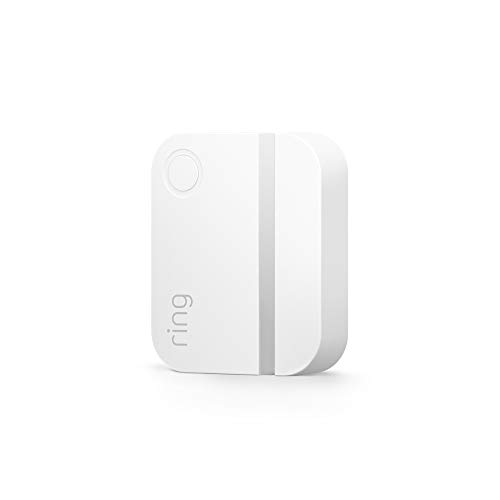
The Ring Alarm Contact Sensor (2nd Gen) is the obvious pick for any home already running a Ring Alarm system. It talks Z-Wave directly to the Ring Alarm Base Station, which is required, and once added it can arm and disarm with the rest of the system, trigger the base station siren, and feed Alexa routines.
Ring shrank this second-generation design considerably, so it sits neatly on most door and window frames at 1.56 by 2.09 by 0.55 inches. The rated magnet gap is a full inch, forgiving of older, slightly warped frames. Power comes from a single CR2032 coin cell with an expected life of roughly three years, and the sensor reports low battery in the app.
Ring also offers optional professional monitoring on its alarm plans. If your home is Ring-based, there is little reason to look elsewhere.
Specs
| Detail | Value |
|---|---|
| Protocol | Z-Wave |
| Hub required | Ring Alarm Base Station |
| Battery | CR2032 coin cell |
| Battery life | Up to about 3 years |
| Max sensor gap | 1 inch |
| Works with | Ring Alarm and Alexa |

Aqara Door and Window Sensor

The Aqara Door and Window Sensor is one of the smallest contact sensors sold, with a main unit just 1.61 by 0.87 by 0.43 inches, so it nearly vanishes on white window frames. It is a Zigbee device, and there is an important catch in the listing: it requires an Aqara Hub and will not pair with third-party Zigbee hubs, even though the radio itself is standard Zigbee.
Through an Aqara hub it integrates with Apple Home, Alexa and IFTTT, and it can trigger the hub’s built-in alarm as well as scenes and automations in the Aqara app. The allowed gap between sensor and magnet is up to 0.86 inches, wider than most rivals, which helps on doors with deep trim or slight misalignment.
Battery life from the CR1632 coin cell is typically around two years. For households already invested in Aqara sensors and hubs, this is the natural contact sensor to add, and its small size makes it a favorite for drawers, cabinets and pet doors as well as entry doors.
Specs
| Detail | Value |
|---|---|
| Protocol | Zigbee |
| Hub required | Aqara Hub only |
| Battery | CR1632 coin cell |
| Max sensor gap | 0.86 inch (22 mm) |
| Works with | Apple Home, Alexa and IFTTT via Aqara Hub |
| Main unit size | 1.61 x 0.87 x 0.43 inches |
YoLink LoRa Smart Door & Window Sensor (3-Pack)
YoLink plays a different game from everyone else on this list. Its sensors use LoRa radio with a claimed open-air range of up to a quarter of a mile, so a sensor on a detached garage, a garden gate or a barn stays connected where Zigbee and Z-Wave would give up. This listing is a three-pack of the YS7704 door and window sensor, and a YoLink Hub is required to bring them online.
Battery life is the other headline: YoLink rates the sensor for up to five years per set of batteries, helped by the low-power LoRa radio. The YoLink app adds genuinely useful touches such as left-open reminders that nag you when a door has been ajar too long, plus app, email and text alerts.
Integrations cover Alexa, IFTTT and Home Assistant, so the sensors can still join a wider smart home. If your problem is distance rather than decoration, this is the contact sensor to buy.
Specs
| Detail | Value |
|---|---|
| Protocol | LoRa (YoLink) |
| Hub required | YoLink Hub |
| Range | Up to 1/4 mile open air |
| Battery life | Up to 5 years |
| Pack size | 3 sensors |
| Works with | Alexa, IFTTT and Home Assistant |
THIRDREALITY Zigbee Contact Sensor (2-Pack)

THIRDREALITY has built a reputation on affordable Zigbee gear that plays nicely with open platforms, and its contact sensor follows that pattern. This two-pack pairs with SmartThings, Aeotec, Hubitat, Homey and Home Assistant hubs, and with Echo devices that have a Zigbee hub built in, so Alexa households can use it without buying another box.
Unlike the Aqara sensor above, there is no brand lock-in: any competent Zigbee coordinator can adopt it, and in Home Assistant it works through both ZHA and Zigbee2MQTT. THIRDREALITY also sells its Smart Bridge MZ1, which bridges its Zigbee devices to Matter platforms such as Apple Home and Google Home if you ever want to change ecosystems.
The sensor itself is a straightforward two-piece design with adhesive mounting and a replaceable battery included. For anyone outfitting several doors and windows on a SmartThings or Home Assistant setup, the per-door cost of the multi-packs is hard to beat.
Specs
| Detail | Value |
|---|---|
| Protocol | Zigbee 3.0 |
| Hub required | Zigbee hub |
| Compatible hubs | SmartThings, Hubitat, Home Assistant, Echo with Zigbee |
| Pack size | 2 sensors |
| Battery | Included, replaceable |
| Works with | Alexa via hub, Matter via MZ1 bridge |
Ecolink Z-Wave Plus Door/Window Sensor (DWZWAVE2.5-ECO)
The Ecolink DWZWAVE2.5-ECO is a long-running favorite of the Z-Wave crowd, and its party trick is flexibility. Alongside the usual sensor and magnet, it has screw terminals for an external wired contact, so one unit can monitor a door plus a wired reed switch, a pressure mat or a second opening. It also reports tamper events if the cover is removed.
Ecolink includes both white and brown snap-on covers in the box, a small touch that matters on dark wood doors where a white sensor would glare. Power comes from a CR123A lithium battery rated for up to three years at typical use, and Z-Wave Plus gives it a range of up to about 100 feet to the hub, extendable through the Z-Wave mesh.
It pairs with SmartThings, Hubitat, Home Assistant running Z-Wave JS, and other Z-Wave controllers including Ring Alarm base stations. Installers and tinkerers who want one sensor to cover awkward jobs will appreciate it most.
Specs
| Detail | Value |
|---|---|
| Protocol | Z-Wave Plus |
| Hub required | Z-Wave hub or controller |
| Battery | CR123A lithium |
| Battery life | Up to 3 years |
| Extras | External contact input, tamper alert, white and brown covers |
| Works with | SmartThings, Hubitat, Home Assistant, Ring Alarm |
Who Should Skip It
Skip add-on contact sensors entirely if you do not own, and do not plan to buy, a compatible hub or smart speaker with the right radio. Every pick here needs some kind of hub, and a sensor sitting in a drawer helps nobody. Also skip them if what you actually want is a complete monitored alarm with keypads and sirens; in that case buy an alarm kit first and add matching sensors afterward.
Renters who cannot use adhesive on painted frames, and owners of steel security doors where magnets behave unpredictably, should also think twice or test with a single unit before committing to a multi-pack. And if your doors spend most of the day open, open and closed alerts will quickly become noise rather than information.
FAQ
Do smart contact sensors need a hub?
Almost always, yes. Zigbee, Z-Wave, Thread and LoRa sensors all need a hub, a border router or a smart speaker with the matching radio built in. The hub is what connects the sensor to your phone and to voice assistants, and it lets many automations run locally without the internet.
Can a contact sensor work with more than one platform?
Sometimes. A Zigbee sensor on SmartThings or Home Assistant can usually be exposed to Alexa, Google Home and Apple Home at the same time through that hub. Brand-locked sensors are the exception: the Aqara sensor in this guide only pairs with Aqara hubs, so check the listing before assuming a standard protocol means universal pairing.
How long do contact sensor batteries last?
Expect roughly two to three years from coin-cell models such as the Ring and Aqara sensors, up to three years from the CR123A-powered Ecolink, and up to five years from the YoLink LoRa sensor. Busy doors, cold garages and weak radio signals all shorten real-world life, and every app here warns you before a battery dies.
What else can contact sensors automate?
Beyond security alerts, common uses include turning on a light when a door opens, announcing through a speaker that the back door is open, pausing the thermostat while windows are open, reminding you that a door was left open, and logging when a liquor cabinet, medicine drawer or gun safe is accessed.
Final Verdict
Match the sensor to the hub and you cannot go far wrong. Ring Alarm homes should buy the Ring sensor, Aqara households the Aqara sensor, and anyone fighting distance should choose YoLink. For open Zigbee and Z-Wave platforms, THIRDREALITY keeps costs down while Ecolink adds installer-friendly extras. Buy one first, confirm the fit, then expand.
More from Amazon
Programs that pair well with the guide above. Offers and eligibility are set by Amazon and may change.
Free shipping on eligible items, Prime Video and more. Eligible new members can start with a free trial.
Start a Prime free trialAd-free music streaming. Eligible new subscribers can start with a free trial.
Try Music Unlimited freeA Prime membership for ages 18-24 with a trial period. Eligibility is set by Amazon.
See Prime for Young AdultsAudiobooks and podcasts to listen to on the go. Eligible new members can start with a free trial.
Try Audible freeAs an Amazon Associate we earn from qualifying purchases.